I listen to Chopin when I drive. My most recent find - all the etudes recorded by Louis Lortie (You Tube recording of Lortie ). The three dramatic ones at the end of Op. 25 are, as a set, a particular favorite. His timing is impeccable and the drama in the music well balanced with the classical perfection of form.
Another favorite CD that I recently returned to is of the two Piano Concerti with Krystian Zimerman at the keyboard, conducting his specially assembled orchestra - Polish Festival Orchestra. The clarinetist from that orchestra, Jan Jakub Bokun, has told me about the experience of rehearsing and playing with the Maestro. It was very strenuous, but immensely rewarding. One phrase, one detail, would take a long time to polish - sometimes aggravatingly long time. It had to be done to perfection... and it was. Just listen to the miraculous details - bringing out inner voices, phrasing, expression... Zimerman's Chopin is a true romantic, quickly moving from one emotional extreme to another, from enchantment to torment. An astounding vision of grand proportions. These are not little pieces of "stile brillante" provenance, ornamental, made to please. These are powerful expressions of the soaring human spirit.
OK, let's leave it at that. The spirit... What about the spirit? First, let me reflect on the spirit of Polish pride. To welcome the year 2010, just as I was finishing the "Chopin with Cherries" anthology that gave rise to this blog, I went to friends' house for a New Year's Eve Party. I never spent that time with this particular family and wanted to do something different, something I had not done before. It was interesting - filled with children and games, not serious adult dinner conversation and dancing.
But one dance captured my attention and remained in my memory: Chopin's Polonaise in A Major, Op. 40, nicknamed "The Military" (the link points to a YouTube recording by Maurizio Pollini). Yes, the same Polonaise that gave its first notes to a signal of the British broadcasts to occupied Poland during World War II. And here we are, dancing? Just after midnight all the guests at the party lined up in a long line of couples, the host sat at the grand piano and off we went. Around the living room, out onto the patio, up and down the steps, out one door, in another, all over the house... The moon was unusually bright that night, surrounded by an enormous halo, a portent of things to come. I felt a rush of pride, elation even, when we moved along with dignity, in triple meter: one long step with bended knees and two short ones. Down, up, up, down, up, up, around the house, around the world... It was so incredibly moving - a small group of Poles and their international rag-tag bunch of friends dancing to music written almost two hundred years ago and heard in so many homes, on so many concert stages. Welcome the new year, the year of Chopin! That was two years ago - and the tradition of dancing that particular Polonaise at midnight continues.
On the way back home, I drove through an unfamiliar neighborhood and saw boys playing with a bonfire on the front lawn of their small house. It was a working class neighborhood with tiny houses squished in neat rows on streets leading up to the hill of the Occidental College. The moon, the fire, the dance - I was inspired to write a haibun about it. It was recently published in an Altadena anthology, Poetry and Cookies, edited by Pauli Dutton, the Head Librarian of the Altadena Public Library:
Midnight Fire
In the golden holiness of a night that will never be seen again and will never return… (From a Gypsy tale)
After greeting the New Year with a Chopin polonaise danced around the hall, I drove down the street of your childhood. It was drenched with the glare of the full moon in a magnificent sparkling halo. The old house was not empty and dark. On the front lawn, boys were jumping around a huge bonfire. They screamed with joy, as the flames shot up to the sky. The gold reached out to the icy blue light, when they called me to join their wild party. Sparks scattered among the stars. You were there, hidden in shadows. I sensed your sudden delight.
my rose diamond brooch
sparkles on the black velvet -
stars at midnight
© 2010 by Maja Trochimczyk
I wrote more verse about the Polonaise itself, but all the descriptions fell short of the delight I felt that night, so it was reduced to just an introduction to a story that has no end. The contrast of warm flames and icy moonlight was unforgettable. I added the romance, of course - poetry is not supposed to be real, though, when rooted in an actual experience it touches a nerve in listeners. After one reading I was asked by an eager member of the audience: "So what about the man who gave you that brooch? Where is he now?" "There was no man. This is my brooch, I got it for my daughter and it returned to me," I said. There was nobody lurking in the shadows. . . The poem sounds better this way, though.
Fast forward two years, and I'm playing recordings of Chopin in jail. This is the path that I took, and this is where it is going. . . forward. My students are inmates who have completed the Sheriff's Education-Based Incarceration program, and are approaching dates of their release after completing their sentences. I do not ask what they are in for, it does not matter. What matters is that once released they never come back. Jailing them is a huge cost to society and committing crimes does not help them or anyone else. It is just not the right thing to do. But many offenders keep returning to jails, keep doing the same thing that they were always doing. My approach to changing their thinking, their image of self and the world, involves classical music. Chopin, in particular. Due to his serious illness, dying of TB, composing between fits of coughing and spitting blood, he can be an example of heroic courage. William Pillin expressed this idea very well, in his poem "Chopin" (included in the Chopin with Cherries anthology):
Chopin
(excerpt from a poem by William Pillin)
White and wasting he dotted
with splashes of blood his lunar pages,
carrying death like a singing bird
in his chest, his tissue held together
by dreams and bacilli. “I used to find him,”
wrote George Sand, “late at night at his piano,
pale, with haggard eyes, his hair almost standing,
and it was some minutes before he knew me.”
In Majorca, the doctors
shuddered at his blood-flecked mouth,
burned his belongings, compelled him
to take refuge in a former monastery.
“My stone cell is shaped like a coffin.
You can roar — but always in silence.”
When it stormed he wrote the ‘raindrop’ prelude
and from the thunder he fashioned an étude.
*
“I work a lot,” he wrote to his sister,
“I cross out all the time, I cough without measure.”
With death’s hand on his slender shoulder
he created ballades, études, nocturnes.
Chopin had what it takes to succeed against all odds. He used his time well - he created something lasting that speaks to us two hundred years later. They can do it too. It is heroic courage that is needed to succeed when you leave jail with a felony record, no friends to turn to (because those you had would bring you straight back to jail and those you hurt would not speak to you again), no home, no job...
America is very punitive. Not only does it have the highest rate of incarceration in the world: one in thirty one adults is under correctional supervision, well over 700 people per 100,000 adult residents. The second highest rate is in the second most punitive country, Russia. There, about 500 inmates are locked up per 100,000 of adults. Other countries have a fraction of that. The "war" of imprisonment was clearly won by the U.S. There are serious societal costs associated with that dubious victory. The stigma of having been once in prison or jail remains and permanently marrs the record of an individual who has virtually no chance for redemption. Job applications feature a box: have you ever been incarcerated, or committed felony, or misdemeanor? Once you check the box, the application lands in the garbage bin. I tell my students behind bars that they have to be really tough to ignore the rejections and insults that will come their way. Their sentences are finished but the stigma is there and will bring them back if they do not fight it by having the courage to be good.
Chopin helps here. How? We listen to a Nocturne and then to the same Nocturne played by The Pianist's Adrien Brody in an old-fashioned suit. The camera pans out to show the engineer's booth. This is a live broadcast of the Polish Radio in Warsaw. This is September 1939. Soon the bombs begin to fall, the pianist initially refuses to stop playing but has no choice. He falls off the bench, the building is destroyed by German bombs, and his odyssey begins. The astounding, true story of survival against all odds - the story of Wladyslaw Szpilman, as told by Roman Polanski (another Holocaust survivor) leaves the incarcerated men I'm speaking to visibly shaken. The stellar beauty of the soaring Nocturne melody is cut down by the noise of explosions. War is evil, always evil. What did the musicians do to deserve their fate? What did the residents of Warsaw do to deserve being killed by German bombs? Nothing. War is a calamity that has to be survived. Living with the stigma of incarceration requires survival skills too. It requires a lot of courage - shown by the pianist in the film and the character's real-life model. It requires a persistent clinging to life, the good life.
I pan forward to another favorite scene in the film: the famous Ballade that Szpilman played for the German officer. This has to be one of the most famous music scenes in the whole history of film-making. When the can of pickles falls down from the pale, think hands of the starving musician and rolls to the feet of the uniformed German officer... when the gaze of the emaciated, long-haired pianist dressed in rags meets the eyes of the proud soldier... Then, the pianist begins to play and the Ballade takes them both on a journey. Away from destruction, away from hunger and suffering - somewhere else.
Here, courage and humanity triumph. The officer has to break his laws and his orders if he wants to save the life of the starving pianist. He does so, moved by Chopin's music that brought him back to the time when there was no war, only life and happiness. He must have heard such beautiful music at home, before the tragedy began. The extraordinary courage of the pianist, the compassion of the "enemy" and the drama of the music speak directly to the heart. Would the lesson stick? I do not know, I can only try to share it.
Is it worth my time? I hear comments: "lock them up and throw away the key." Not everyone behind bars committed, serious violent crimes and those who did would have been sent to the prisons, not jails. Once they did something wrong, paid the price for it and returned to the society "rehabilitated" - their sentences are supposed to be over and a new life is supposed to begin. But more often than not, it does not. They cannot find jobs, cannot earn a living, cannot function. Some are willingly returning to drug dealing or stealing. Others feel cornered, feel they have no option. If they do it the second time, the sentence will be longer, the return to the "narrow path" harder. I do not write it to excuse them. But it is important for them to know that they can stay on the "narrow path" of honest life, if they make some sacrifices, just like Chopin had to make sacrifices in order to continue to compose. What other option do we have?
Looking for Chopin and the beauty of his music everywhere - in concert halls, poetry, films, and more. In 2010 we celebrated his 200th birthday with an anthology of 123 poems. Here, we'll follow the music's echoes in the hearts and minds of poets and artists, musicians and listeners... Who knows what we'll find?
Showing posts with label Polanski. Show all posts
Thursday, April 26, 2012
Tuesday, June 29, 2010
Chopin and The Karate Kid (Vol. 1, No. 4)

“You have to play the pauses” – says the distraught American teacher to his scatterbrained Chinese student, after she rushed through a beautiful melody without paying attention to proper phrasing and expression. She played all the notes mechanically, like a music box. Her technique was spotless, immaculate, but there was no soul in the sounds she made. The adolescent performer, Mei Ying, a young girl played by Wen Wen, appears in the newest re-incarnation of The Karate Kid (2010), directed by Harald Zwart, with Jaden Smith and Jackie Chan as the stars.
It is hard not to smile when hearing the melody Mei Ying plays, in the context of this film: the Nocturne in C-sharp Minor, Op. Posthumous, by Fryderyk Chopin, scored for violin and piano. Chopin composed this piece in 1830 and dedicated it to his sister, Ludwika, but did not publish it. The Nocturne first appeared in print 26 years after his death. However, it was not written for the violin.
Apart from an early Piano Trio in G Minor, Op. 8, and using violins in his orchestral works, Chopin did not write for the violin. Even in the Trio, he thought after hearing it a year later, using a viola instead of the violin would have been much better, as it would have better blended with the cello. This he confided to his friend, Tytus Wojciechowski in a letter of August 31, 1830 (letter no. 63 in the new edition of Fryderyk Chopin’s Correspondence, edited by Zofia Helman, Zbigniew Skowron, and Hanna Wroblewska-Strauss, University of Warsaw, 2010).
What we hear in The Karate Kid is a transcription of a piano piece for violin and piano made by an experienced film composer and arranger, Craig Leone, who also penned film scores for Ghost River and Orbit: Journey to the Moon. The first time the soaring melody appears, marked “Lento, con gran espressione,” the girl is accompanied by her teacher playing the piano. Mei Ying is late to her practice and she still does not understand what she plays, her teacher complains. No “grand expression” here. The teacher certainly is not pleased – so much is at stake at her recital. She is set to win admission to a prestigious music school in Beijing, but she has to work hard, much harder, to have a chance.
The second time we hear Chopin and Mei Ying’s violin is at her "recital" (actually, a competition). Mei Ying runs in late, after spending a carefree day with Dre Parker (Jayden Smith) at a traditional festival instead of practicing. Everyone is anxiously waiting, then Mei Ying takes up her bow and the magic begins. The graceful, expressive melody captivates the audience. A string orchestra of Chinese youth plays the accompaniment of the “left-hand” chords and arpeggios expanded to symphonic proportions. (The violin part is actually performed by Alyssa Park, a skilled actress-musician who appeared in many films as violinist or violin teacher, or recorded soundtracks, including The Soloist, American Teen, and Inside Man.)
While running around the festival with her crush, Dre, Mei was having fun, but did not waste her time. She was learning from “the Karate Kid” himself what he was just taught by his master, Mr. Han (Jackie Chan) about living in the present and letting go of anxiety and tension. The passed-on lesson worked: Mei Ying did “play the pauses” and the intense beauty of her tone and expression made all the difference when the timing was right. She won her scholarship, but Dre lost, being banned from any further contact with her by her ambitious, affluent parents. (The reversal of this ban is implied in the final sequences of the film, after the momentous tournament victory of the young kung-fu student.)
“Playing the pauses” means, in lay terms, “tempo rubato” – the flexible give-and-take of minuscule fluctuations in rhythm that make music “breathe” with life, instead of sounding stiff and rigid. The emotional impact of rhythmic fluidity in a continuous, arching melody was summarized by one anonymous YouTube user who said, “this song makes the soul weep.” A Nocturne is not a “song,” but Chopin was the king of “tempo rubato” and “stile cantabile” (the singing style). There’s more to learn about it in a book by Richard Hudson, Stolen Time: The History of Tempo Rubato (Clarendon Press, 1997).
Why score Chopin for the violin, though? Why transform a piano work into a violin concerto? Is there no other piece for violin and piano in the repertoire of thousands that could be used here? Why this particular Nocturne? I have not talked to the director, so I do not know for sure. But this is THE Chopin year. And this is THE Chopin piece for filmmakers, since it appeared in the opening of The Pianist by Roman Polanski (more about this later). Well, you may guess “why” use a transcription, when you hear the first competitor for the scholarship during the concert: a pianist playing Rimsky-Korsakov’s The Flight of the Bumblebee, originally composed for violin and piano, but transcribed for piano solo by Serge Rachmaninoff. Absurd as it sounds, this buzzing portrayal of an insect should be noisily flying under the violinist’s bow, but instead it is mired in trills on the keyboard. Why not something else for the piano? A piece originally written for this instrument, perhaps?
“Transcription” is the key here, what we are witnessing is a “remake,” or a series of “remakes.” I believe these transcriptions are all tongue-in-cheek references to the core existential fact about the film. Called The Karate Kid like the original Karate Kid on which it is based (1984), the film is set in China, not in Reseda, California, and the martial arts it depicts are Chinese “kung fu” not Japanese karate. Incidentally, the Asian releases have titles reflecting the actual content of the film, leaving behind the historical reference to the first version of this coming-of-age story: The Kung-Fu Kid in China and Best Kid in Japan and Korea.
From Japan to China, from karate to kung-fu, from a piano nocturne to a slow movement of a concerto for violin and orchestra… Remakes, all remakes. A new version is bigger, “better” than the old one. While the orchestral transcriptions of Chopin’s Nocturne were done by Craig Leone, the film was actually scored by James Horner (who got two Oscars for his music to Titanic, and scored over 100 films including Avatar, Braveheart, two Zorro movies, and Apollo 13). In a feature about the music for this film, the director, Harald Zwarts, said that he wanted to have an “emotional score” using “several significant Asian instruments” and that he selected Horner because his music could both depict this “big, epic, traditional China and have the tiny small emotional moments.”
Horner admitted that it would have been very easy to just have a lot of songs instead of an orchestral score. The songs are there, of course, including the official theme song, “Never Say Never” sung by the teen star-of-the-day, Justin Bieber with Jaden Smith, and a gaggle of other hits-in-the-making packaged together in the film’s soundtrack CDs by Sony Pictures – Red Hot Chili Peppers, Rain, Lady Gaga...
As far as I know, the violin transcription of Chopin's Nocturne is not included in those materials. The powerful presence of the well-known, romantic melody is felt in the moment it appears in the film. Its emotional impact stems, in part, from the meaning associated with this nocturne since its appearance in Roman Polanski’s Oskar-winning The Pianist (2002). Based on a true story of a Polish Radio pianist, Władysław Szpilman and starring Adrien Brody, The Pianist begins with a radio broadcast of the Nocturne in C-sharp Minor (played rather fast by Janusz Olejniczak) which is interrupted by German bombs falling on besieged Warsaw in September 1939. The pianist first refuses to stop playing and leaves the studio only after being thrown down onto the floor by the force of explosion. At the end, having miraculously survived unspeakable horrors, the Polish-Jewish musician returns to his instrument and plays the same melody that he rehearsed silently in his mind during the years in hiding while his family and friends were killed and his home destroyed. Beauty transcends it all…
_____________________
Since The Karate Kid does not use Chopin in marketing materials, here is the trailer to The Pianist with the Nocturne: www.youtube.com/watch?v=itR0-I9idXk.
Claudio Arrau’s 1960s version of this Nocturne is slow, imaginative and rich in rhythmic and expressive nuances.
Adam Harasiewicz recorded the Nocturne in C-Sharp Minor in 1968, and his version is slightly faster than Arrau’s. It is delicate and forward moving, effervescent and elegant.
Janusz Olejniczak who plays the Nocturne in The Pianist, has the least amount of tempo rubato and rhythmic irregularities. He also plays it much faster, with accelerated “flights of scales” at the end.
(c) 2010 by Maja Trochimczyk
____________________________
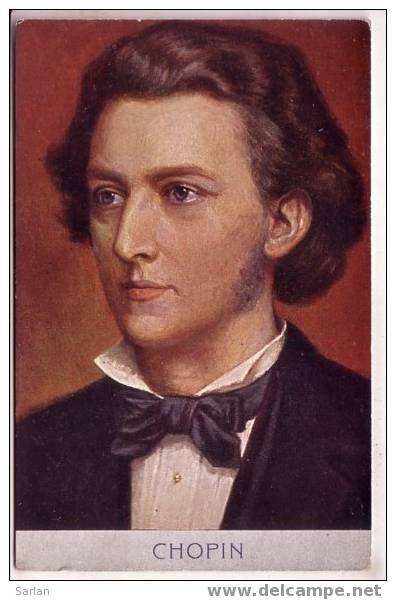
PHOTO CREDIT: Austrian postcard with a portrait of Chopin by Eichert. Vienna: BKWI (Bruder Kohn), c. 1900-1910. The series also includes a portrait of pianist Ignacy Jan Paderewski. Maja Trochimczyk Collection.
Subscribe to:
Comments (Atom)


