Showing posts with label Martin Willitts Jr.. Show all posts

Tuesday, July 7, 2015

Martin Willitts, Jr. Discusses Chopin's Music and Poetry (Vol. 6, No. 6)

A talented poet, musician, gardener, healer, and a Quaker, Martin Willitts, Jr., is also a retired librarian, a publisher and an artist, working on paper cutouts. He contributed to two of my anthologies, Chopin with Cherries (2010) and Meditations on Divine Names (2012). In June 2015, he and his wife, also a Quaker and a poet, Linda Griggs, welcomed me to their  home. They took me on a sight-seeing tour of Syracuse, New York, including a splendid rose garden in the rain, and organized a reading for me for the Palace Poetry Group at DeWitt Community Library.

Having spent all this time with these two fascinating individuals and poets, I decided to share Martin's poems about Chopin on this blog, and publish an interview I conducted with him by email, about poetry and Chopin's music.

Willitts Jr. and Griggs - by Maja Trochimczyk
Martin Willitts Jr. and Linda Griggs, Photo by Maja Trochimczyk


MARTIN WILLITTS Jr.'s POEMS ABOUT CHOPIN


THE ENEMY IS IN THE HOUSE


“The enemy is in the house (...) Oh God, do you exist? You do and yet you do not avenge. -  Have you not had enough of Moscow’s crimes - or - or are You Yourself a Muscovite (...) I here, useless! And I here empty-handed. At times I can only groan, suffer, and pour out my despair at my piano!”
                                                — Chopin, 1831, learning that Poland
                                                      had been defeated by Russian armies.


The piano cannot stop wars, nor lift the dead,
nor block the door. I am numb, empty handed,
wondering why you cannot stop this silence
deadly as bullets. There are no avenging angels crying.
The Russians are shooting notes of despair
and all I can do is huddle in the sheet music of snow.
Paris is the gathering place of defeated friends,
failed politicians, grieving mothers and wounded artists.
There are exiles everywhere speaking Polish sadness.
I cannot pound the keys on my piano loud enough.
I shall never return to my homeland.
I shall not give in to the Russian demands.
I shall not let one note from my fingers serve them.
The enemy is in the house.
It does not mean they can trample the rugs with mud.
We have a saying where I come from.
If a stranger stays uninvited, then call him a friend
and mistreat him like a friend, then he will go away
thinking your false friendship is real as butter on bread.
It is like playing with a piano one-handed. It can be done,
but not as well as with two hands.
It is like a gun without bullets.
It is like a person without a home.


Published in "Chopin with Cherries," 2010, p. 24

White rose snowfall - by Maja Trochimczyk

DISCORD

1.  Chopin to George Sand, 1847


The delicate touch you felt on your neck
is the same as on a piano, with the same lyrical rush,
the music of leaves in the resolute winds.
It is the same idiomatic language of geese leaving.
My heart has the same feeling, restless, yearning.
When I play a rondo, no one can hear the silence after.
I leave these early movements behind
like I must leave you.
Some things are finished when they are finished.

I thought of returning to you.
I hesitated at your window.
I knew if you saw me with that melodic look you have,
it would enrapture me.
Our bodies would become counterpoints.
But it would be fragmentary motifs. Textural nuances
of what used to be.

Our love was illicit, some say.
I say, it was melodic, rhythmic, and full of music.
Our love was repetitions of a single note.

You criticized me for my primitive sense of form
when we would lie in bed, soaked in harmonic intonations.
You were right about me as well as everything else.
I cannot help being in the soundscape of textures,
in the lightness of sound, in the last moment leaving you.
For life is opening one door and descending unknown stairs.

Sheltered in White - by Maja Trochimczyk


2. George Sand to “beloved little corpse”


You could not stand a woman who did not act like a woman
except in bed. Even then you were horrified
by the idea a woman could enjoy passion.
What were all those compositions of love-soaked music then?

You were not my first lover and you will not be my last.
A woman should pick and choose who will enter her bedroom.

You shake your head, expecting me to fall for your music like others.

A woman cannot be a slave to men.
You will not allow us to be equal.
So what choice do I have?
What choice does any woman have?

I changed my name so I could publish what scandalizes you.
Women have a right to sincere love and I will write about it.
I shall write about my desires and disappointments.
I will not miss you. I will only find another.

What have you done recently?


Note: “Beloved little corpse” was her name for Chopin due to his numerous sicknesses.

 Published in "Chopin with Cherries" p. 131-132.

Red and White in the Rain - by Maja Trochimczyk


OPUS 21

Blackened corpses of stars are going nova.
All day, it has been crackling with heat insects.
I say, it is God’s voice telling us something important.
The heat grinds us for not listening.
We cannot seem to leave well enough alone.
Our futile attempts to improve or streamline life
only makes it worse.

Sheet music’s passages of wildness — briars
and milkweed sends music into trumpets of wind —
this melody heals stunted saplings, brings Light
to darkened air, finding cures for emptiness —

Light! — come fill us! Heal the forgotten!


Published online in the Black Poppy Review, with the Opus series.
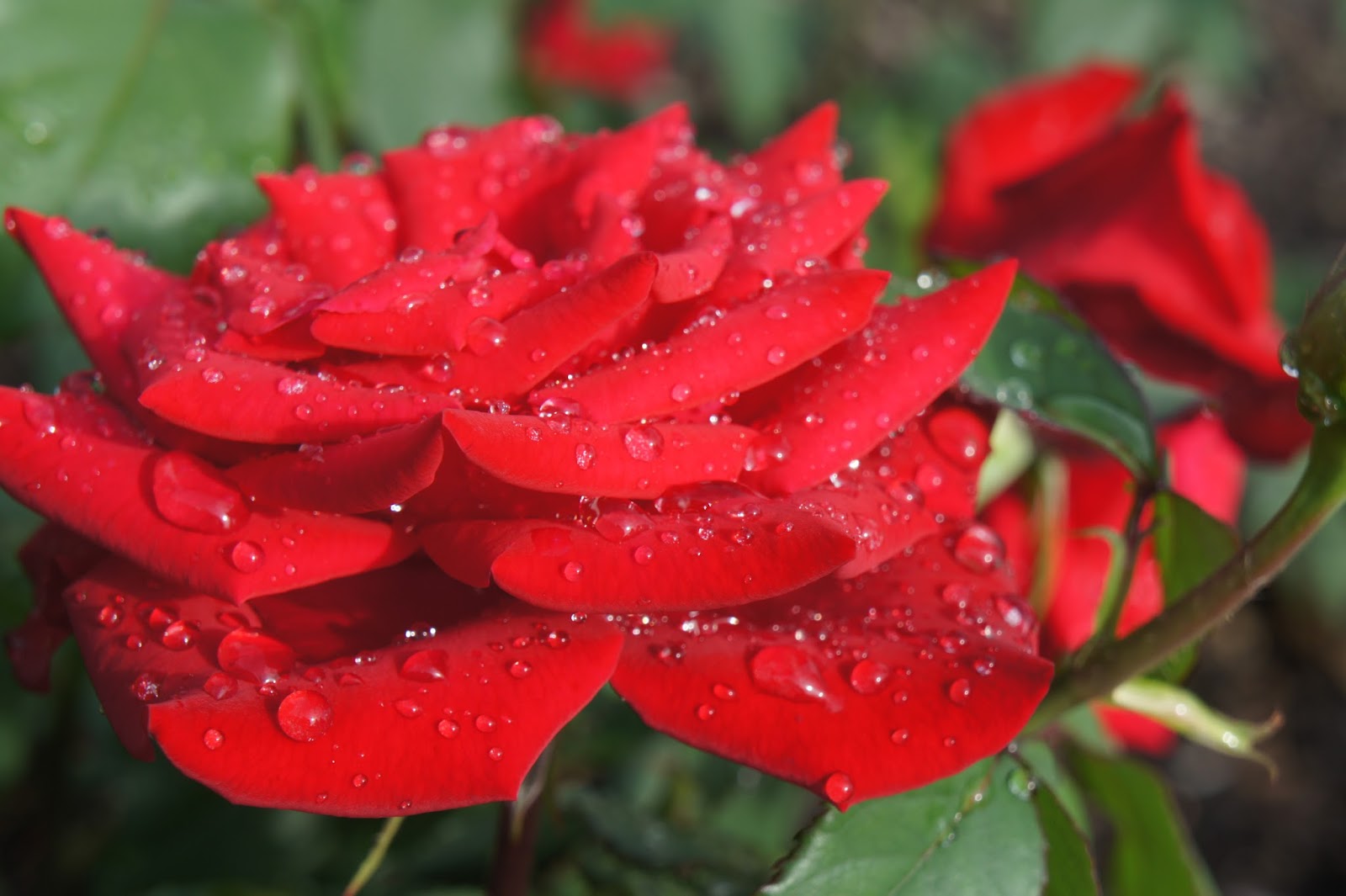
Rainy Red Passion - by Maja Trochimczyk


INTERVIEW WITH MARTIN WILLITTS, JR.

Maja Trochimczyk's Question: What does Chopin mean for you? What do you like about his music?

Martin Willitts, Jr.'s Answer: I was playing piano at an early age. I am not sure when I started, but by the time I entered Kindergarten (about 5) I was already playing classical music: Beethoven, Mozart, Handel, Brahms, Chopin, and others. I eventually played with a full orchestra in Syracuse, New York. I was also playing chamber music. At one point, I played the Brandenburg Concertos by Bach on the harpsichord.

What I liked about Chopin was all the different styles of music: etudes; polonaises; waltzes; nocturnes, sonatas, and preludes. I think his most challenging piece was Prelude in D-flat Major, Opus 28, No, 15, often called “raindrop” for its sound. I never felt I could exactly get that sound right. I felt it was better plucked by bow on a violin, stretching the open E string.

I have written a series of poems based on the concept of the Opus; and I have titled a number of poems as “Nocturne” as I think of the Chopin and Nocturne in E-Flat Major, Opus 9, No. 2, and others. Although I have not played piano since I was about 12, I still recall the sounds, techniques, fingering, and exactness of pitch. When I lost my hearing, I lost pitch, then I quit playing; but I still hear the music in my head.

Q: What types of music have you studied, or played?

I was bored with classical as a child. I needed something to challenge me. I do not remember why I felt this way, but the structure was boring my creativity. I discovered Jazz, and switched from piano to mandolin. My grandfather had this mandolin from when he was a Union organizer. It has a metal plate resonator making high pitch sounds. My grandfather gave it to me when I tried the “raindrop” from the Preludes. Some people call this mandolin a dobro-mandolin, and I would bottle-neck it like a steel guitar player or a Blues slide guitar player.

I played on live radio some swing Jazz, fast tempo, improvisational fingering. Because a mandolin has double strings, I would trill notes (playing notes really fast), and because of the high scales, I was able to go extremely high compared to a piano. By this time, all I was interested in was individual notes and I abandoned all chord structures and sight reading.

For a while I played in coffeehouses with folk singers, and the people I played with became famous later. I decided I did not like the egos involved in band structures. Vietnam interrupted my playing, and I lost perfect-pitch.

When we met, I talked about the mathematics in music, and suggested there were two kinds of composers: the ones who stressed the math and tried to treat music as a mathematical formula; and those who wrote and/or played from the heart. There is an awareness of the metronome and the music signature at the top of the sheet music that tells you the measure and pace. The famous Jazz piece “Take-Five” performed by the Dave Brubeck Quartet is E-Flat Minor, quintuple (5/4) time.

Martin Willitts Jr. with his antique mandoline. 


Q: What is it about music that appeals to you?

A: I listen to all types of music, including contemporary. When I listen, I am focused on the notes, their technique, what they do differently, how they play solos or work with the group. If the band only knows three chords or repeat too often, I lose interest. It also helps if I hear the music without seeing the musicians, so I am not judging them by their “name” or appearance. A good example was the contemporary singer Lady Gaga singing Sound Of Music. I was surprised at her vocal range.

Q: Why do you write poetry?

I became interested in poetry accidentally. If someone had asked me about poetry when I was a teenager, I would have thought they were crazy. Schools do a lousy job at promoting poetry. I originally thought of writing drama. I took a creative writing course to find out if I was good at it. The first day, the teacher said they would only read and talk about poetry. I am the kind of person who hears that as a challenge. At first, I was better than the average beginner. Over time, I would like to think I have become better.

I tend to write like a Jazz musician in that I improvise while writing. I tend to write thematically. I write several poems in a short burst of energy. When you play live music, you learn to perform on one-take, and if you make a mistake, you must continue. I disliked multiple attempts at recording music. When I was a session musician, I had in my contract about the one-take concept. If they wanted to re-record, I was already packing up. I seldom revise for this same reason, because I am revising as I am writing.

Sometimes, the classical musician in me will set aside a poem for revision. I will become overly cautious about every word, the value of each word, the structure of the line, the way it appears on the page, the punctuation, the imagery, and the phrasing of a line.

I have opposite viewpoints about writing. Sometimes, I do not trust my poems and I wonder if I am good enough. Other times I trust whatever I write. There are times I want to destroy everything; and other times the urge to write is overwhelming. I range from the highly structure to the totally unstructured compositions. I think of Chopin: how he must have felt, looking at the blank sheet music, wanting to fill it all in faster than he could write.

I am a retired Librarian. Over thirty years of the same reference questions, I reached to the point I knew a lot of subjects. I tend to bring all that information into the poems: history, art, politics, social issues, plant identification, spirituality, and other subjects.


Martin Willitts Jr. with one of his papercuts. 


ABOUT MARTIN WILLITTS, JR.

Martin Willitts Jr is a retired Librarian living in Syracuse, New York. He was nominated for 11 Pushcart and 11 Best of the Net awards. He provided his hands-on workshop “How to Make Origami Haiku Jumping Frogs” at the 2012 Massachusetts Poetry Festival. Winner of the 2012 Big River Poetry Review’s William K. Hathaway Award ; co-winner of the 2013 Bill Holm Witness Poetry Contest; winner of the 2013 “Trees” Poetry Contest; winner of the 2014 Broadsided award; winner of the 2014 Dylan Thomas International Poetry Contest.

He has over 20 chapbooks including "Swimming in the Ladle of Stars" (Kattywompus Press,2014),“City Of Tents” (Crisis Chronicles Press, 2014), “The Way Things Used To Be” (Writing Knights Press, 2014), and “Late All Night Sessions with Charlie “the Bird” Parker and the Members of Birdland, in Take-Three” (A Kind Of a Hurricane Press, 2015). He has 8 full length poetry books including ), national ecological award winner for “Searching for What You Cannot See” (Hiraeth Press, 2013), “Before Anything, There Was Mystery” (Flutter Press, 2014), and “Irises, the Lightning Conductor For Van Gogh's Illness” (Aldrich Press, 2014).

His forthcoming books include “Martin Willitts Jr, Greatest Hits” (Kattywompus Press), “How to Be Silent” (FutureCycle Press), “God Is Not Amused With What You Are Doing In Her Name” (Aldrich Press).

He wrote a collection of poems numbered “Opus” poems which have appeared in the following magazines (some under different titles): Big River Poetry Review, Blue Heron Review, Kentucky Review, Literature Today, Love Notes (anthology), Moon Magazine, Page & Spine, Black Poppy Review, Poppy Road Review, and Seven Circles Press. You can read the Black Poppy Review Opus Poems here.

Shaded Upside Down - by Maja Trochimczyk


Tuesday, April 5, 2011

On Letter-writing and the Intimate Chopin (Vol. 2, No. 6)

Holy Cross Church with Chopin's Heart Entombed in a column, Photo by Maja TrochimczykIs the art of letter-writing dead? How little would we know about the lives of people long gone if not for their letters, or diaries and letters... Many of them had a chance to sift and sort, deciding which letters to keep and which to burn, creating their own portrait for posterity. When future historians gain access to every single email, FB status update, and Tweet, in addition to realms of recordings, would they be able to create a better, more insightful, more complete picture of the subject of their study? I think not. It seems that it will be much harder to distill the essence of a person's character, interests, and passions from this avalanche of trivial information and redundant data.

Who knows what type of "letters" will scholars study in the future. For now, we have the letters of Fryderyk Chopin and his friends, hundreds of letters and notes, a dozen of editions. The image that emerges from these handwritten notes is not that of a sublime romantic genius, conversing with the greatest minds of his time about the most elevated subjects, dwelling in a spiritual realm. Not at all: in Chopin's letters we discover his humanity, we learn how vulnerable and weak he was, how angry at his illness, self-centered and inconsiderate of his friends, yet often greatly concerned about the well-being of his parents and sisters. The Chopin that we feel we know from his music does not seem to be the same Chopin that we discover in his letters.

There is a lot of suffering there, true, and a lot of humor. There are quick notes left when visiting someone who happened not to be at home (the equivalent of a phone call or texting). There are discussions about arrangements of the most mundane matters - ordering sets of evening gloves, tailored suits and shirts, or bill payments and earning from teaching.

All the collections of Chopin's letters start from a card he wrote for his father. It is his epistolary message no. 1 in the following collections and editions:
  • Bronisław Edward Sydow, editor - Korespondencja Fryderyka Chopina [Correspondence of F. Chopin], in 2 volumes. Warszawa: Państwowy Instytut Wydawniczy, 1955.
  • Bronisław Edward Sydow, editor - Correspondance de Frédéric Chopin. Paris: Richard-Masse, 1953-1960. In three volumes, reprinted in 1981.
  • Arthur Hedley, editor and translator - Selected Correspondence of Fryderyk Chopin, abridged from Sydow. New York: McGraw-Hill, 1963.
  • Krystyna Kobylańska, editor - Korespondencja Fryderyka Chopina z rodziną. [F. Chopin’s Correspondence with his family]. Warszawa: Państwowy Instytut Wydawniczy, 1972.
  • Zofia Helman, Zbigniew Skowron, and Hanna Wróblewska-Straus, editors. Korespondencja Fryderyka Chopina [Fryderyk Chopin's Correspondence] , volume 1: 1816-1831. Warszawa: Wydawnictwo Universytetu Warszawskiego, 2009.
  • Narodowy Instytut Fryderyka Chopina [The Fryderyk Chopin Institute]. Chopin’s Letters. Warszawa: Internet Chopin Information Centre, 2010. http://en.chopin.nifc.pl/chopin/letters/search/


What did the boy say to his dad? The equivalent of "Happy birthday" and "I love you, Dad" - but in a more formal fashion, surprising for a six-year old. The lovely card was written for Nicholas Chopin's "Name-day" - a far more important celebration in Poland than that of a birthday. The Chopin family paid homage to their patriarch on the feast day of St. Nicholas, December 6 (1816):

Gdy świat Imienin uroczystość głosi Twoich, mój Papo, wszak i mnie przynosi Radość, z powodem uczuciów złożenia, Byś żył szczęśliwie, nie znał przykrych ciosów, Być zawsze sprzyjał Bóg pomyślnych losów, Te Ci z pragnieniem ogłaszam życzenia. F. Chopin. Dnia 6 grudnia 1816

Whereas the world proclaims the celebration of your Name-day, my dear Papa, thus it is also a great joy of mine, occasioned by the expression of heartfelt feelings, to wish you a happy life, that does not know sorrow, nor adversity, that is always blessed by God with good fortune, so these are, longingly expressed, my wishes. F. Chopin. On the 6th day of December, 1816.

If written by a child, and not dictated by his mother, older sister, or caretaker, these wishes surprise with the maturity of vocabulary and complication of syntax. What was Chopin's last letter, then? And how many letters did he write? This remains an issue of contention.

Scholars Zofia Helman, Zbigniew Skowron, and Hanna Wróblewska-Straus have been working for more than two decades on a fully annotated critical edition of all currently known Chopin's letters. The national edition, handsomly issued by the University of Warsaw (available in Polish only) features not only detailed context of each letter, revised and defined placement in chronology, but also extensive notes about every single person mentioned in the letters or in any way associated with them. The hosts of summer vacations, the musicians and friends of musicians, the students and their families - all find their life-stories briefly noted. They were blessed and immortalized by their encounters with a genius whom the world does not want to forget. The one issue that makes it difficult to use along with older edition is letter numbering. The universally accepted numbering by Sydow has been changed, as new letters were inserted in the proper slots and those that were assigned to wrong dates or years, were moved to the appropriate point on the chronology.

The first volume, covering the years up to Chopin's departure from Poland and ending with the famous, tortured pages from his so-called Stuttgart Diary, written after Chopin heard about the end of the November Uprising (started in November 1830), with the fall of Warsaw to Russian troops on September 7, 1831. As the editors ascertained, the Stuttgart press published the first reports about these tragic events on September 16. The famous, dramatic and despairing monologue of an embittered exile was written partly before and partly after that date. Following von Sydow, it is customarily attributed to September 8, a day after the fall of Warsaw, but Helman and her team were able to argue for a more accurate date. After the outburst of despair, on September 18, 1831, Chopin left Stuttgart to continue his way on to Paris where he spent the rest of his life.

The long and dramatic text, permeated with interruptions and exclamations, written in a stream-of-consciousness narrative expresses the composer's distress at a turning point of his life. The format and accusatory tone recall the - written much-later - monologue from Adam Mickiewicz's romantic play, The Forefather's Eve Part III. Chopin really sounds like Konrad in his Grand Improvisation: "Oh God, You are there! You are there and take no revenge! Have You not had Your fill of Muscovite crimes – or – or else You are Yourself a Muscovite! And I sit here idle, and I set here with my hands bare, sometimes just groaning, grieving at the piano, in despair..."

___________________________

The "national edition" of the last letters is not ready yet, though the second volume went to print. Therefore, for Chopin's final word in epistolography, I turned to the online edition of full text of his letters in Polish and the original languages found on the Fryderyk Chopin Information Centre website, managed by the National Fryderyk Chopin Institute in Poland. Alas, the list compiled by NIFC includes mistakes in dates in the summaries of letters - so much so that it appears that he was still writing letters to Auguste Franchomme while dying (listed on October 17, the actual date was September 17) and to Tytus Wojciechowski, that Chopin appears to have written three days after breathing his last (listed on October 20, but actually written on August 20).

The last words, scribbled on a piece of paper, were not a letter but a somber instruction to his attendants, family and friends: "When all this coughing will finally suffocate me, I beg you, please order my body to be opened, so that I will not be buried alive." (Comme cette toux m'étouffera je vous conjure de faire ouvrir mon corps pour je suis pas enterré vif). These are customarily dated "somewhat before October 17, 1849" - not by Chopin.

One of the final dates Chopin wrote in his own hand was that of August 1849, when he sent a note to Auguste Franchomme in Paris, asking for some good wine to be delievered at Chailot where the composer was spending his summer:

"My Dear. Send me some of your Bordeaux. I must drink wine today and I do not have any at home. But pack the bottle well and do not forget to mark it with your seal; oh, these messengers! I do not know to whom you will entrust this package. How suspicious have I become! Yours truly, C. (Mon Cher, Envoie-moi un peu de ton Bordeaux. Il faut que je boive aujourd'hui un peu de vin et je n'en ai d'aucune sorte. Mais enveloppe bien la bouteille et n'oublie pas d'y mettre ton cachet, car les porteurs!! Je ne sais à qui tu confieras cet envoi. Comme je suis devenu soupçonneux! Tout à toi C.

From filial devotion, to patriotic duty, to mundane concerns: Chopin's letters reveal a complicated, conflicted man whose idyllic childhood was followed by adult age tormented by loneliness and disease, yet transfigured in the most inspired music. Two studies of letters of his friend Julian Fontana and his lover George Sand reveal Chopin's character and habits to a greater extent and merit further exploration.

_______________________________


As if Chopin's own letters were not enough, poets wrote new letters in his name. The anthology Chopin with Cherries includes three imaginary letters to and from Chopin by Tammy L. Tillotson. She tries to capture Chopin’s heartbreak in the 1830s, marked by a packet of letters, that he had tied with a ribbon and inscribed “moja bieda” (“my misery”).

Similarly, through two epistolary poems, Martin Willitts Jr. recreates the growing discord between Chopin and Sand after their romance fell apart and the sick pianist was close to death in 1847. Willitts was nominated for four Pushcart Awards. His recent poems appeared in Blue Fifth, Parting Gifts, Bent Pin, New Verse news, Storm at Galesburg and other stories (anthology), The Centrifugal Eye, Quiddity, Autumn Sky Poetry, Protest Poems, and others. His tenth chapbook was The Garden of French Horns (Pudding House Publications, 2008) and his second full length book of poetry is The Hummingbird (March Street Press, 2009). He also has won many national storytelling contests and was invited to Denmark to tell many of the Hans Christian Andersen stories.

"Discord" consists of two letters, one from Chopin to George Sand and one from her to her "beloved little corpse" that she lovingly nicknamed her former lover and patient. Through these invented letters, Willitts tells the story of a romance with a bitter end.

Discord

by Martin Willitts, Jr.


1. Chopin to George Sand, 1847


The delicate touch you felt on your neck
is the same as on a piano, with the same lyrical rush,
the music of leaves in the resolute winds.
It is the same idiomatic language of geese leaving.
My heart has the same feeling, restless, yearning.
When I play a rondo, no one can hear the silence after.
I leave these early movements behind
like I must leave you.
Some things are finished when they are finished.

I thought of returning to you.
I hesitated at your window.
I knew if you saw me with that melodic look you have,
it would enrapture me.
Our bodies would become counterpoints.
But it would be fragmentary motifs. Textural nuances
of what used to be.

Our love was illicit, some say.
I say, it was melodic, rhythmic, and full of music.
Our love was repetitions of a single note.

You criticized me for my primitive sense of form
when we would lie in bed, soaked in harmonic intonations.
You were right about me as well as everything else.
I cannot help being in the soundscape of textures,
in the lightness of sound, in the last moment leaving you.
For life is opening one door and descending unknown stairs.


Would the real Chopin ever write anything like it? We do not know. That is what poetic license is for. Another poet, Roxanne Hoffman, writes in Chopin's persona to Sand. Hoffman is an experienced and widely published poet. Her poems and stories appears on and off the net, most recently in Amaze: The Cinquain Journal, Danse Macabre, The Fib Review, Lucid Rhythms, MOBIUS The Poetry Magazine, Word Slaw and two anthologies: The Bandana Republic: A Literary Anthology By Gang Members And Their Affiliates (Soft Skull Press), and Love After 70 (Wising Up Press). She and her husband own the small press, POETS WEAR PRADA, www.reverbnation.com/pradapoet

Taking the cue from the composer’s notebooks, Hoffman entitles her letter-poem, “G” for George and signs it “F” for Frédéric.
G

by Roxanne Hoffman

G,

I tell my piano
the things I used to tell you,

pull back its fallboard
after propping up the lid,
stroke its sturdy trusses,
hear the strings vibrate in sympathy,
undampered escapement permits,
as my fingers depress and release its keys
to unlock unsaid thoughts,
the music I dream.
The solid back frame
understands the balanced tension
of romance:
the give and the take
of the player and the played,
the rhythm of two heartbeats, even at rest,
the somber melody
of disharmony.
We of equal temperament
speak at length,
practice our arpeggios and scales,
regulate our voices,
and play Mozart in your absence.

F.


Poet's Note: Lines 1 and 2 are a quotation attributed to Chopin. Toward the end of his life he had a falling out with his long time love George Sand, they separated, and she was absent from his funeral. A final request of Chopin’s was to have Mozart’s Requiem sung in his memory. After his death, among his possessions, a lock of her hair was found in a small envelope embroidered with their initials “G.F” tucked in the back of his diary.

A different Chopin emerges as the lyrical subject and protagonist in a poem by Elizabyth Hiscox, ostensibly narrated by "3784 Chopin" a small asteroid up in the sky:


Fryderyk Speaks to George of the Sky


by Elizabyth A. Hiscox


“3784 Chopin” – small asteroid in main belt


They’ve placed me in the vault:
fashioned me
near Jupiter and Mars;
fastened me to the side of old gods.

Power and War, my love,
a chaos created by moveable giants;
an uprising of stone circling itself
all orbital resonance and constant revolution.

Crowded together like notes
written in failing health.

I miss the way the earth broke
over itself each morning:
tender eyedawn of aurorean love.
Broke all of us.

Space, its extended nocturne
is a grand room, my love.
But, as with the past, there is no sound
– only music.


Poet's Note: Italicized line is from John Keat’s “Ode to Psyche.”
George Sand was the pseudonym for Chopin’s one-time lover, Amandine Aurore Lucile Dupin.

Hiscox's venture into the night skies is an imaginative way of personalizing astronomy with a musical romance. Her poetry has appeared in numerous journals – most recently The Fiddlehead and Hayden’s Ferry Review. She is the author of the chapbook Inventory from a One-Hour Room (2009) from Finishing Line Press. Former poet-in-residence at Durham University U.K., she currently serves as Program Coordinator for the Virginia G. Piper Center for Creative Writing at Arizona State University.

She "met" with Willitts and Hoffman in Chopin with Cherries, a book that provided a meeting space for poets and music lovers. Three of the epistolary poems cited here explored the fascinating love affair of Chopin and Sand, and this will be the subject of our next exploration on this forum.

__________________________________________

PHOTO CREDITS:

Photo of the Holy Cross Church in Warsaw, with the pillar containing Chopin's heart on the left. (c) copyright February 2010 by Maja Trochimczyk.

Photo of Zelazowa Wola, Chopin's birthplace by Wojsyl (Own work) [GFDL (www.gnu.org/copyleft/fdl.html), CC-BY-SA-3.0 (www.creativecommons.org/licenses/by-sa/3.0/) or CC-BY-SA-2.5 (www.creativecommons.org/licenses/by-sa/2.5)], via Wikimedia Commons.

Photo of Chopin's piano at the Chopin Museum in Warsaw, Poland. (c) copyright February 2010 by Maja Trochimczyk.

Rare Autograph Musical Quotation Signed of Frederic Chopin Op.53 Polonaise. Provenace: Private Collection. May 25, 1845. Frederic Chopin [Public domain], via Wikimedia Commons.

First known photograph of Chopin (1847) published in John O'Shea, Music and Medicine: Medical Profiles of Great Composers (London, Dent, 1990). O'Shea's source is the Fryderyk Chopin Society in Warsaw. The original is in the Bibliothèque Nationale in Paris.

George Sand. Paper art decoration at the Chopin's Birthday Concert in Warsaw, Poland, Grand Theater of Opera and Ballet, March 1, 2010, (c) copyright by Maja Trochimczyk (photograph only).