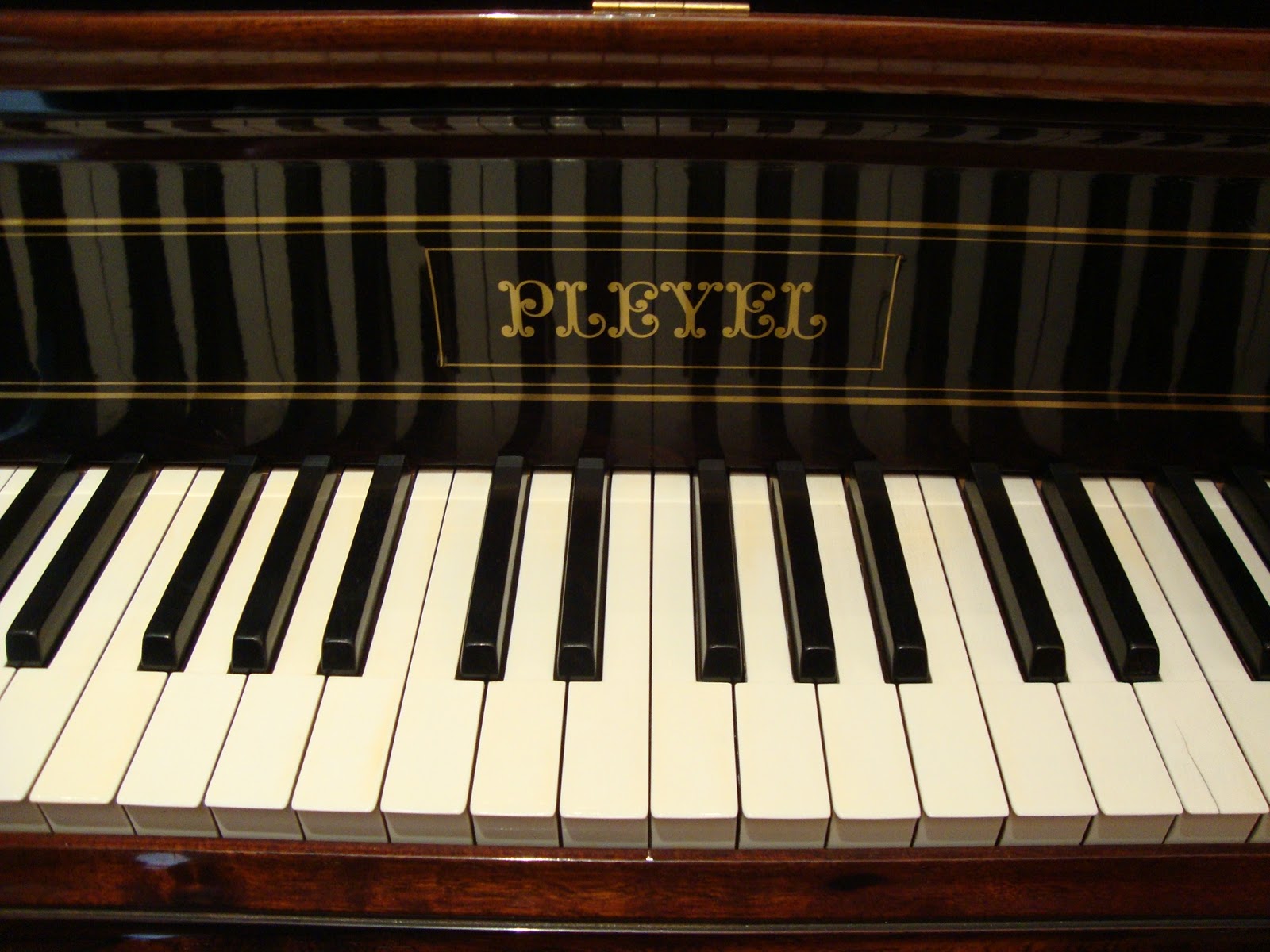
Showing posts with label Chopin's piano. Show all posts

Tuesday, July 7, 2015

Martin Willitts, Jr. Discusses Chopin's Music and Poetry (Vol. 6, No. 6)

A talented poet, musician, gardener, healer, and a Quaker, Martin Willitts, Jr., is also a retired librarian, a publisher and an artist, working on paper cutouts. He contributed to two of my anthologies, Chopin with Cherries (2010) and Meditations on Divine Names (2012). In June 2015, he and his wife, also a Quaker and a poet, Linda Griggs, welcomed me to their  home. They took me on a sight-seeing tour of Syracuse, New York, including a splendid rose garden in the rain, and organized a reading for me for the Palace Poetry Group at DeWitt Community Library.

Having spent all this time with these two fascinating individuals and poets, I decided to share Martin's poems about Chopin on this blog, and publish an interview I conducted with him by email, about poetry and Chopin's music.

Willitts Jr. and Griggs - by Maja Trochimczyk
Martin Willitts Jr. and Linda Griggs, Photo by Maja Trochimczyk


MARTIN WILLITTS Jr.'s POEMS ABOUT CHOPIN


THE ENEMY IS IN THE HOUSE


“The enemy is in the house (...) Oh God, do you exist? You do and yet you do not avenge. -  Have you not had enough of Moscow’s crimes - or - or are You Yourself a Muscovite (...) I here, useless! And I here empty-handed. At times I can only groan, suffer, and pour out my despair at my piano!”
                                                — Chopin, 1831, learning that Poland
                                                      had been defeated by Russian armies.


The piano cannot stop wars, nor lift the dead,
nor block the door. I am numb, empty handed,
wondering why you cannot stop this silence
deadly as bullets. There are no avenging angels crying.
The Russians are shooting notes of despair
and all I can do is huddle in the sheet music of snow.
Paris is the gathering place of defeated friends,
failed politicians, grieving mothers and wounded artists.
There are exiles everywhere speaking Polish sadness.
I cannot pound the keys on my piano loud enough.
I shall never return to my homeland.
I shall not give in to the Russian demands.
I shall not let one note from my fingers serve them.
The enemy is in the house.
It does not mean they can trample the rugs with mud.
We have a saying where I come from.
If a stranger stays uninvited, then call him a friend
and mistreat him like a friend, then he will go away
thinking your false friendship is real as butter on bread.
It is like playing with a piano one-handed. It can be done,
but not as well as with two hands.
It is like a gun without bullets.
It is like a person without a home.


Published in "Chopin with Cherries," 2010, p. 24

White rose snowfall - by Maja Trochimczyk

DISCORD

1.  Chopin to George Sand, 1847


The delicate touch you felt on your neck
is the same as on a piano, with the same lyrical rush,
the music of leaves in the resolute winds.
It is the same idiomatic language of geese leaving.
My heart has the same feeling, restless, yearning.
When I play a rondo, no one can hear the silence after.
I leave these early movements behind
like I must leave you.
Some things are finished when they are finished.

I thought of returning to you.
I hesitated at your window.
I knew if you saw me with that melodic look you have,
it would enrapture me.
Our bodies would become counterpoints.
But it would be fragmentary motifs. Textural nuances
of what used to be.

Our love was illicit, some say.
I say, it was melodic, rhythmic, and full of music.
Our love was repetitions of a single note.

You criticized me for my primitive sense of form
when we would lie in bed, soaked in harmonic intonations.
You were right about me as well as everything else.
I cannot help being in the soundscape of textures,
in the lightness of sound, in the last moment leaving you.
For life is opening one door and descending unknown stairs.

Sheltered in White - by Maja Trochimczyk


2. George Sand to “beloved little corpse”


You could not stand a woman who did not act like a woman
except in bed. Even then you were horrified
by the idea a woman could enjoy passion.
What were all those compositions of love-soaked music then?

You were not my first lover and you will not be my last.
A woman should pick and choose who will enter her bedroom.

You shake your head, expecting me to fall for your music like others.

A woman cannot be a slave to men.
You will not allow us to be equal.
So what choice do I have?
What choice does any woman have?

I changed my name so I could publish what scandalizes you.
Women have a right to sincere love and I will write about it.
I shall write about my desires and disappointments.
I will not miss you. I will only find another.

What have you done recently?


Note: “Beloved little corpse” was her name for Chopin due to his numerous sicknesses.

 Published in "Chopin with Cherries" p. 131-132.

Red and White in the Rain - by Maja Trochimczyk


OPUS 21

Blackened corpses of stars are going nova.
All day, it has been crackling with heat insects.
I say, it is God’s voice telling us something important.
The heat grinds us for not listening.
We cannot seem to leave well enough alone.
Our futile attempts to improve or streamline life
only makes it worse.

Sheet music’s passages of wildness — briars
and milkweed sends music into trumpets of wind —
this melody heals stunted saplings, brings Light
to darkened air, finding cures for emptiness —

Light! — come fill us! Heal the forgotten!


Published online in the Black Poppy Review, with the Opus series.

Rainy Red Passion - by Maja Trochimczyk


INTERVIEW WITH MARTIN WILLITTS, JR.

Maja Trochimczyk's Question: What does Chopin mean for you? What do you like about his music?

Martin Willitts, Jr.'s Answer: I was playing piano at an early age. I am not sure when I started, but by the time I entered Kindergarten (about 5) I was already playing classical music: Beethoven, Mozart, Handel, Brahms, Chopin, and others. I eventually played with a full orchestra in Syracuse, New York. I was also playing chamber music. At one point, I played the Brandenburg Concertos by Bach on the harpsichord.

What I liked about Chopin was all the different styles of music: etudes; polonaises; waltzes; nocturnes, sonatas, and preludes. I think his most challenging piece was Prelude in D-flat Major, Opus 28, No, 15, often called “raindrop” for its sound. I never felt I could exactly get that sound right. I felt it was better plucked by bow on a violin, stretching the open E string.

I have written a series of poems based on the concept of the Opus; and I have titled a number of poems as “Nocturne” as I think of the Chopin and Nocturne in E-Flat Major, Opus 9, No. 2, and others. Although I have not played piano since I was about 12, I still recall the sounds, techniques, fingering, and exactness of pitch. When I lost my hearing, I lost pitch, then I quit playing; but I still hear the music in my head.

Q: What types of music have you studied, or played?

I was bored with classical as a child. I needed something to challenge me. I do not remember why I felt this way, but the structure was boring my creativity. I discovered Jazz, and switched from piano to mandolin. My grandfather had this mandolin from when he was a Union organizer. It has a metal plate resonator making high pitch sounds. My grandfather gave it to me when I tried the “raindrop” from the Preludes. Some people call this mandolin a dobro-mandolin, and I would bottle-neck it like a steel guitar player or a Blues slide guitar player.

I played on live radio some swing Jazz, fast tempo, improvisational fingering. Because a mandolin has double strings, I would trill notes (playing notes really fast), and because of the high scales, I was able to go extremely high compared to a piano. By this time, all I was interested in was individual notes and I abandoned all chord structures and sight reading.

For a while I played in coffeehouses with folk singers, and the people I played with became famous later. I decided I did not like the egos involved in band structures. Vietnam interrupted my playing, and I lost perfect-pitch.

When we met, I talked about the mathematics in music, and suggested there were two kinds of composers: the ones who stressed the math and tried to treat music as a mathematical formula; and those who wrote and/or played from the heart. There is an awareness of the metronome and the music signature at the top of the sheet music that tells you the measure and pace. The famous Jazz piece “Take-Five” performed by the Dave Brubeck Quartet is E-Flat Minor, quintuple (5/4) time.

Martin Willitts Jr. with his antique mandoline. 


Q: What is it about music that appeals to you?

A: I listen to all types of music, including contemporary. When I listen, I am focused on the notes, their technique, what they do differently, how they play solos or work with the group. If the band only knows three chords or repeat too often, I lose interest. It also helps if I hear the music without seeing the musicians, so I am not judging them by their “name” or appearance. A good example was the contemporary singer Lady Gaga singing Sound Of Music. I was surprised at her vocal range.

Q: Why do you write poetry?

I became interested in poetry accidentally. If someone had asked me about poetry when I was a teenager, I would have thought they were crazy. Schools do a lousy job at promoting poetry. I originally thought of writing drama. I took a creative writing course to find out if I was good at it. The first day, the teacher said they would only read and talk about poetry. I am the kind of person who hears that as a challenge. At first, I was better than the average beginner. Over time, I would like to think I have become better.

I tend to write like a Jazz musician in that I improvise while writing. I tend to write thematically. I write several poems in a short burst of energy. When you play live music, you learn to perform on one-take, and if you make a mistake, you must continue. I disliked multiple attempts at recording music. When I was a session musician, I had in my contract about the one-take concept. If they wanted to re-record, I was already packing up. I seldom revise for this same reason, because I am revising as I am writing.

Sometimes, the classical musician in me will set aside a poem for revision. I will become overly cautious about every word, the value of each word, the structure of the line, the way it appears on the page, the punctuation, the imagery, and the phrasing of a line.

I have opposite viewpoints about writing. Sometimes, I do not trust my poems and I wonder if I am good enough. Other times I trust whatever I write. There are times I want to destroy everything; and other times the urge to write is overwhelming. I range from the highly structure to the totally unstructured compositions. I think of Chopin: how he must have felt, looking at the blank sheet music, wanting to fill it all in faster than he could write.

I am a retired Librarian. Over thirty years of the same reference questions, I reached to the point I knew a lot of subjects. I tend to bring all that information into the poems: history, art, politics, social issues, plant identification, spirituality, and other subjects.


Martin Willitts Jr. with one of his papercuts. 


ABOUT MARTIN WILLITTS, JR.

Martin Willitts Jr is a retired Librarian living in Syracuse, New York. He was nominated for 11 Pushcart and 11 Best of the Net awards. He provided his hands-on workshop “How to Make Origami Haiku Jumping Frogs” at the 2012 Massachusetts Poetry Festival. Winner of the 2012 Big River Poetry Review’s William K. Hathaway Award ; co-winner of the 2013 Bill Holm Witness Poetry Contest; winner of the 2013 “Trees” Poetry Contest; winner of the 2014 Broadsided award; winner of the 2014 Dylan Thomas International Poetry Contest.

He has over 20 chapbooks including "Swimming in the Ladle of Stars" (Kattywompus Press,2014),“City Of Tents” (Crisis Chronicles Press, 2014), “The Way Things Used To Be” (Writing Knights Press, 2014), and “Late All Night Sessions with Charlie “the Bird” Parker and the Members of Birdland, in Take-Three” (A Kind Of a Hurricane Press, 2015). He has 8 full length poetry books including ), national ecological award winner for “Searching for What You Cannot See” (Hiraeth Press, 2013), “Before Anything, There Was Mystery” (Flutter Press, 2014), and “Irises, the Lightning Conductor For Van Gogh's Illness” (Aldrich Press, 2014).

His forthcoming books include “Martin Willitts Jr, Greatest Hits” (Kattywompus Press), “How to Be Silent” (FutureCycle Press), “God Is Not Amused With What You Are Doing In Her Name” (Aldrich Press).

He wrote a collection of poems numbered “Opus” poems which have appeared in the following magazines (some under different titles): Big River Poetry Review, Blue Heron Review, Kentucky Review, Literature Today, Love Notes (anthology), Moon Magazine, Page & Spine, Black Poppy Review, Poppy Road Review, and Seven Circles Press. You can read the Black Poppy Review Opus Poems here.

Shaded Upside Down - by Maja Trochimczyk


Thursday, July 31, 2014

Chopin's Pianinos and the Discovery of Their Secrets, or Fadini's Workshop (Vol. 5, No. 10)

Fadini works on Keys of a Playel Pianino No. 7037.

On May 3, 2014, after the end of the Szymanowska Conference in Paris, I took a trip outside of Paris to the workshop of harpsichord maker and collector of Pleyel pianos, Oliver Fadini. I went with the renowned Chopin specialist, Prof. Halina Goldberg of Indiana University.  Our tour was arranged by Fadini's friend, music journalist at Radio France, Gilles Bencimon, a fervent lover of Chopin's music and the sound of historical pianos and pianinos.

                                       Maja Trochimczyk, Halina Goldberg and Oliver Fadini

We arrived in time to see our host work on restoring a Playel Pianino no. 7037  from 1837; very close to the number of Chopin's pianino from 1830s.

Rabbit fur felt is wrapped in layers on the hammer. 

Mr. Fadini took the pianino apart and was restoring all the hammers that had old leather on the heads, and had to be refurbished with rabbit-fur felt.  We looked around at his magnificent collection of Pleyel pianos and pianinos, including square pianos, and an example of every model that Playel made until mid 1840s.

A sample of hammers with leather, rabbit felt (grey) and lamb felt (white).

Apparently, if you cover the heads of the hammers with leather, it will dry and shrivel after a year or two, and will have to be entirely replaced, or else it will cause the piano to sound like a honky-tonk instrument from a saloon in an old Western.  However, if the heads of the hammers are covered with stripes of rabbit-fur felt and leather, the sounds is different, softer, rounder, more distant and mysterious, but also more resonant.  Interestingly, the harder felt from sheep's wool does not create the same effect; and the sounds remains harsh, unforgiving.

The pianino had a built in square stand for the candle  holder.

In order to show us this difference of tone, Mr. Fadini used the hammer heads to strike the exposed strings of the pianino. Indeed, the leather-covered hammer hit the strings very hard, with a pointed, sharp accent at the beginning, and the confused, sharply dissonant resonance afterwards. In contrast, the felt-covered hammer touched the string more delicately, and did not have that sharp, twang attack at the beginning of the sound that was richer, rounder and more sonorous.

This was Pleyel Pianino No. 7037. Chopin's pianino in Mallorca was no. 6668.

The different hammers require a different performance technique and Halina Goldberg had a chance of trying out the historical pianino, playing through fragments of various preludes and etudes, from old editions that Mr. Fadini also collects.  The pianino's location in the studio was also interesting, as it was not set flat against the wall, but turned with the resonance holes, covered for modesty with blue fabric, towards the listeners. While the instrument is not very pretty seen from this side, its "underbelly" as it were, the sonorities are more present and especially the high registers sound crystal clear.


As it turned out, the pianist's "touch" has to be entirely opposed to the traditional way of approaching the keyboard on a grand piano, with heavy keys and mechanism.  The touch on the historical Pleyel pianino is lighter and never forceful; this is the most apparent in loud passages, played forte or fortissimo.  The heavy handed forte of the grand piano is entirely unsuitable for the historical Pleyel pianino, with delicate mechanism and soft, felt hammers.  The pianist has to forget what she or he knows and learn anew.


Another difference is in the use of the pedal; practically non-existent on the historical pianinos, where the legato is created on the keyboard, not by pedal, and the high register maintains the pearly quality of sounds that were often commented upon in Chopin's own performances. Chopin's pedal markings, different from one edition to the next, may also be intended for diverse types of instruments - he would use varying amount  of pedal on instruments that are naturally more resonant and more attenuated.  Sandra Rosenblum currently researches the issue of Chopin's changing pedalization and may take the structure and sonority of Pleyel pianinos into account.

Indeed, Chopin's students and listeners, have left testimonies about this delicate, nuanced way of playing, that had a full dynamic scale, but also a shimmering inner life of shifting dynamic levels, crescendos and decrescendos. They also talked about his abhorrence of loud, forced chords that sounded to him like the "barking of a dog" - in the words of his student Karol Mikuli, quoted by Aleksander Michalowski in 1932.


Halina Goldberg played on restored Pleyel Pianino No. 3495.

Mr. Fadini found a confirmation for his theories in a period study about the sound of pianos and the importance of the proper hammers and proper pianist's touch on the sonorities created by the instrument. The book, written by Nannette Streicher nee Stein in Vienna, and entitled "Quelques observations sur la facon de jouer, d'accorder, et d'etretenir les fortepiano" (transl. by Hubert Bedard and Felia Bastet, Heugel et cie., 1982) contains a lot of fascinating insights into the sonorous world of instruments used in Chopin's lifetime.  Another highly recommended book is "Art classique et moderne du piano" published in Paris in 1842 by A. Marmontel (https://archive.org/stream/artclassiqueetmo00marm#page/n4/mode/1up)


Streicher writes about the "veiled, mysterious" sonorities in mid-range and of the "pearly" - distinct, clear and almost translucent - scales in the high register. She insists on the proper articulation and "touch" that is never forceful but always very precise. The sounds described so vividly by the author, a Chopin contemporary, may be heard on a recording by Fadini's wife, a Japanese-born pianist. The recording is not yet commercially available, but it will contain enough material to convince its listeners about the veracity of Fadini's theories.


While few piano-makers subscribe to Fadini's hypotheses at this time, he continues to restore pianinos and show them in concerts and exhibits. Most recently, he finished the restoration of a pianino for Mallorca; where it was shown and played at a special event. Gilles Bencimon assisted his friend in the time-consuming restoration tasks, that include making the artisan's own glue, paints, and felt.

Chopin's Playel Pianino No. 6668 and Fadini's Playel Pianino No. 7037.
Photo courtesy of Gilles Bencimon.

The restored Pleyel Pianino No. 7037 is the same model and was made in the same year as Playel Pianino 6668 that is preserved in the museum in Mallorca. The restoration project is a subject of a book that is being prepared by Fadini and Bencimon. That Mallorca Pianino is important: Chopin composed his Preludes Op. 28 on this very instrument! Wouldn't you want to know how it sounds like?

As it turns out, you can. Oliver Fadini's wife, Japanese pianist Aya Okuyama (http://www.ayaokuyama.com) recorded them playing on the Pianino 7037, identical to the one that Chopin composed the preludes on in 1839. More information may be found on http://www.nomadmusic.fr/fr/webzine .  


Antique pianinos and harpsichords in Fadini's workshop.


You can read more and see the photographs of various historical pianos on Fadini's blog, called Pianino Pleyel, pianinopleyel.blogspot.com.  It is certainly a fascinating topic, worth further explorations. If more comparisons are made between fully restored old pianinos with rabbit-fur-felt hammers, and modern grand pianos, and if the various editions of Chopin's preludes, waltzes, mazurkas and etudes are played on these diverse instruments, we will be able to expand the scope of knowledge about Chopin and his musical world. I do not know if the argument will be resolved in this discussion; people like holding on to their ideas for their dear life. On the basis of what I heard in Fadini's studio, though, I can say that he certainly won one convert that day.  If I ever want to play Chopin well, I'll buy a Pleyel pianino.


In the meantime, I admired the collection of antique piano in a cramped studio, where piano legs may be found in the ceiling, and one beautiful instrument stands on its side, while another is piled up on the third.  We saw a beautiful old harpsichord with "inverted" white and black keys, and a beautiful Viennese Graf piano.


But Fadini likes only the Pleyel made by Pleyel himself. He considers these to be the best sounding instruments of all time, the most suitable pianos for Chopin's music. Listening to them and to Fadini's explanation about the role of proper materials in the reconstruction of historical instruments made me understand my decades-old dislike of historical fortepiano that, to me, typically sounded shrill and out of tune. Yes - they would have sounded like that if the leather on the hammers was worn out, which was bound to happen as soon as one or two years of making them, as Fadini explained... That was an "AHA!" moment and I felt as good as if I discovered America myself.


I have not discover America, only moved there... so on they way back home to California, I pondered the many mysteries that remain to be discovered in the performance history of Chopin's music and in the history of his pianos.

Piano by Graf from Fadini's collection (not associated with Chopin).


An instrument does not have to look pretty to sound good - and pianinos (or upright pianos) do look nice only from the front, and have that fabric covering the mechanism on the other side. Yet, they do have wheels on all legs, which is hard to understand if they are meant to just stand in place by the wall and be pretty, but easy to consider useful - when we realize that the instruments would have been moved away from their stationary position and turned towards the audience, to enhance their sound.  There is a sketch of Chopin playing a piano turned like that.

Back side of Pleyel Pianino no. 3495 in Fadini's collection. 

_________________

FADINI PROJECTS:

The restoration of the piano owned by Mme Natalia d'Obreskoff, often played by Chopin.
http://www.youtube.com/watch?v=mJhhUzBXN1Q
http://www.pianoworld.com/forum/ubbthreads.php/topics/2167504/Re:%20A%20restoration%20of%20Chopin%20Pl.html

Fadini's Blog: Pleyelpianino.blogspot.com

ON CHOPIN AND GEORGE SAND

Celda Chopin y George Sand: http://www.celdadechopin.es/


Friday, April 19, 2013

National Poetry Month: A Chopin Poem and Chopin's Piano (Vol. 4, No. 5)

Petals and Randrops in Blush, by Maja Trochimczyk

For the National Poetry Month (April), we will have some Chopin poetry in Pasadena. Three years after the publication of Chopin with Cherries, one of the poets included in this anthology, Rey Romea Luminarias, invited me to present some of my poetry at his National Poetry Month celebration at the Pasadena Public Library, Wright Auditorium, April 29 at 6 p.m.


The event, entitled "Co-Inspirators: Poets, Artists, Music-Makers" will present interactions between various arts. The Pasadena Library is located at 285 East Walnut Street Pasadena, CA 91101, tel. (626) 744-4066. Rey invited me to read three poems: "Memory Mirrors" (inspired by Susan Dobay's digital artwork, "Reminiscence" from her "Impression of China"), and "A Study with Cherries," and "How to Make a Mazurka" from the Chopin with Cherries anthology. For the first poem, Rick Wilson will accompany me on a Chinese flute from his exquisite and extensive flute collection. For the Chopin's pieces, celebrating his music as heard in my childhood, at my grandparents house in a Polish village, I will bring two Chopin music boxes... It is going to be a beautiful, beautiful event.


To play some Chopin, I will bring two of my music boxes tthat play Chopin - I have a mazurka, in a box shaped like a brown, wooden grand piano, and a nocturne in a rectangular jewelry box with a peacock inlay... How very, very sweet...

Here's a Chopin's Nocturne in B-flat Major played on a music box (the whole piece!):
http://www.youtube.com/watch?v=3h0LcKI4dec . The main problem is that it has no rubato, nor any kind of rhythmic flexibility. It is truly mechanical music! Very fast and very square.

That is a strange way to "kill" the charm of Chopin's music. Here's another music box, held in hand, with a fragment of Nocturne Op. 9, No. 2. http://www.youtube.com/watch?v=dDLTmnPB2yk. That one is quite lovely.


Just Joey Rose by Maja Trochimczyk

Reynald Romea Luminarias wrote a beautiful poem for my anthology Chopin with Cherries. I was very happy to include it in the book.


There Is No Other Love

 After Chopin’s Etude in E Major, Opus 10, No. 3

R. Romea Luminarias

—for Annie


November sunlight peers
Between leaf-veins. Oval windows.
Rose petals on velvet. Autumn vines our arms
Glazed with ripeness, steeped in unrestrained embrace.
Tongues stilled; drought-pained mouths this one now-love alone

Can heal. Our Love steers
Unknown universes’ oceans of shadows,
Maps red coral galaxies. Anemone-meteors swarm
Around us, stir hunger’s hull knifing waves, probing abysses.
There is no other love obtains the soul, breaks open steel and stone;

There is no other Love destroys this present, ancient drought, this fall
Stripped bare of songs, deprived of harvest; there is no other Love sees
Through storms of swirling fires; only this love, O this our Love alone:
No other Love ordains, builds up the spirit, breathes life into dry bones.

_______________________

Here's the Etude that inspired this poem:

Here's the information about the Etude on the website of the National Chopin Institute of Poland:
http://en.chopin.nifc.pl/chopin/composition/detail/name/etude_in_E_major_op._10/id/162 (this is very slow and on a historical fortepiano, so it sounds out of tune).

As Prof. Mieczyslaw Tomaszewski writes: "The third Etude (Lento ma non troppo), in E major, is a nostalgic song, broken off by a moment of extreme agitation. It is one of Chopin’s most beautiful melodies, which he also regarded as such. Almost a nocturne, though at the same time a song, it proceeds in accordance with the rhythm of deep breathing, rising and falling. A moment of agitation and passionate explosion fills the middle section of this Etude, as the unavoidable consequence of the previous song. The reprise of the music from the opening is like a mere recollection. The quieting that concludes it heralds the next Etude, with which it forms a coherent whole."


Ballerina Rose Skirt by Maja Trochimczyk


On May 21, there will be another celebration, that of American Paderewski Piano Competition .Held at the Colburn School of Music in Los Angeles, the event will preasent 27 pianists; with 30 hours of Chopin, Paderewski, Bach, Liszt, Ravel, Debussy, Beethoven, Scriabin, Prokofiev, Rachmaninoff, Schumann, Szymanowski, Haydn, Bartok, Brahms, Mozart, Clementi, and many more.

There will be Piano Masterclass with a world-renowned pianists; Piano Recital of the Winner of the APPC 2010 --  http://www.ijpaderewski.org/95812/180712.html

One of the "fringe events" will be an exhibition of photographs about music. Andrew Kolodziey, the founder and president of the Art Group KRAK, invited me to show some of my music-themed photographs and selected two of my photographs - a portrait of Henryk Mikolaj Gorecki and the keyboard of Chopin's Playel Piano in Paris. The piano dates back to 1845 and belongs to the permanent collection of the Polish Library in Paris. The photo was taken during the 2011 Maria Szymanowska Colloquim, when the piano was taken downstairs and played!  The recitals of French songs by women composers and of Szymanowska and Chopin  were unforgettable.

I'm very happy to share this photo here; the Szymanowska concerts and presentations were truly wonderful! But I'm also quite thrilled to be invited to a second "invitation-only" art exhibition of my brief career as a photographer.

Chopin's Piano in Paris, Pleyel 1845 - by Maja Trochimczyk


_____________________________

Photos of roses from my garden and Chopin's piano from Paris
(C) 2011-2013 by Maja Trochimczyk

Wednesday, April 4, 2012

Chopin's Revolutionary Etude in a California Jail (Vol. 3, No. 5)

Sunset over a desert stream in Tujunga Wash, Photo (c) by Maja TrochimczykOn March 26, 2012, I started a new adventure - teaching a class on art and ethics to inmates of Pitchess Detention Center in Castaic, CA. I designed my four-part class as lessons in connecting feelings to thoughts, to teach virtues by using artwork, music, and poetry - a full range of artistic experiences. I called it EVA, or Ethics and Values in Art.

The core framework is provided by the Four Cardinal Virtues - courage, justice, wisdom or prudence and moderation, or temperance. Known since antiquity and used to teach moral values and character through over two thousand years of Western history, the virtues have largely been forgotten. Their presence in the lives of artists and their artwork is very strong, from Rembrandt to Chopin... In planning the classes I associated each virtue with an emotion - grief, shame, joy and calm - and with a moral action - compassion, forgiveness, generosity and gratitude...

While designing the curriculum, I thought I would be teaching women, so I was quite surprised when I was assigned to a men's institution. At Pitchess, they have been given a chance to think through their decisions and change their lives. The group I'm working with has decided to do exactly that. They enrolled in and graduated from the MERIT-WISE program, a part of the Sheriff's Education-Based Incarceration project. In some ways, these men have the best chance for a successful life after completing their "time out" to rethink their life choices and orientation.

In order to get ready for the challenges ahead, they participate in various workshops and classes taught by volunteers like me. The majority have never been to an art museum or a classical music concert. My goal is to help them find their way to the Hollywood Bowl . . . That and not to return to jail. How does one do that?

The Cornerstone

Justice:
Do what's right, what's fair.

Fortitude:
Keep smiling. Grin and bear.

Temperance:
Don't take more than your share.

Prudence:
Choose wisely. Think and care.

Find yourself deep in your heart
In the circle of cardinal virtues
The points of your compass
Your cornerstone.

Once you've mastered the steps,
New ones appear:

Faith: You are not alone . . .
Hope: And all shall be well . . .
Love: The very air we breathe
Where we are.

Desert plants among rocks, Photo (c) by Maja Trochimczyk, 2011The framework I designed and teach right now is non-religious and, therefore, I skip the three Theological Virtues mentioned at the end of my poem. There is enough material for discussion, though, in the paintings of the Prodigal Son and Tobias by Rembrandt, Guernica by Picasso, City Whispers by Susan Dobay... There is enough inspiration in the Revolutionary Etude by Chopin and the Ode to Joy by Beethoven. If I put my own poetry in this context, am I acting grandiose and, as someone once called me (to my immense delight) - a megalomaniac? The point is to find yourself in your own words. I may "know" what's out there or what I've been taught, but I truly know only what I have experienced myself. I have to go deep inside, to the truth about me, to express a vision of the world that is both deeply personal and unique in my poetry.


Non Omnis Moriar


Only the best will remain.
Startled by beauty
I fly into the eye of goodness.

Only the best . . .
Wasted hours, words, signs,
Sounds and fake symbols.

Only:
Blue torrents of feeling
Crystallized in empty space
Twisted above our heads
Where light freezes
Into sculpted infinity

Oh,

If I could be there

Once

____________________________________

If only... To open their eyes and ears to new worlds, I take my students in blue prison garb on a wild tour of the most astounding creations of the human mind. The very first piece of music they hear is the "Revolutionary Etude" - Op. 10 No. 12, a lightning strike of a piece, designed to shake up and awaken... There applause at the end is intense. The majority has never heard anything like it.

Last Photograph of Fryderyk Chopin, 1848One man said, "thank you so much! This is my most favorite piece in all music, in all the world." He had asked for Chopin in the previous class and was beyond himself with delight when his unspoken wish was answered. I asked him to explain the piece to the class and put it in context. He knew enough to talk about Chopin's rage at the war, Poland being attacked by Russia, the composer's loneliness in Paris. He also thought about expressing anger and other powerful emotions in art as a positive way of responding to something that is overwhelming and destructive. From the feeling of despair at the unfairness of the world and Poland's tragic defeat to an unprecedented masterpiece.

I did not ask, why, if he was so educated and knew so much, was he there, sentenced to jail... Everyone makes mistakes. Some more serious than others. My presence among the inmates is to help them use their time as a turning point, find a new path for the future. I use classical and romantic masterpieces to show criminals that they can and should remake themselves and live a different life. How different? Are they going to learn to play the piano and become Chopin experts? Not really, but they can learn from his courage, his fortitude. He composed while spitting blood, sick with TB since the age of 16. Suffering all his mature life, he died prematurely, but left for us timeless treasures.

Etudes are, in essence, practice exercises; they are designed to learn certain skills, solve particular technical problems - arpeggios, chordal patterns, layering of melodies, the use of specific fingers. Practice makes perfect. After 10,000 hours of practicing a skill, we may become experts in it, as Malcolm Gladwell assures us. That is another lesson for offenders serving their sentences. Moral character takes time and effort to develop. Even the least educated inmates in the Los Angeles County jail may be inspired by the perfection of Chopin's art, transforming a humble exercise into a perfectly structured and intensely emotional artwork that has and will survive the ravages of time.

Versions (Pollini's is my favorite):

Svatoslav Richter: extremely fast and apparently transposed a halftone higher, the image does not go with the sound

Stanislaw Bunin: not technically perfect, but immensely popular, 2:33

Janusz Olejniczak: The phrase endings are somewhat rushed, but the drama is immense! 2:33

Maurizio Pollini: as dramatic and tender as it has to be, with great climaxes, and a score to follow, 2:49


_________________________________

Photos from Big Tujunga Wash (c) 2012 by Maja Trochimczyk

Chopin's last known photograph - daguerreotype by Louis-Auguste Bisson, 1849.

Tuesday, March 13, 2012

On Kocyan Playing Chopin and Liszt (Vol. 3. , No. 4)

Wojciech Kocyan plays at the Ruskin Art Club, 2010When I first saw Polish pianist Wojciech Kocyan on the concert stage about twenty years ago, I felt he looked just like Fryderyk Chopin: frail, with longish dark-blond hair, sensitive, and sophisticated. Here was a pianist with great emotional and musical intelligence, a refined technique, and subdued charm. He excelled in the Mazurkas, but was equally fascinating in the repertoire of Debussy, Ravel and Skryabin. I felt that his well-thought out large-scale musical structures and his attention to expressive and textural detail made him a "pianist's pianist" - like Chopin himself who was thriving in salons of the aristocracy but abhorred crass and vulgar behaviors of the general public.

Over the years, I have invited Kocyan several times to play for events I organized, and I was always delighted with the charm and virtuosity he shared with his listeners, helping us make new discoveries even in well-known pieces. One outstanding appearance was not at a concert at all: Kocyan agreed to play a number of Chopin's compositions in-between readings of poetry from the anthology Chopin with Cherries.

Wojciech Kocyan plays at the Ruskin Art Club, 2010, with Maja TrochimczykThe Ruskin Art Club event of May 2010 has remained in the memory of everyone in attendance. The fifteen or so poets who were present inspired the pianist and the pianist inspired the poets. Magic was in the air. In the elegant, old-fashioned interior of the Ruskin Art Club (a Los Angeles cultural landmark with over 120 years of history), we found ourselves in a 19th century salon. The interplay of profound, nostalgic, and romantic music with the spoken word remains unforgettable.

On Friday, March 9, 2012, we had an opportunity to witness another unforgettable event centering on Mr. Kocyan. His Faculty Recital at Loyola Marymount University's Murphy Recital Hall was a feast of music-making that revealed to me a side of Kocyan's talent I did not know well. After listening to his monumental interpretations of Beethoven, Chopin, and Liszt I have looked for an appropriate adjective to capture my experience. The old-fashioned expression "a Titan of the keyboard" came to my mind - with its 19th century extravagance and uncanny accuracy.

Maja Trochimczyk, and Edward Hoffman, at the Ruskin Art Club, 2010Kocyan's appearance on the stage is hardly "Titanic" - he seems frail and delicate, like Chopin, not Liszt (and now with short-cropped hair). Yet, this is how the music sounded to my ears - majestic, awe-inspiring, sublime. The program followed a trajectory from an early Beethoven Sonata (in E-flat Major, Op. 7), through Chopin's Barcarole Op. 60 and Concert Paraphrase of Verdi's Rigoletto by Liszt, to a culmination in the latter's composer's masterly Sonata in B minor. Kocyan found the right tone for the various movements of the "Grand Sonata" (one of the longest written by Beethoven, exceeded only by the "Hammerklavier"). His virtuosity and technical prowess were obvious from the start of the Allegro molto e con brio and quite prominent in the second Allegro. The delicacy of feeling and graceful phrasing in the final Rondo were exceeded only by the emotional depth and structural flow in the second movement, Largo, con gran espressione . His program notes identified this movement as one of the greatest in all music, "overwhelming in the simplicity of means and the depth of its message."


Wojciech Kocyan with Maja Trochimczyk, at the Ruskin Art Club, 2010How would a simple gondolier's song, the Barcarolle, fit in this context? Surprise, surprise... in this most beloved Chopin's work, Kocyan revealed the "titanic" elements of Chopin's style that permeate many of his etudes, sonatas and scherzos. Under the pianist's fingers, the Barcarolle was neither sentimental, nor simplistic -he was able to structure the overall arch of dramatic flow of the music, reaching a climax of expressive passion. Having listened to a lot of nocturnes and mazurkas recenty (and just one astounding concerto, by Garrick Ohlsson with the Wroclaw Philharmonic Orchestra conducted by Krzysztof Kaspszyk in February 2012), I was thrilled by the raw emotional power coupled with Olympian clarity that Kocyan brought out from this piece.

As for Liszt, I never liked his "show-off" pieces of a three-ring-circus-master variety. The Rigoletto Concert Paraphrase certainly belongs among such magicians' tricks - pulling a rabbit out of a hat, or a complete orchestra out of a black-and-white keyboard. Kocyan's admirable technique was on display here - both in the velocity of his fingers, flying in a blur from end to end of the keyboard, and in the multiplicity of colors and textures he was able to create. The 19th century listeners had no recordings, no Ipods, no CDs, no music-in-the-cloud... After hearing an opera, they could experience it again only in transcription. Liszt's raised the bar of technical impossibility very high and shifted the attention away from the music or drama, towards the sheer mastery of the instrument.

I thought that this was the most difficult piece on the program, but Kocyan stated that the Sonata in B-minor was by far the most complicated and involved work that he had ever learned. And learn he did - the truly monumental (I'm running out of adjectives here) piece reaches the heights of elation when waves of sound wash over the whole concert all only to crush in the tragic darkness at the end. Kocyan deserves an award for the incomparable profundity of expression in rendering those dark chords more piercing and dramatic than any of the contrasts and upheavals that went on before it. Hopefully, the documentary recording will be made available. We are so lucky that music once played remains...

Born in Poland and a student of the legendary pedagogue Andrzej Jasinski (M.A. degree with the teacher of Krystian Zimerman) and the eminent John Perry at USC (DMA degree), Kocyan won his share of awards at piano competitions, including the Busoni, Fiotti, XI International Chopin Competition (special prize), and the Paderewski Piano Competition (first prize). He is notably at home in the recording studio and issued many CDs, on the Dux label.

Cover of Wojciech Kocyan's CDIn 2007, the Gramophone magazine chose his recording of Prokofiev, Scriabin and Rachmaninoff as one of 50 best classical recordings ever made. The Gramophone web site includes the following recommendation about Kocyan's Dux CD (no. 0389) with sonatas by Prokofiev and Skryabin, as well as Rachmaninoff's preludes:

"Small label and unknown pianist deliver world-class artistry and first-rate engineering. Wojciech Kocyan not only stands ground alongside Pollini, Ashkenazy and Richter, but he also offers original insights that totally serve the music. If you see this disc, grab it."


Kocyan currently serves as the Professor of Piano at Loyola Marymount University and Artistic Director for the Paderewski Music Society in Los Angeles. His students are lucky, indeed... and so are his listeners. By the way, I had a close look at Kocyan's miraculous hands when turning pages for him at the Ruskin Art Club. I did not take any pictures this time, so all the illustrations are from 2010.

____________________________

Photos from An Evening of Poetry and Music - Chopin with Cherries reading at the Ruskin Art Club, May 2010. Kocyan at the piano, with Maja Trochimczyk and choreographer Edward Hoffman.

Cover of Kocyan's CD by Dux (Poland).

Tuesday, December 20, 2011

Chopin, Taffeta, Dance and Christmas (Vol. 2, No. 15)

Christmas Tree Decorations, Photo (c) 2011 by Maja TrochimczykIn America, December is the holiday season. Houses are decorated starting on December 1 and each weekend brings at least four party invitations, luncheons, dinners, and Christmas carols sing-alongs. By the second week of January all of it will be thrown out or packed away and the Christmas season will recede into the distance.

The calendar of celebrations looked somewhat different in Chopin's Paris: yes, there were gatherings in December, but the real party season started with the Christmas day, and went on and on, until the end of Carnaval in early February. The rustle of taffeta and richly colored velvets, the glimmer of candlelight, jewels sparkling like laughter... Kerri Buckley's poem "The Songs of Chopin: A Villanelee" published in Chopin with Cherries captures the mood of the seaso, while looking back at the romantic salons frequented by Chopin:

The Sounds of Chopin: A Villanelle
by Kerri Buckley

Hearts open like French doors as Chopin plays
At his birth, cherry blossoms were splashed with snow
Entering sound deeply changes ways one prays

His concertos have filled cafes, chateaus, chalets
Inspiring toasts with brandy, champagne, or Bordeaux
Hearts are open French doors when Chopin plays

Faces aglow, women wear taffeta, velvet, brocades
Join men in bow ties, gloves, a man gleams in a tuxedo
Slipping into glissandos changes how he deeply prays

Intoxicating Nocturnes brightly sets one’s soul ablaze
Chords slice air like fire batons atop the high crescendo
Hearts could burst like French doors if Chopin plays

Lovers’ lips shine like sugar, chocolate, cherry glacés
In hours most arrive, sweethearts steal away, dolce adagio
Entering melodies softly changes ways a beloved prays

Composers’ lives overflow in continuous, sacred praise
Onstage below glimmer of candelabras, maestros glow
Hearts glisten, French doors wide open as Chopin plays
Enter music to change all deep mystical ways one prays

____________________________________________

The rotational and repetitive character of the villanelle is well suited to the subject, filled with the turns of the waltz, and the alluring moods of the evening. Kerri gave us a wonderful holiday gift in this poem. The online editor programs do not allow extra spaces which separate phrases and words, so the layout of the poem is somewhat faulty. This should not detract the readers from its beauty.

Chopin was a creature of the aristocratic salon, elegant and refined. He liked to remember the simple music of Polish countryside, including folk dances and carols. He transformed the cited or stylized music to the universal level. The beloved lullaby carol, "Lulajze Jezuniu" appears in Chopin's Scherzo in B-minor, Op 20, written in 1831-32 and dedicated to his friend Thomas Albrecht. The sweet melody appears in the central, slow section of the Scherzo, marked Molto Piu Lento.

I selected several recordings of this lovely Christmas Carol and its version in the Scherzo to share with Chopin lovers this Christmas.

Christmas Tree Decorations with the Black Madonna, Photo (c) 2011 by Maja Trochimczyk


____________________________

For my Poetry Laurels blog, I created a couple of illustrations to my Christmas poems, one from this year and one from 2009. In early December, I was asked to read some poems at a party and realized that I have not written my annual Christmas poem yet. It came to me in the rain, when I could barely see the road ahead and the sky was heavy with darkness.

Poem "Did you know?" by Maja Trochimczyk

Did you know?

Some Christmases are rainy
Tears fall from overcast sky
On lonely crowds in hospitals
And prison yards

Sometimes Christmas is icy
Frozen under the pale moon
Changing faces into lifeless
Shadows at night

Some Christmases are scarlet
And green like fir garlands and hearts
Warmed by barszcz and hot chocolate,
Evenings by the fire

Sometimes Christmas is white
Snowflakes melt on my gloves
The thin wafer of opłatek we break
Shelters us in good wishes

Some Christmases are sparkly
With the tinsel of laughter
Giggling children unwrap gifts
Magic in the morning

My Christmas is golden
Like that first star of Wigilia,
Warm kisses with kompot and kutia
Blessings under the tree

© 2011 by Maja Trochimczyk

I paired this poem with a photo I took this October at the Notre Dame Cathedral in Paris. I liked the open window, looking out through the multitude of shapes and colors onto a simpler, luminous world.

Merry Christmas Card with Stained-Glass Window, by Maja Trochimczyk

The picture became the cover of my Christmas card. I also reprinted my last year's holiday poem, "Rules for Happy Holy Days" as a reminder about the importance of celebrating the holidays in the right way, by sharing and loving. This poem was written for my last year's Christmas wishes. These Rules are timeless.

Rules for Happy Holy Days  Poem by Maja Trochimczyk

Rules for Happy Holy Days

Don’t play Christmas carols
at the airport. Amidst the roar
of jet engines, they will spread
a blanket of loneliness
over the weary, huddled masses,
trying not to cry out for home.

Don’t put Christmas light on a poplar.
With branches swathed in white
galaxies, under yellow leaves, the tree
will become foreign, like the skeleton
of an electric fish, deep in the ocean.

Clean the windows from the ashes
of last year’s fires. Glue the wings
of a torn paper angel. Brighten
your home with the fresh scent
of pine needles and rosemary.

Take a break from chopping almonds
to brush the cheek of your beloved
with the back of your hand,
just once, gently. Smile and say:
“You look so nice, dear,
you look so nice.”

© 2009 by Maja Trochimczyk

Christmas Wishes by Maja Trochimczyk
_____________________________________

NOTES:

Photographs and Christmas poems (c) 2011 by Maja Trochimczyk
Christmas tree decorations by Eva DiAngelo, California