Showing posts with label piano. Show all posts

Saturday, September 21, 2013

Susan Svrcek Plays Ives's Concord Sonata and I Feel Like George Sand (Vol. 4, No. 10)

Leafy Sky (c) 2013 by Maja Trochimczyk
What is a perfect ending to a perfect day? Hearing Charles Ives's Concord Sonata at the Boston Court in Pasadena, in a small 60+ seats recital hall, so close to the stage, you feel the waves of sounds washing all over you, through you...Tonight, I felt like George Sand must have felt when she lied on the floor under Chopin's piano and listened to him improvise on those warm summer evenings in Nohant.  Powerful and seductive, delicate and distant, intensely present and overwhelming with spiritual grandeur - Ives's music is rarely juxtaposed with Chopin's. Two continents, two cultures, two different traditions... and yet...

Think about those moments in the second movement, Hawthorne, when glimpses of serene, childlike melodies emerge momentarily from a phantasmagorical kaleidoscope of music, only to be crushed by yet another avalanche of sound. The sweet lullaby of a Polish Christmas Carol, Lulajze Jezuniu (Hush, baby Jesus), emerges, to the same effect, in Chopin's Scherzo No. 1 (hear Garrick Ohlsson's interpretation), creating a moment of respite, among wildly careening sound masses that ultimately destroy the homely sweetness with their despairing might. You may also listen to a jazzy arrangement of this fragment of Chopin's Scherzo by Polish vocal quartet Novi Singers.

It is easy to fall into "purple prose" when trying to capture the effect of music on the mind and heart after a spectacularly inspiring concert, such as the rendition of Charles's Ives transcendental Concord Sonata by the California pianist, Susan Svrcek. The concert, on September 20, 2013 was presented in a collaboration of Piano Spheres and Boston Court, a musical organization and a theatrical institution. The result was sublime, thanks to a great pianist taking her audience on a travel through a sonic landscape envisioned by an absolute, complete genius. "It's getting better all the time, doesn't it..." commented Catherine Uniack, the Executive Director of Piano Spheres, on her way out the door. Yes, such a glorious evening inspires one to even quote the Beatles.

Let's start from Ives's words, though, from his "Essays before a Sonata" that encapsulated his frustration with "the instrument! ... there is the perennial difficulty-there is music's limitation... Is it teh composer's fault that man has only ten fingers?" And his tongue-in-cheek expression of musical aesthetics: "We like the beautiful and don't like the ugly; therefore, what we like is beautiful, and what we don't like is ugly - and hence we are glad the beautiful is not ugly, for if it were, we would like something we don't like."

Now, that sounds like sophistry, or splitting the match-head into four, but is it? Susan Svrcek selected this quote for the program notes of her recital, coupling it with other quotes from Ives's Essays that explain his understanding of the spiritual essence of the four Transcendentalists portrayed in the four movements of the sonata, one of the greatest works of the century - composed by Ives (1874-1954), who made his living as an insurance salesman and invested his time in music.

Sycamores in Heaven(c) 2013  by Maja Trochimczyk

  • Ives on Ralph Waldo Emerson:  "Though a great poet and prophet, is is greater, possibly as an invader of the unknown, freely describing the inevitable struggle in the sol's uprise and would then discover, if he can, that 'wondrous chain which links the heavens with earth - the world of beings subject to one law."

  • Ives on Beethoven's Fifth: "There is an 'oracle' at the beginning of the Fifth Symphony - in those four notes likes one of Beethoven's greatest messages. We would place its translation above teh relentlessness of fate knocking at the door, above the greater human-message of destiny, and strive to bring it towards to spiritual message of Emerson's revelations - even to the 'common heart' of Concord - the Soul of humanity knowing at the door of the Divine mysteries, radiant in the faith that it will be opened - and that the human will become the Divine!"

  • Ives on his music for Nathaniel Hawthorne "which is but an extended fragment trying to suggest some of his wilder, fantastical adventures into the half-childlike, half-fairy like phantasmal realms. It may have something to do with the children's excitement on that 'frosty Berkshire morning," and the frost imagery on the enchanted hall window, or something to do with the old hymn tune that haunts the church and sings only to those in the churchyard, to protect them from secular noises, as when the circus parade comes down Main Street; or - not something that happens but the way something happens; or something about the ghost of a man who never lived, or about something that never will happen, or something else that is not."

  • Ives on the Alcotts's house in Concord (home of  Bronson Alcott and Louisa May Alcott: "Within the house, on every side, lie remembrances of what imagination can do for the better amusement of fortunate children who have to do form themselves - much needed lessons in these days of automatic, ready-made easy entertainment which deaden rather than stimulate the creative faculty. And there sits the little old spinet-piano Sophia Thoreau gave to the Alcott children, on which Beth played the old Scotch airs, and played at the Fifth Symphony."

  • Ives on Henry David Thoreau: "As he stands on the side of the pleasant hill of pines and hickories in front of his cabin, he is still disturbed by a restlessness. His eagerness throws him into the lithe, springy stride of the specie hunter - the naturalist - he is still aware of a restlessness with these faster steps his rhythm is of a shorter span - it is still not the tempo of Nature, and h e knows now that he must let Nature flow through him and slowly; he releases his more personal desires to her broader rhythm. And before ending hid say he looks out over the clear, crystalline water of the pond and catches a glimpse of the shadow-thought that was in the morning's mist and haze - he knows that by his final submission, he possesses the 'Freedom of the Night,' with a strange liberty in Nature, a part of herself." 
Almost Magritte, not Quite, (c) 2013 by Maja Trochimczyk

At the beginning of her performance, the pianist pointed to these quotes she selected to insert in the program. She then explained her general interpretation of the four parts of the Sonata. As Svrcek stated, other musicians sometimes experiment with changing the order of the movements, to end on a note of grandeur instead of tranquility, but she firmly believes that the order selected by Ives is perfect, it is what it should be. We start in the transcendence of the universe, finding our place in the cosmic order and disorder of the world (Emerson). We are then surrounded by the chaos and liveliness of the bustling town or village, where marching bands meet half-way through their different tunes and everyone has something different to say (Hawthorne).  Going inward, in the next stage, we find rest and happiness in the safety of our homes (The Alcotts), and then there is just solitude, being alone within the world and hearing the call from beyond one self that can only be heard when one is by oneself (Thoreau).  The trajectory from the universe through city crowds to loneliness, from the whole world to one person, from external glories of nature to the tranquility of internal life provides unassailable logic to Ives's Concord Sonata.

Ellenai 1


I drank the sun –
there is nothing left
for the world

I’m full of light

nobody’s sweetheart
I am a universal widow
of forty four springs
and one true love

(prophetic poetry
echoes through my mind
with this messianic number)

life’s winds took me
from place to place
like a rose-petal
carried by waves

I breathe the sky –
torn apart by red clouds 
its blue pierced


by rays of sunset 

(c) 2002 by Maja Trochimczyk (from Miriam's Iris)

But there's another trajectory that leads through the stages of human life, as in the famous riddle of the Sphinx: "What goes on four legs in the morning, on two legs at noon, and on three legs in the evening?" Oedipus's answer - "the man" - is at the heart of Ives's spiritual quest. This Sonata portrays a spiritual ascent through turmoil, drama, anger, whimsy, trivial and elevated joys and delights, to a deep and singular understanding.  It moves from the surface inwards, on a path towards maturity. The monumental movements of cosmic dimensions glitter with internal light under Svrcek's dancing fingers: alternatively taking your breath away and moving you to tears.

The alternation of moments of phantasmagorical grotesque and the briefest stillness of beauty emerging like brittle islands of peace in the Hawthorne.  The reflection of a reflection, or quotation of a quotation - a memory of music, with Ives taking us inside the warm glow of a candle-lit parlor, with the family gathered around the piano to listen to Stephen Foster's songs in The Alcotts. The 'oracle' four-note motive from Beethoven's fifth that takes us to the door of Divine mysteries, a threshold of comprehension of our place in the world...

Amor 6 

the more I love
the more dangerous
life becomes
in its graphic beauty
carved with a dagger
stolen from time
the blade cuts
old wounds open
 it slides on the skin
of the moment


 pierced by knowing


(C) 2006 by Maja Trochimczyk (from Miriam's Iris)


Oak Heart of Warsaw (c) 2012 by Maja Trochimczyk


Every time I hear this Sonata I understand something new, something more profound about its beauty. It speaks, with its timeless voice, of wisdom and acceptance of our place in the cosmic order, the place in the world, in our communities, in our homes. The magical appearance of a distant flute in the finale dedicated to Thoreau brings this idea to the forefront (and cannot be easily heard on a recording). Flutist Julie Long was beautifully playing from behind closed doors in a quiet dialogue with the piano in a breath-taking rendition of one of the most sublime, unforgettable moments in the entire history of music. It is a moment wrought with meaning. A voice is heard from beyond time, a melody that in its pure essence is timeless personified. T.S. Eliot tried to capture this voice in his Little Gidding from the Four Quartets:

The voice of the hidden waterfall
And the children in the apple-tree
Not known, because not looked for
But heard, half heard, in the stillness
Between the two waves of the sea.
Quick now, here, now, always--
A condition of complete simplicity
(Costing not less than everything)
And all shall be well and
All manner of things shall be well
When the tongues of flame are in-folded
Into the crowned knot of fire
And the fire and the rose are one.

Coral Rose (c) 2010 by Maja Trochimczyk

In the past, I listened to the sonata with the score, trying to figure out how it is made, what are the structural points that carry the momentum forward, building a monumental edifice of sound, like the arches and buttresses carrying the weight of a cathedral. Now, floating in the space of sounds, carried along by wave after wave of sonorities in their rich expressiveness and diversity, I listened for the meaning.  Thanks to an extraordinarily talented artist, Susan Svrcek, her heart, mind and her ten fingers, I found what I was after. . .


Ellenai 6

with the noise
of unfurling wings
silence descended

turmoil within
my frightened self
dissolved
into the glass surface
of tranquil seas
at sunset

angels account for
moments such as these

love’s cruel sweetness

my days are numbered

I’m caught again

emptied
of thought and sorrow

poured
into the last vessel
of midnight calm


(c) 2002 by Maja Trochimczyk (from Miriam's Iris)


Ives wrote about Beethoven's famous four note motive  that he called the "oracle" of human fate (ta-ta-ta-daa). The motive's presence is vividly felt  throughout the Concord Sonata, yet I went home singing not that famous theme, but a humble, if uplifting Hymn that also permeates The Alcotts: Henry Carey's 1844 melody to "God Bless our Native Land"  (in the recording you will hear the organ surrounded by birdsong at St. Luke Church of Sedona, Arizona). I then think of
"My Country 'tis of Thee, sweet land of liberty, of Thee I sing..." and go to bed singing American patriotic songs I never knew, growing up in distant Poland.

Sunland Mountains (c) 2013 by Maja Trochimczyk

___________________________________

Charles Ives's Concord Sonata, or, as it formally titled "Piano Sonata No. 2, "Concord, Mass., 1840-1860" was composed between 1911 and 1915, and first published in 1919, with the second revised edition issued in 1947.

For those who missed this concert, and would like to listen to transcendental music on horrible laptop loudspeakers here are some YouTube links:

Gilbert Kalish plays Ives's Concord Sonata (whole piece, 49 minutes)

John Kirkpatrick plays The Alcotts from the Concord Sonata (second movement)

Jeremy Denk plays Ives's Concord Sonata (whole piece)

If you missed the concert and want to hear Susan Svrcek playing for the Piano Spheres again you have to wait until April 22, 2014, when she'll be on the program.

In their 2013-14 season, the Piano Spheres will also present:
Gloria Cheng (November 12),
Mark Robson (February 11, 2014), and
Vicki Ray (March 18, 2014).


Sunday, January 20, 2013

Did Chopin Like Donuts? A Culinary Travelogue (Vol. 4, No. 1)

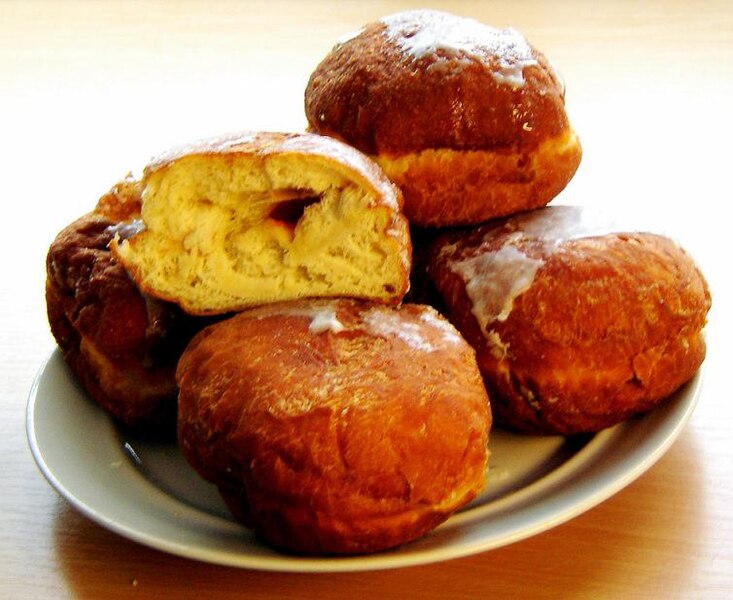
http://upload.wikimedia.org/wikipedia/commons/thumb/4/45/Polish_paczki.jpg/733px-Polish_paczki.jpg
Polish donuts, photo from Wikipedia Creative Commons

Just about every aspect of Chopin's life has been subjected to scholarly scrutiny. His music, his love life, his family background all the way back to those small Alpine villages of his distant ancestors... (See: Piotr Myslakowski and Andrzej Sikorski, Fryderyk Chopin: The Origins, 2010; I discussed Polish versions of these studies in a previous blog). 

Scholars research Chopin's taste in opera, in women, in clothes. .. his daily habits, the sources of his income, the layout of furniture in his rented rooms... his letters...


On March 27, 1830 Chopin wrote from Warsaw to his friend Tytus Wojciechowski, describing the triumphs of his two concerts presenting the First Piano Concerto and other works.  The Concerto's slow movement, Adagio, completely delighted the musicians and critics. The use of a better Viennese piano at the second concert was also noted to Chopin's advantage: "What applause, praise that each note articulated like a little pearl..."  
The young pianist was justifiably proud of the compliments for his virtuosity and precocious compositional talent, though slightly apprehensive of all this admiration being "too much all at once." For instance, he protested the specter of having a portrait made for someone he hardly knew, and, thus, "being wrapped in butter"... The latter expression ("nie mam ochoty, żeby we mnie masło owijano") is an example of Chopin's lively and idiosyncratic language. 


Donuts, pastries, and gingerbread for Mother's Day, Warsaw, Poland
Photo (c) 2012 by Maja Trochimczyk

The composer ends the confessional letter with protestations of undying affection for his dearest friend and reveals that he was "hiding everything for dessert, and I have no other dessert than the most sincere embrace, because I only have you..." ("Wszystko chowałem na deser, a tymczasem nie mam innego deseru, jak tylko uściśnienia najszczersze, bo ja Ciebie tylko mam.") 

So here's Chopin's butter and desert. . .  And now, for his favorite dishes. During the Third International Chopin Congress Wojciech Bonkowski discussed "Chopin as Gourmand" (February 2010, Warsaw). What difference does it make whether Chopin liked the Viennese Sacher torte, or had a favorite brand of wine?  We know, however, that in his teen years, he was most impressed by the Toruń gingerbread (piernik).  In early August 1825, the 15-year composer wrote a report from a trip to Toruń in a letter to his friend, Jan Matuszyński, discussing Copernicus's museum, various fortified buildings, and the local specialty:

"According to the custom of gingerbread makers, gingerbread stores are entryways filled with boxes kept under key and lock; in these large wooden boxes gingerbread rests, divided into different types and arranged into dozens.  This is all I am able to write to you about Toruń, maybe I'll tell you more, but now I will only write that it was the gingerbread that made on me the greatest impression, or impact." [Podług zwyczaju tutejszego piernikarzy, sklepy do pierników są to sienie obstawione skrzyniami na klucz dobrze zamykanymi, w których rozgatunkowane, w tuziny ułożonepierniki spoczywają....To jest wszystko, co Ci o Toruniu napisać jestem w stanie, może więcej opowiem, ale to tylko Ci napiszę, iż największą impresję, czyli alias[2] wrażenie, pierniki na mnie uczyniły. ]

Torun piernik from Wikipedia (en.wikipedia.org)

Chopin liked his carbs - he admitted spending quite a lot of money on Viennese "strudels" at his favorite "Wild Man" restaurant (letter to family from Vienna, 1 December 1830). But no taste nor the most elegant company at fancy dinners and parties could replace the lost family that he sorely missed, feeling sad and gloomy (letter to Jan Matuszynski, 26 December 1830).  Still, he enjoyed traditional Polish cuisine and admitted stuffing himself on "cabbage and beef cutlets" ("kapusta i zrazy") at a hospitable Viennese home of Dr. Johann Malfatti (1775-1859)who served traditional Polish delicacies to his Polish guests. 

We could safely assume that the desserts included donuts in the mix. Chopin was familiar with the dish and saw it in favorable light, as we can infer from the following quote from his letter to Tytus Wojciechowski, written on 10 April 1830 from Warsaw: "I saw Karol's brother, he as cute as a donut..." (i brata Karola widziałem, ślicznie jak pączek wygląda). The increasingly difficult stay in Vienna ended with Chopin's departure for Paris, via Salzburg and Stuttgart.  He arrived there on 11 September 1831 and lived there ever since,  leaving only for vacations with George Sand and concert tours in England. Chopin's first descriptions of the metropolis reveal the overwhelming impression that the city made on the young visitor from provincial Poland:

"Here exist the greatest luxury, the greatest wickedness, the greatest virtue, the greatest sin, posters about sexually transmitted diseases are everywhere! - there is more screaming, yelling, noise and mud than you could possibly imagine - you can disappear in this crowd and it is comfortable because nobody asks you how you live. You can walk during wintertime down the street in rags, and then visit company of the highest rank - one day you will eat the most abundant and satisfying dinner for 32 sous in a restaurant with mirrors, gold and gas lamps - and the next day you can go to have breakfast where you'll get food for a bird and you'll pay three times as much, as it happened often to me, until I paid my dues..."(Letter to Norbert Alfons Kumelski in Berlin, written in Paris on 18 November 1831)


Soon, Parisian elegance improved his mood with countless dinner invitations that helped expand his network of supporters and students. At times, though, these invitations interfered with Chopin's friendships. For instance, in 1837 he apologized to Wojciech Grzymala, cancelling their get-together because of an "extremely boring dinner even without truffles at someone else's."  The composer-pianist made a living from teaching and concert appearances at aristocratic salons; he could not afford to refuse these "boring" invitations.  
As for the wine and coffee, the consumptive composer had to replace them with warm milk, as he admitted in a letter to his good friend Julian Fontana, who took care of his Parisian errands while the composer was travelling: "I do not drink coffee, nor wine - only milk; I stay warm and look like a maiden..." (7 March 1839).  

Nonetheless, two years later the composer asked Fontana to run a wine-related errand and find out the price of Tokay from a certain Dr. Roth in Paris; with Chopin's approval of the cost, Fontana was asked to then pass on the payment from and ship the boxes of Tokay to Marseille (24 August 1841).


Sand's Nohant estate in Berry, France, (c) 2010 by Scotiana.com

In the same letter, the composer admitted to having profound feelings of internal distress, covered up by outward cheerfulness:

 "I'm joyous outside, especially among my own (my own I call the Poles), but I'm tortured by something inside - some misgivings, anxieties, dreams or sleeplessness - longing - indifference - will to live and a moment later will to die - a certain sweet peace, apathy, unconsciousness of the mind, and sometimes an exact memory exhaust me. I feel sour, bitter, salty - what a horrid mixture of feelings is tormenting me! I feel more stupid than ever." But then, Chopin admitted, he had to cast such feelings aside in order to not miss his social obligations. That evening he was planning to dress up and go to a special dinner for Ramorin and Langerman: "there will be several hundred [guests] in the enormous restaurant 'Au Rochercancal'" (Chopin's letter to Julian Fontana, 24 August 1841).  

This restaurant, Au Rocher de Cancale, the second of this name, since 1846 in this location, is still open, you can visit it at 78 rue Montorgueil, Paris 75002.

  • Chopin's Waltz in D-flat Major, Op. 64 no. 1, composed in 1846-47, dedicated to Countess Delfina Potocka (National Institute of Fryderyk Chopin website), the Minute Waltz
  • Chopin's Waltz in C-sharp Minor, Op. 64, no. 2, composed in 1846-47, dedicated to Charlotte de Rothschild (National Institute of Fryderyk Chopin website)
  • Chopin's Waltz in A-flat Major, Op. 64, no. 2, composed in 1846-47, dedicated to Countess Katarzyna Branicka (National Institute of Fryderyk Chopin website)
Chopin also liked to eat at Cafe de Foy, located on his street. (It was open in that location in 1749-1854).  Then, of course, there was Cafe Tortoni, the most famous of Parisian restaurants of the century.  Since George Sand liked it (she met her husband Baron Dudevant in 1822 in that Cafe), she may have visited the fashionable restaurant with Chopin. But most of his dinners were taken with friends, admirers, students, benefactors, and fellow musicians in his or their homes, during elegant parties, often filled with music.  There are more than 60 mentions of dinners (obiad) in Chopin's letters, documenting a range of social engagements that mixed business with pleasure and often lasted well after midnight. 


Cafe Tortoni by Eugene Guerard,  1854 from Wikimedia Commons
Cafe Tortoni by Eugene Guerard, 1854

The busy social calendar  filled with never-ending invitations to dinners, parties and visits continued after Chopin went on a tour of England and Scotland.  On 16 October 1848, during his tour of England, Chopin wrote to his friend in Heidelberg, Adolf Gutmann:

"I wander around from one lord to another, from one count to another. Everywhere I'm welcomed with a heartfelt sincerity and infinite generosity; everywhere I find perfect pianos, beautiful paintings, and choice libraries, as well as hunting, dogs, endless dinners, as well as cellars, of which I have the least use. It is hard to imagine the sophisticated luxury and comfort of English castles."  


______________________

As a fourteen-year old spending his vacations in Szafarnia, Chopin begged his father for permission to eat the local village bread, that he was forbidden to taste for health reasons. His pean to the glories of home-baked bread of Szafarnia reaches the level of culinary poetry... If only his doctor would have tasted this white bread made of beautiful flour, he certainly would have allowed his patient to eat it. At the same time, the young musician admits that he drinks a little bit of sweet wine and eats only the ripest fruit, with the approval of his sister, Ludwika (Letter to his "Most Beloved Parents," 10 August 1824). 

No doubt, his Polish childhood included also the donuts with rose filling and candied orange peel garnish, just like the ones seen and described below.  


Donuts and pastries at an airport in Krakow
Photo (C) 2012 by Maja Trochimczyk

On Eating a Donut at the Kraków Airport


I am moved to tears by the taste of a donut
Polish donut at a Kraków airport

Puffy, oval, brown yeast ball with sticky white icing
of lukier, dotted with candied orange peel

And the aroma of the rose confiture, a delight
I found in a café with a pretentious English name

One “Morning Coffee” in an ancient city of a hundred
Kawiarnias – alive with the dark fragrance of kawa

That black powder looted from the Turkish army
After the victory of Polish cavalry ended the siege of Vienna

Ah, forgotten stories, secrets, tastes of my childhood
My mom’s lessons how to properly peel an orange

Cook slices in syrup, add just enough vodka to the dough
To keep grease away… I bite into the soft, white flesh

My eyes fill with tears I had swallowed
When I walked into her antique-filled condo

And I saw her - frail, dove-white, forgetful
A shadow of the boisterous woman I feared

She ruled over her family with iron resolve
And made perfect donuts with rosehips and orange

I cry over my donut on this cloudy morning
Grey Polish skies open to let sunrays through

A dazzling hole in heaven, like the triangular eye
Of the Trinity resting on a stack of puffy clouds

On the ceiling of the Baroque church on Skałka
The nation’s shrine with gold angels on sandstone walls

It saw generations pass on their pilgrimage
To the agate-columned altar and the eye of infinity

This Divine Eye looks at me from beyond
when I bite into the teary saltiness of my donut  

Sweet Polish donut at a Kraków airport –
Full, round donut as it should be 

(C) 2013 by Maja Trochimczyk


Tuesday, September 25, 2012

Living in the Present with Chopin, Pianists, and Poetry (Vol. 3, No. 10)

The three studies of Chopin's endless lists of relatives, friends and close of kin, that I selected for my summer reading, have completely exhausted me, so instead of finishing the third book (Chopinowie: Krag Rodzinno-Towarzyski, in Polish [The Chopins: A Familial-Social Circle] by Piotr Myslakowski and Andrzej Sikorski, wyd. Familia, 2005), I decided to write some poetry. 

The first poem is about poets and pianists, and is dedicated to the ghost of Fryderyk Chopin, hovering above the fingers of all aspiring pianists and haunting their dreams... The poem recently appeared in the San Gabriel Valley Poetry Quarterly Vol. 55 (Fall 2012).

Willows in Water, Boston, September 2012 photo by Maja Trochimczyk
Waves and Willows, (C) 2012  by Maja Trochimczyk

The Art of the Fugue

I prefer pianists to poets
passages of fancy on the keyboard
to the wool of words spun out to confuse

the sensuous touch of fingers
the flight of ivory starbirds
airwaves caressing my skin

I tremble when the pianist's chords
ascend beyond his shadow
into the rare, translucent heaven

with words, the passion's distant
conjured up, it lingers
emerging stealthily, an assassin

waiting to destroy indifference
from the crafty magician
of similes and synecdoches

poetry's dangerous to the poet
deluded by power to create
worlds evoked in brilliance

woven into nets of shifting meanings
the black spots on the page
hide a universe of wishful thinking

music is here to last - transient,
immortal, it carries you into yourself
the heartsong of ever now
________________________________

My most recent project is publishing the same poem about living in the present in the greatest number of languages possible. Memento Vitae so far appeared in several publications in the original English, but was also translated into Serbian by Dr. Mirjana Mataric  (and published in a literary journal Svenske and in a daily newspaper Vecernje Novosti in Belgrade, in July 2012).  Only after the Serbian translation has proven to be such a big hit, I translated it into Polish, while Elizabeth Zapolska-Chappelle made a French version (reproduced below with the English), and Elsa Frausto, an Argentinian Californian of Slavic descent, has worked on a Spanish version. Having a poem, any poem, picked for publication by a major national daily paper is a reason for celebration. And I'd like to celebrate it by spreading the news about this poem and its impact, as a reflection on the meaning of life and the universe and everything... Other translators are welcome.

Water Droplet on a Leaf, Boston, September 2012 photo by Maja Trochimczyk


Memento Vitae


Let’s talk about dying,
The gasp of last breath.
The end - or maybe not,
We don’t know.

Let’s talk about the last day.
What would you do
If you knew?
Whom would you love?
Would you find your dearest,
Most mysterious love?
Or would you just stay
In the circle of your own?
Would you rob, steal
Or insult anyone?
Would you cry?
Burn your papers?
If the fabric of your future
Shrank to one day,
Or maybe an hour?

Let’s talk about living, then.
The next breath,
That will take you
To the next minute,
The next heartbeat.

Just about – now.

(c) 2008 by Maja Trochimczyk
__________________________

Water Droplet on a Leaf, Boston, September 2012 photo by Maja Trochimczyk

Et si l’on chantait la mort?

Le bruit du dernier soupir ?
Est-il vraiment le dernier ?
Qui peut en être assuré…

Et si l’on chantait l’ultime jour ?
Comment serais-tu devenu
A l’annonce de son arrivée ?
Vers quel amour serais-tu allé ?
Vers le plus beau et l’inconnu,
Le plus mystérieux des amours ?
Ou vers celui qui t’accompagne
Depuis une éternité ?
Aurais-tu envie alors
De blesser, de voler quelqu’un ?
T’effondrerais-tu en larmes
Ou brûlerais-tu tes papiers ?
Si l’étoffe de ta vie entière
Se rétrécissait à un jour
Ou à une seule petite heure ?

Et si l’on chantait donc la vie ?
Avec le prochain soupir,
Qui te rapprochera
De la minute qui vient ?
D’un cœur qui bat à nouveau?

Maintenant. Juste – maintenant.

Translated by Elisabeth Zapolska-Chappelle, September 2012

___________________________________

As for Chopin's family and genealogy, yes, it is important and I hope that the three studies will be translated and published in English. At least a summary should be translated and used by his biographers who have access only to the secondary literature in English. There were so many branches in each family - cousins, people with the same name, and no relation... Previous biographers of Chopin would pick a name and assume because it was the same as used in Chopin's family (Krzyzanowski, for instance), its owners were surely members of Chopin's family as well as his ancestors. As Myslakowski and Sikorski documented these genealogies and family links, over more than 10 years of archival reasearch, it becomes clear that Chopin's family history is both more complicated and simpler than assumed. Let me finish by stating that not everyone is a cousin of everyone else...

___________________________________

NOTE: Photos from Boston's "Swan Lake" Park, September 2012 by Maja Trochimczyk

Tuesday, January 11, 2011

Chopin in Colorado with Ben Humphrey (Vol. 2, No. 2)


The last 2010 group reading from the Chopin with Cherries anthology took place at the November 2010 Chopin & Paderewski Conference at the Loyola University Chicago.

A lively and lovely group of poets gathered, including guests from Chicago who listened to visiting poets from around the country. George Bodmer, Sharon Chmielarz, Ben Humphrey, Gretchen Fletcher, Katrin Talbot, Maja Trochimczyk, Kathabela and Rick Wilson were there in person, sharing the poems by others.

Photos from the event may be seen at the Loyola University Chopin Album, and, to those who are friends of Kathabela, on her Facebook page, but a more substantial review still waits for its completion.

Each of the poets presented their work in a different way. Colorado-based Ben Humphrey decided to write out little introductions to his two poems and allowed me to reprint them, along with his poems.

______________________________________

Ben Humphrey - Introductions and Poems

Introduction to An Invitation in D-flat Major

When I go to a reading, I like to know a little about the poet and how a poem came to be written, so I’ll trouble you with a few comments about my own work.

I live at 9,300 ft in the Rockies. I’m six miles from a paved road, so it’s quiet, and except when I’m listening to music, there is only the sound of the weather or “the sound of silence.”

I’m never annoyed by the weather. I have a dog; she always has her coat. So we go for walks whatever nature has to offer. Rain, snow, sleet and hail are a blessing; we need water for the trees and wild flowers.

I like to watch the snow fall and my dog loves to romp in snow drifts. One day in watching the swirling snow, the idea of the wind whistling a waltz can to mind and that lead to Chopin’s Minute Waltz.

An Invitation in D-flat Major

Snowfall over, sun’s out,
wind whistles a Waltz,
refracting flakes whirl in triple time.

My focus limited
to page, paragraph.
Sun warms my cabin’s roof.

A crescendo of clattering slabs
Awakens me from my book
calls me – to take a Minute for the dance.


* * * * * * * * * *

Introduction to: A Pastoral Piece in D-flat Major

It’s quiet where I live, and I enjoy the sound of the weather, rain, wind, sleet or hail. Poor Chopin, his vacation in Majorca was ruined by rain.

One morning, I was enjoying the sound of rain against my windows. I started to write a poem, cited the repetitious notes and then Chopin’s: The Raindrop Prelude, came to mind.

I reworked the poem and included as many musical terms as possible: motif, pianissimo, figures, grace notes, theme and cadence.
Finally it occurred to me, if the solo piano can take center stage, so can the weather.

A Pastoral Piece in D-flat Major

Gently beating on a window pane,
a rain storm’s motif
usually a patter, pianissimo
like repetitious figures of a Chopin prelude.

There are grace notes in raindrops,
a passing pastoral theme and a final
closed cadence. An atmospheric disturbance
has occupied center stage.


________________________________

NOTE: Photos from the Loyola University Chicago Conference include all poets present in person with musician Rick Wilson. L to R: Rick Wilson, Sharon Chmielarz, Kathabela Wilson, Gretchen Fletcher, Maja Trochimczyk, Katrin Talbot, George Bodmer, and Ben Humphrey. The second photo depicts Ben Humphrey in conversation with Gretchen Fletcher. Ben provided the following biographic note for the book:

"In his somewhat wasted youth, G. BENNETT HUMPHREY received a MD and PhD from the University of Chicago, a disfiguring experience that turned his head into an egg. In his not so wasted youth, Ben studied piano, trumpet and later the banjo. Music was and still is an escape into solitude. Ben is pleased to have an opportunity to participate in this tribute to Chopin. He has been a guest on several occasions in Poland and wishes to express his gratitude for the hospitality that was extended to him by the Polish people. A retired Professor of Pediatric Oncology, Ben has been writing poetry since 2005. His poems have been published in American and British Journals and anthologies. He is an active member of Poetry West and serves on its Board of Directors."

______________________________________

Sunday, November 7, 2010

Chopin Songs by Marta Wryk and Adam Kosmieja (Vol. 1, No. 13)


The month of October in the Chopin Year "belongs" to Chopin. His death anniversary is on October 17. On October 10, 2010, the Modjeska Club (modjeskaclub@blogspot.com) hosted two wonderful young musicians from New York, students from the Manhattan School of Music, already engaged in a variety of professional activities. Mezzosoprano Marta Wryk and pianist Adam Kosmieja gave a Concert of Romantic Music celebrating the 200th birth anniversary of Fryderyk Chopin at the South Pasadena Library Community Room. The engaging and well-presented program included songs and piano works by Chopin and songs by Antonin Dvorak.

Adam Kosmieja set the tone for the evening with a dramatic interpretation of Chopin's Etude in C Minor, Op. 10, No. 12, "Revolutionary." The fluid waves of arpeggios and anguished drama of internal voices evoked the feelings of turmoil and helplessness recorded in Chopin's famous Stuttgart Diary. The emotional intensity of the music came to life under the pianist's fingers with youthful zeal and freshness.

Ms. Wryk divided the songs by Chopin into two sets, framing those of Dvorak and interspersed with Chopin's piano pieces. Chopin composed songs all his life; he wrote for his friends, family, and for salon entertainment. He gave them as special, personal gifts and souvenirs written into albums of his admirers, friends, and family members. He did not think these songs were good enough to be published and left instructions to destroy them along with all unpublished works after he died. Had these wishes been followed, the world would have suffered a tremendous loss. Despite Chopin's insistence, these musical gems were gathered and published after his death by his friend and confidante, Julian Fontana, who found and annotated 17 songs from Opus 74 (two more songs were added later).

The first song on the program, Zyczenie (A Wish, or A Maiden's Wish), remains the best known and the most beloved among Chopin's songs, reaching the level of popularity that would have transformed it into a folk song, had it been easier to sing.

Its delightful interpretation by Ms. Wryk was enhanced with her lovely gestures, as if catching the sunlight, spreading arms widely in exuberance, turning around... She was, in turn, coy, bashful, and joyous - and a joy to behold. A classic, Slavic beauty, in an elegant, purple, satin evening gown, she transported us to a romantic salon of Chopin's time. The engaging presentation of the music served to amplify the main asset of Ms. Wryk as a singer: her fantastic voice. Rich and flexible, her "instrument" easily filled the large hall, reaching out to each individual listener. Her intonation and phrasing were impeccable.

Her emotional range was further revealed in the poignant interpretation of Smutna Rzeka (Sorrowful River), Gdzie lubi (Where he likes), Śliczny chłopiec (A Beautiful Lad), Hulanka (A Wild Party), and Wojak (A Soldier). Ms. Wryk also gave a beguiling interpretation of a set of energetic, amusing, and melancholy Gypsy Songs by Antonin Dvorak. She sang the Czech songs quite differently than the pieces by Chopin, revealing a flexibility of a true artist. The fluid melodies and seductive rhythms of Gypsy music were amplified by Adam Kosmieja's lively accompaniment, sparkling with wit and expression.

Mr. Kosmieja's interpretative talents were apparent in two sets of Chopin's piano pieces: three Mazurkas from Op. 56 (written in 1843 and published in 1844) and the Polonaise in A-flat Major, Op. 53. More sophisticated and complex musically than Chopin's early works of this type, the Mazurkas Op. 56 showcased the pianist's virtuosity and expressive scope. Kosmieja skillfully highlighted the strong echoes of folklore in the second piece from the set, Mazurka in C Major. The melancholy final piece called for an ability to structure a larger form which was also apparent in the noble, "Heroic" Polonaise, truly inspired and inspirational. The Polonaise provided a rousing finale to the recital, and was followed by another rendition of Zyczenie as an encore welcomed by a standing ovation. The full program of the concert is listed below.

On Monday, October 11, 2010, Ms. Wryk and Mr. Kosmieja attended a meeting of the American Jewish Committee, held in Beverly Hills. The guests were treated to a special mini-recital, consisting of just three pieces: two Chopin songs, Zyczenie (A Wish) and Melodia (A Melody), and the Revolutionary Etude.

Having heard the first song, a setting of a love poem by Stefan Witwicki, many times, I was again delighted by its youthful sweetness. The mature, haunting rendition of Melodia impressed the listeners with its profundity of emotion. Zygmunt Krasinski's poem was amplified in Chopin's setting by an emphasis on the desolate loneliness of the "forgotten" heroes, whose struggles were in vain. This interpretation of Melodia proved beyond any doubt that Ms. Wryk is a great artist, destined for international success.


PROGRAM

Fryderyk Chopin - Etude in C Minor, Op. 10, No. 12, "Revolutionary"
Adam Kośmieja - Piano

Fryderyk Chopin - Selected Songs, Op. 74
Marta Wryk – Mezzosoprano
Adam Kośmieja – Piano

o A Wish / Życzenie
o Lithuanian Song / Piosnka litewska
o Sorrowful River / Smutna rzeka

Antonin Dvorak - Gypsy Songs, Op. 55
Marta Wryk – Mezzosoprano, Adam Kośmieja – Piano

o My Song of Love Rings Through the Dusk /
Má píseň zas mi láskou zní

o Hey, Ring Out, My Triangle /
Aj! Kterak trojhranec můj přerozkošně zvoní

o All Round About the Woods are Still /
A les je tichý kolem kol

o Songs My Mother Taught Me /
Když mne stará matka zpívat, zpívat učívala

o Come and Join the Danci /
Struna naladěna, hochu, toč se v kole

o The Gypsy Songman /
Široké rukávy a široké gatě

o Give a Hawk a Fine Cage /
Dejte klec jestřábu ze zlata ryzého

Fryderyk Chopin - Three Mazurkas, Op. 56
Adam Kośmieja – Piano

o Mazurka in B Major, Op. 56 No. 1
o Mazurka in C Major, Op. 56 No. 2
o Mazurka in C minor Op. 56 No. 3

Fryderyk Chopin - Selected Songs, Op. 74
Marta Wryk – Mezzosoprano
Adam Kośmieja – Piano

o Where he likes / Gdzie lubi
o A Lovely Boy / Śliczny chłopiec
o A Wild Party / Hulanka
o A Soldier / Wojak

Fryderyk Chopin - Polonaise in A-flat Major, Op. 53 ("Heroic")
Adam Kośmieja – Piano


PERFORMERS

Born in Poznań, Polish mezzo-soprano Marta Wryk has been active as a recitalist and opera singer performing in Europe and the United States since 2004. Recently Ms Wryk won the first prize in the 15th International Voice Competition in Gorizia, Italy, where she was the youngest participant. Last year the young artist had her debut at the Manhattan School of Music Opera Theater where she performed Prince Orlowsky in Die Fledermaus. This year she appeared as Mirtillo in Handel`s Il Pastor Fido, also at the Manhattan School of Music, and she was praised for her clear sound and assured presence. This summer Ms. Wryk was covering Gondi in Maria di Rohan in prestigious Bel Canto at Caramoor Festival.

While attending voice classes at the Fryderyk Chopin University of Music In Warsaw, Ms Wryk appeared in many operas and operatic ensembles, in roles including Dorabella in Cosi Fan Tutte, 3rd Lady in Der Zauberflöte, Idamante in Idomeneo Re Di Creta, and Ms. Quickly in Falstaff.

Ms Wryk performed at the Caramoor Music Festival in New York, International Festival Art-Connection in Rotterdam, First International Baroque Festival in Warsaw and IVth Forum of Baroque Music in Warsaw. She also sung for Henryk Wieniawski Music Society in Poznan, Kammeropere Schloss Rheinsberg in Germany, Kosciuszko Foundation and De Lamar Mansion in New York. This spring brought Ms. Wryk to Albuquerque where she performed a recital with great American instrumentalists Kevin Kenner and William De Rosa and to Toronto where she performed arias from Carmen with Toronto Sinfonietta. Her future concert engagements include recitals in Symphony Space in New York,Chopin Foundation in Miami and in Teatro Comunale in Ferrara, Italy. In her still young career, she has been selected for master classes by such artists as: Franc Corsaro, Ileana Cotrubas, Tom Krause, Helena Łazarska, Alison Pearce, Simon Standage, Wiesław Ochmann and Jerzy Marchwiński.

Ms. Wryk graduated with distinction from the Fryderyk Chopin University of Music In Warsaw. In 2004-2007 she was studying in the College of The Inter-Faculty Individual Studies in the Humanities at Warsaw University. She majored in musicology and was under the tutorial of legendary Polish musicologist Michał Bristiger. Currently she is studying Voice at the Manhattan School of Music under Maitland Peters.


In addition to her musical performances, Ms. Wryk is also active as a musicologist, poet and writer. She has won numerous competitions for young poets and writers. Her poems and essays were printed in important Polish literature journals and magazines such as Zeszyty Literackie, Gazeta Wyborcza and Arkusz. Currently she is publishing her music reviews and articles in Przegląd Polski of Nowy Dziennik.

During summers she also serves as a tutor for Polish Children’s Fund, teaching class about opera. In appreciation of her numerous achievements in both music and humanities, Ms. Wryk has been awarded scholarships from Polish Children’s Fund, the Ministry of Education, the Prime Minister of Poland, Business and Professional Women`s Club, Leszek Czarnecki Foundation and Polish and Slavic Federal Credit Union. Ms. Wryk is a also a recipient of the Manhattan School of Music Scholarship.


Adam Kośmieja was born in Bydgoszcz, Poland, started playing piano at the age of six, and first performed with orchestra at the age of eleven. For 13 years, he studied with Dr.Ludmiła Kasyanenko, at The Arthur Rubinstein High School of Music in Bydgoszcz, Poland. He currently studies with Solomon Mikowsky at the Manhattan School of Music, New York. At the same time he is a student at the Feliks Nowowiejski Academy of Music in Bydgoszcz, Poland in Jerzy Sulikowski's class. A first-prize winner at the Chopin Piano Competition at Columbia University, New York (2010) he also received First Prize at Mieczysław Munz Piano Competition, New York (2009). He performed in the U.S., Poland, France, & Sweden.

_____________________________

PHOTO CREDITS:

Vintage Chopin Postcard from Maja Trochimczyk Collection. Used by Permission. All Rights Reserved.

Photographs by Anna Harley-Trochimczyk and Wieslaw Zuchowski. A complete album is found on Picasa Web Albums: http://picasaweb.google.com/Maja.Trochimczyk/ChopinSongsByWrykAndKosmieja#

Photo 4: Maja Trochimczyk, Marta Wryk, Wanda Presburger, Adam Kosmieja.