MAJA
TROCHIMCZYK INTERVIEW FOR COLORADO BOULEVARD
Short version published in March 2015:
http://coloradoboulevard.net/mapping-the-artist-maja-trochimczyk/
Short version published in March 2015:
http://coloradoboulevard.net/mapping-the-artist-maja-trochimczyk/

Kathabela Wilson: As a
poet, artist, writer, host, publisher, music historian, I see you as having an
unusual scope and vision. How do you see yourself as a poet/artist in the
world?
Maja Trochimczyk: Poetry is a window into the soul; an opening into the rift between the earthly and the divine; a unique way of communicating the beauty, and the richness, and the love, and the sorrow of the world. With poetry, first we prove our own existence, then we document the “real” world inside and around us – that has nothing to do with the “reality” created and perpetuated in the media – and then we share the joy of words creating worlds with other poets, listeners and readers. Poetry is written to be read and to be heard, t is best when performed with music. My first, and most favorite musical accompanist is Rick Wilson, flautist extraordinaire, who can set the mood for each poem and describe its trajectory with his music played on a variety of flutes. I was so thrilled to perform my Awakenings poem inspired by Susan Dobay’s painting, City Whispers, with Rick, and you, and Jean Sudbury on the violin at Susan’s salon. It was a group improvisation of the highest caliber. Unfortunately, it was not recorded: the poem is published in the On Awakening book. Rick played for all of my readings for Poets on Site at the Pacific Asia Museum that included the Illuminata (known as “I want that crown…”) – my humorous take on the Buddhist virtue of renunciation of the worldly riches. Rick was amazing on his Tibetan flute, as he was in many other performances, for instance A Box of Peaches and the recent Woman in Metaphor reading at Beyond Baroque. As one of the original members of Poets on Site, I participated in all Poets on Site events and have poems in ALL Poets on Site books – this is a perfect marriage of poetry, music and art, by the way. Here’s your “telescope” answer, then, the perfect marriage…

A Compass to the Poet
KAW: Your Polish roots are strong, and have been set into our local poetic world deeply and with vital expression. What have been the influences of both, the activities, extensions and blends.
MT: I first read poetry in Polish and my Mom had a huge poetry collection at home in Warsaw, including Rilke, Miłosz, Szymborska, and bilingual editions of Guillaume Apollinaire and Arthur Rimbaud in Polish and French. (She was learning French until she died in 2013, 13 years after being shot in a 2000 home invasion robbery, that also seriously wounded my father who died after a protracted illness in 2001). I inherited her love of poetry. Interestingly, Apollinaire was a Pole, born Wilhelm Albert Włodzimierz Apolinary Kostrowicki, and French was his second language. I still do not speak much French, but when I learned English, I started to read poetry in the original: I had three favorite poets, T.S. Eliot, E.E. Cummings and Emily Dickinson.
When I got a copy of
Eliot’s Four Quartets from the composer Louis Andriessen, my artistic
mentor, I copied its lines into notes and gave them as hand-made cards to
people. These were so amazing: “the dove descending breaks the air,” “the end
is where we start from” and “the fire and the rose are one.” Spiritual themes are at the heart of my
poetry – as in the Meditations on Divine Names anthology I edited in
2012. Then, the memory of my Polish childhood and its loss, the pain of
homelessness that every immigrant feels – these are the basic themes of my
poetry. I recently completed my third book of poems based on childhood memories
of my parents and my own, lived in the long shadow of the war. It is called Slicing
the Bread: A Children’s Survival Manual in 25 Poems and can be found on
Finishing Line Press, with selected poems published in the San Gabriel Valley
Poetry Quarterly, Poetry Magazine, Quill and Parchment, Poetry SuperHighway,
and others.

Microphone to the Poet
KAW: You have been Poet-Laureate of Sunland- Tujunga, and continue as a
gracious host of the Village Poets Reading series at Bolton Hall Museum each
month. How does this factor in your life and community? What else in the
community, especially Pasadena area has influenced and enlivened your work?
MT: I started writing poetry in English after I emigrated to Canada in 1988; the loss of the “ground under my feet” – my family, language, culture – was just too painful and my first hundred poems were the saddest ever written. It helped – even now I write poems or journal entries for psychotherapeutic reasons and never publish those poems or notes. I continued after coming to California in 1996, trying to express the inexpressible in a language I started learning in my teens. When my daughter, Anna Harley Trochimczyk (USC Graduate and Ph.D. Candidate at UC Berkeley in Chemical Engineering and an accomplished jazz singer) asked me to enter the competition for the Poet Laureate of Sunland-Tujunga, I read my poems in public for the first time.
A year later, in 2008, I met you and a great poetic and artistic friendship was born. I’ve had many titles and wore many hats – Professor, Director, President – but that title of the Poet-Laureate, mine in 2010-2012, is still my favorite. (I was so delighted I wore a silly grin during most of my Passing of the Laurels ceremony, when I was crowned with an actual laurel wreath at the McGroarty Arts Center, a former home of California Poet Laureate John Steven McGroarty).
I marked my tenure with publication of two anthologies – one dedicated to the music of Chopin called Chopin with Cherries: A Tribute in Verse that saw numerous readings and concerts in the Foothills, Los Angeles and even Chicago, and another one about religion, the Meditations on Divine Names that included work of all four of former Poets-Laureate who form the core of the Village Poets. We put together the monthly readings in the Bolton Hall Museum in Tujunga, Los Angeles’s Historical Monument No. 2, built of river rocks in 1913. The readings were started during my tenure, but the credit goes to poets Dorothy Skiles, Joe DeCenzo, and Marlene Hitt, plus our newest addition, current Poet Laureate, Elsa Frausto. I select and invite featured poets with the group’s approval and we rotate the duties of the host. We have one Featured Poet on each fourth Sunday of the month (no readings in December) and have presented many Pasadena poets, we are all a part of the Foothills, after all.

Metronome to the Poet
KAW: You are a music historian by education
and inclination. What areas have you explored, what have been your adventures,
encounters and how does it relate to your art and poetry?
MT: I
already mentioned the Chopin anthology – of 92 poets and an exploration of the music
and life of Frederic (Fryderyk) Chopin (1810-1849) in 123 poems. The book was
born from an invitation to the Second International Chopin Congress in Warsaw
in 2010 – I hold a Ph.D. in music history and Chopin is among composers that I
have often written about. (I have a bibliography of my writings on the website www.trochimczyk.net/bio.html.) All Polish people are raised on Chopin
whose music became a symbol of national identity in the dark times of the partitions
when the country was divided between Russia, Prussia and Austria for 123 years.
Chopin’s music was banned by the Germans during World War II and his monument
in Warsaw was destroyed. But we love him not for that, but for the deeply
personal, intimate voice with which it speaks to each of us, “expressing the
inexpressible” – I could say that my poetry tries to do the same.
I wrote
about so many topics and studied so many composers, from the 19th to
the 21st century, that I became very hard to classify as a
“specialist” that marks his/hers territory like the wolves or dogs mark theirs.
I want to know, and I’m most excited when embarking upon a new topic. This
intellectual curiosity and restlessness has taken me from the Western
avant-garde (the topic of my doctorate on musical space and spatial music),
that is Xenakis, Brant, and R. Murray Schafer, back to Bartok and Messiaen. This
then led to birdsong and ecomusicology studies – I’m on the Board of the Ecomusicology
Newsletter of the American Musicological Society. When I worked as Director of
the USC Polish Music Center (1996-2004) I started publishing about Polish music
–Bacewicz, Gorecki, Lutoslawski, Paderewski, Szymanowska and Chopin. I just
finished co-editing Frederic Chopin – A Research and Information Guide
for Routledge in New York, and a book on Witold Lutoslawski for the Polish
Institute in Canada. I’m also on the
Board of the Polish American Historical Association documenting the immigrant
experience. Who knows what the future
will bring.

Microscope on the Artist/Poet
KAW: What are interior qualities of your artistic life? Why are you a poet?
Poetry
is a proof that I exist, that I feel, see, experience… I document my life in
poetry: even when it is about others, I write about the way I see them. There
is an enormous difference with music history: in my books and articles I write
about what the others thought, imagined and did. In my poems, I write about
what I think, imagine and do. Poems come
to me when I drive and I have to remember the lines until I can write them
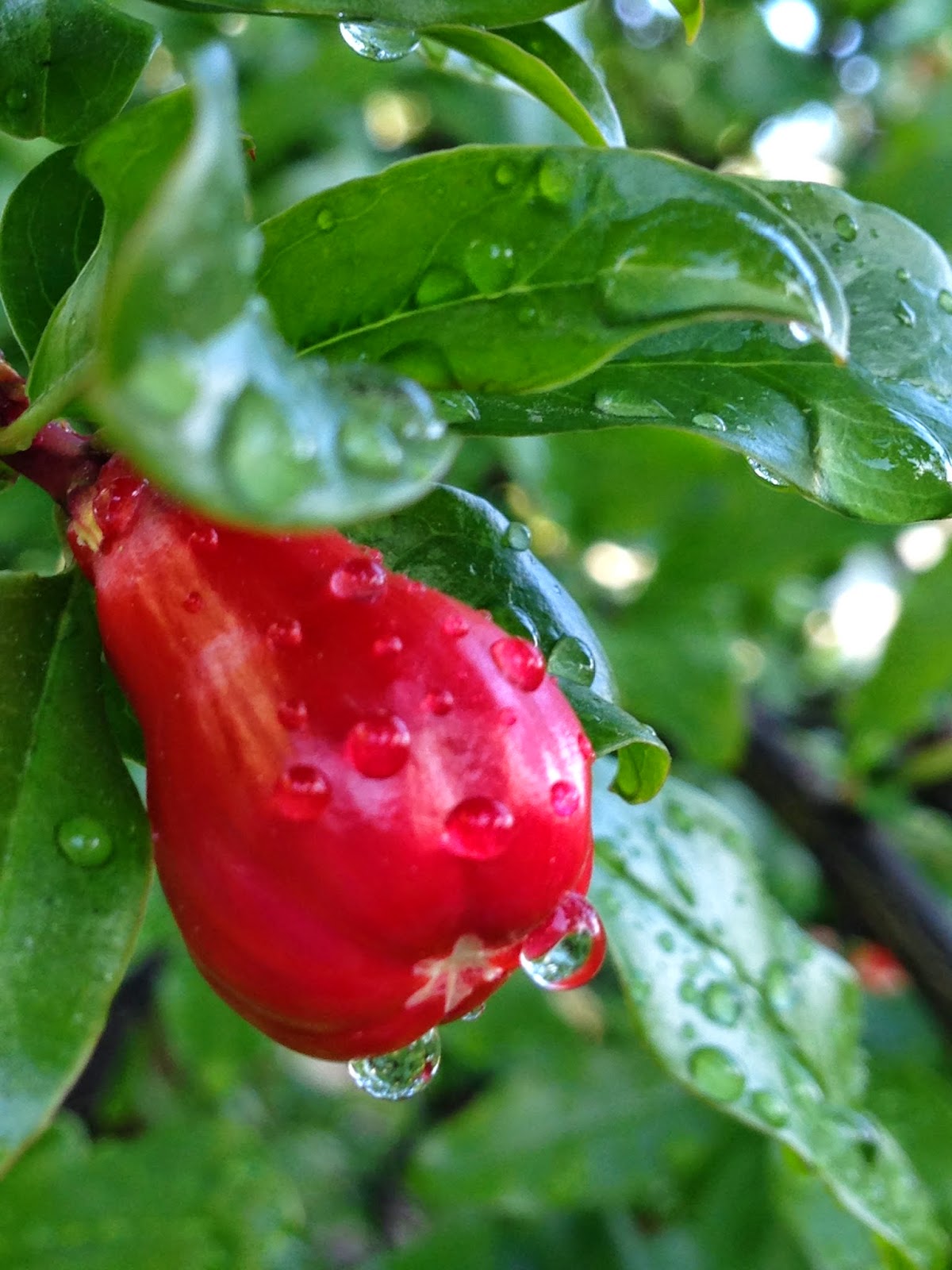
down. I call these my “freeway poetry.” I love my roses in my garden, I keep
photographing them. I’m fascinated with the veins on the petals, veins on the
leaves changing colors, shapes of river rocks. I even had a solo exhibition,
thanks to the courtesy of Susan Dobay. I write about roses as the symbol of the
core spiritual virtue in our lives: love in all of its incarnations. We do not
celebrate the Valentine’s Day in Poland (or did not when I was growing up
there, like there was no Halloween, but All Souls’ Day), but I wrote a series
of meditations on love for my blog, illustrated with poems from my two books of
love poetry, Miriam’s Iris, or Angels in the Garden and Rose Always –
A Court Love Story. Since both books
were so personal, I did not want any editors to mess with them, and formed my
own Moonrise Press in 2008. By now, the press issued seven books and keeps
going – Ed Rosenthal, the L.A.’s original “poet-broker” was the most recently
published, and Marlene Hitt, a witty and insightful poet from Sunland will be next.

Pulse of the Poet
KAW: You are a mother and also I know your professional work involves supporting and encouraging others to be creative. Can you elaborate, and show how this motivates and extends your creative work?
MT: I love being a part of the poetry community in California. In addition to being the core member of Poets on Site and Village Poets, I belong to the group of eight Westside Women Writers, so named by Millicent Borges Accardi, our fearless leader. I am active, sometimes, in the Southern California Haiku Study Group, and attend a variety of readings. My three children are scientists – Marcin graduated from USC with two computer science degrees and moved back to Poland, Ania is a chemical engineering and jazz singer, and Ian studies theoretical physics at UC Santa Barbara and has great hopes for the future. They are not into poetry and are not the subjects or recipients of my poems, except for a couple of educational ones, about virtues.
These particular poems have proven very useful for my “day job” as the Senior Director of Planning and Research for Phoenix Houses of California. I occasionally organize poetry readings at our various rehabilitation facilities, with residents reading their own poems about their lives and recovery. Poetry is a great tool for therapy. An unnamed trauma remains horrific, when you name and describe it, you put a limit to it, a border around it – you enclose it in words. That’s what I did after my parents were shot, I wrote about grief and loss. Many poems like that are not for publication during the poet’s lifetime. But you can sublimate the pain into art, and leave the details behind while capturing the essence…
For me it is that late
afternoon, with the last golden-red rays of sunlight, and the nostalgic mood of
the “waning of the day” – the farewell, the end of life, of time…. I talked about this and other issues in an
interview with Lois P. Jones on Poets’ Café, featuring “Tiger Nights”
inspired by a nightmare and a concert at the Hollywood Bowl. I wrote about the
impossibility of stopping time, in the “Easter Apocalypsis” and the “Three
Postcards from Paris ” (featured on Poetry L.A.) You have to capture the moment, enjoy the
here and now: like grains of sand, seconds and minutes slip through your
fingers. And poof! We are gone.

A SAMPLE POEM
Moon Reality
I watched the Moon around the House
Until upon a Pane –
She stopped –
~ Emily Dickinson
Long nets of power lines
Stretch out to catch the orange
Ball of the moon that falls, falls, falls
Down to the horizon
It bounces off the mountaintops
A bright white pancake
That floats in silver sky
Above the freeway turning home
What is real? What imagined?
We are caught in the electric net
Of our own devising
Hypnotized
We stare at moving electrons in a black box
We smile at pictures
Looking straight into the eyes on the screen
We practice witticisms on the keyboard
For all to see, no one to hear
Illusion of connection
The flat pancake of full moon
Slides along the taunt wires
Over purple hills, deserted streets
I am going home
To gaze at my pale moon of a screen
Read my personal invitation
To Atlantis

SELECTED POEMS AND LINKS
Illuminata:
A Box of Peaches:
The Four Quartets: http://www.davidgorman.com/4Quartets
T.S. Eliot reading the Four Quartets. https://www.youtube.com/watch?v=Ga8tQrG4ZSw
Slicing the Bread http://poetrylaurels.blogspot.com/2014/07/finishing-line-press-to-publish-slicing.html
PAHAnews.blogspot.com
Poets Café – http://www.timothy-green.org/blog/maja-trochimczyk/
Moonday Feature with three poems
Poetry LA reading of Three Postcards from Paris https://www.youtube.com/watch?v=cVgHby3aKJw
Easter Apocalypsis - http://www.thescreamonline.com/poetry/poetry7-4/trochimczyk.html