Thursday, November 5, 2015

Maria Szymanowska in Paris for the Third Time, November 25-27, 2015 (Vol. 6, No. 11)

Maria Szymanowska by Walenty Wankowicz, ca. 1825.
Collection of the Polish Library, Paris.

The 3rd International Symposium about the composer Maria Szymanowska (1789-1831) and her times will take place on 25-27 November 2015 at the Polish Academy of Sciences’ Paris Center (74, rue Lauriston, Paris 16e). The previous conferences took place in 2011 and 2014. This edition of the Szymanowska Symposium will be dedicated to "Talents of Women: The Borders between Myth and Reality."  We will focus on the question: "What do we know about the cultural heritage of women (“matrimoine” in French) of this epoch?"

Researchers and musicians from 10 European countries and the U.S. will be discussing the recent scholarly findings and the current state of knowledge about Szymanowska and other women of influence from her time period. A rich musical program of works composed by women will be presented. Singers will be accompanied on the period instrument, Johann Alois Graff pianoforte (1825). This concert, held on Wednesday, 25 November 2015, entitled “Fondness for music” will open the Szymanowska Symposium, filled with scholarly presentations and musical interludes. 


A historic Johann Alois Graff pianoforte from 1825, private collection of Bart van Oort.


The Director of the Paris Center of the Polish Academy of Sciences, Dr. Marek WIĘCKOWSKI will open the proceedings moderated by the President of the Maria Szymanowska Society, singer Elisabeth ZAPOLSKA-CHAPELLE. The participants include scholars from Poland, France, and the U.S.: Helen GEYER, Valérie COSSY, Maja TROCHIMCZYK, Françoise PITT-RIVERS, Jérôme DORIVAL, Jean-Marc WARSZAWSKI, Irena PONIATOWSKA,  Maria STOLARZEWICZ, Irène MINDER-JEANNERET. The music will be presented by Ms. ZAPOLSKA-CHAPELLE with pianist Bart VAN OORT, as well as an international group of pianists: Marcia HADJIMARKOS, Edoardo TORBIANELLI, Claudia Dafne SEVILLA CARRION, Francoise TILLARD,  Petra SOMLAI, Ekaterina GLAZOVSKAYA, and Iwo ZALUSKI. 

The 3rd International Maria Szymanowska Symposium  has been organized jointly by the Maria Szymanowska Society and the Polish Academy of Sciences’ Paris Center. The program is reproduced below (in French). For more information & reservations contact the Maria Szymanowska Society: societe.mariasz@laposte.net. 

3e Colloque international 

Maria Szymanowska (1789-1831) et son temps

Talents au féminin: Mythes et réalité

Sous le Haut Patronage de l’ Ambassadeur de Pologne en France Son Excellence Monsieur Andrzej Byrt
                                               
Paris, 25-27 Novembre 2015, Centre Scientifique de l’Académie Polonaise des Sciences, 74, rue Lauriston, Paris 16e
                                                                          
organisé par la Société Maria Szymanowska et le Centre Scientifique de l’Académie Polonaise des Sciences à Paris
__________________________

MERCREDI 25 Novembre - Wednesday, 25 November 2015
Opening Presentation
18h00    Allocution d’ouverture

Monsieur Marek WiĘckowski, Directeur du Centre Scientifique à Paris de l’Académie Polonaise des Sciences
Concert autour du piano Johann Alois Graff in Wien 1825 (collection Petra Somlai & Bart van Oort, Pays Bas)

Concert - Gourmandise de musique
Elisabeth zapolska, mezzo-soprano & Bart VAN OORT, piano
Annette von Droste-Hülshoff (1797-1848) / Johann Wolfgang Goethe
Lied des Harfners                                                                         
Maria Theresia von Paradis (1759-1824) / Johann Timoteus Hermes
Morgenlied eines armen Mannes                                              
Maria Szymanowska (1789-1831) / Louis-François Jauffret        
Complainte d’un aveugle qui demandait l’aumône au Jardin du Roi à Paris
Hortense de Beauharnais (1783 – 1837) / François Guillaume Ducray-Duminil
Romance                                                                                                       
Hélène de Montgeroult (1764-1836) / Metastasio
Nocturne N°6 à voix seule avec accompagnement de Piano Forte    
Isabelle de Charrière (1740-1805) / Le Comte de St-Méran
Air avec accompagnement de Clavecin                                                                 
Maria Szymanowska (1789-1831) / Madame de Saint-Onge
Ballade                                                                                                         
Louise Reichardt (1779-1826) / Philipp Otto Runge
Die Blume der Blumen                                                                                              
Louise Reichardt (1779-1826) / Ludwig Tieck
Genoveva                                                                                                      
Sophie Gail (1775-1819) / Anonyme
N’est-ce pas [d’] elle                                                                          
Bolleros                                                                                                                                      
Maria Szymanowska (1789-1831) / Cervantes, trad.Florian
Le Départ                                                                                                     
Fanny Hensel née Mendelssohn (1809-1847) / Johann Wolfgang Goethe
Harfners Lied                                                                                               
Über allen Gipfeln ist Ruh                                                          
BART VAN OORT, piano             
Maria Szymanowska (1789-1831)
Romance du Prince Galitzine                                                                                   
Hélène de Montgeroult (1764-1836)
4e Sonate, en sol mineur                                                                                           
Allegro con molto espressione (1er mouvement)                                   
MARCIA HADJIMARKOS, piano
Maria Szymanowska (1789-1831)
Menuet N°4  en sol mineur : Vivace                                                                        
Polonaise en fa mineur                                                                              
EDOARDO TORBIANELLI, piano                            
Caroline Boissier-Butini (1786-1836)
1ère sonate : Allegro (1er mouvement)                                                                    
Variations sur deux airs languedociens : 
Introduction-Lento-Andante-Andante-Presto
Claudia dafne sevilla carrion,  piano
Hélène de Montgeroult (1764-1836)
Etude N°113                                                                                                
Maria Szymanowska (1789-1831)
Nocturne en si bémol majeur       
FRANçOISE TILLARD, piano
Fanny Hensel née Mendelssohn (1809-1847)
Lied pour piano en mi bémol  majeur : Andante espressivo - Più Allegro - Tempo primo
Lied op. 4 n°2 en do dièse mineur                                                            
Lied op. 6 n°4 en la mineur Il Saltarello romano                                                 
PETRA SOMLAI, piano
Clara Schumann (1819-1896) - Soirées Musicales op. 6
N° 2 : Nocturne en fa majeur                                                                                    
N° 3 : Mazurka en sol mineur                                                                                  
N° 5 : Mazurka en sol majeur                                                                                  
PETRA SOMLAI & BART VAN OORT, piano
Maria Szymanowska (1789-1831)
Nocturne Le Murmure, version à 3 mains                
20h00    Cocktail d’inauguration
Participants of the 2014 Szymanowska Symposium, Prof.  Halina Goldberg at the Piano.


JEUDI 26 Novembre - Thursday, 26 November 2015   
Scholarly  Papers with Musical Interludes    
10h15    Accueil des intervenants par la modératrice du Colloque
               Elisabeth ZAPOLSKA-CHAPELLE
10h30    Helen GEYER     
               The four women conservatories of  Venice : models of  life, rivalry and outstanding examples of quality                
11h15    Valérie COSSY
               Du "talent" pour demoiselle à l'expression de soi : la musique selon Isabelle de Charrière et Jane Austen
                              p a u s e  d é j e u n e r
14h00    Première madeleine musicale - par Marcia Hadjimarkos, piano
14h30    Maja TROCHIMCZYK
               Szymanowska in the Circle of Duchess Maria Czartoryska de Wittemberg
15h15    Françoise PITT-RIVERS
               Madame Vigée Le Brun, Angelica Kauffmann, deux peintres  musiciennes
               pause café
16h15    Jérôme DORIVAL                            
               Influence d’Hélène de Montgeroult sur la génération romantique
               avec l’aimable participation de Marcia Hadjimarkos, piano


Participants of the 2014 Szymanowska Symposium


VENDREDI 27 Novembre -  Friday, 27 November 2015.  


Scholarly  Papers with Musical Interludes  

10h15    Jean-Marc WARSZAWSKI
               Musiciennes au temps de Maria Szymanowska : un contrepoint  d’inégalités et de préjugés
11h00    Deuxième madeleine musicale – par Claudia Dafne Sevilla Carrion, piano           
11h10    Irena PONIATOWSKA                   
               Etudes  et  Préludes  de Maria Szymanowska : leur apport dans l'art pianistique européen des premières décennies du XIXe siècle
11h50    Troisième madeleine musicale – par Ekaterina Glazovskaya, piano                         
               p a u s e  d é j e u n e r
14h00    Quatrième madeleine musicale – par Iwo ZALUSKI, piano
14h15    Maria STOLARZEWICZ
               History of a musical friendship : Michał Kleofas Oginski & Maria Szymanowska
15h00    Irène MINDER-JEANNERET
               Entre cosmopolitisme et patriotisme : les « airs nationaux »  dans les compositions de Caroline Boissier-Butini (1786-1836)
15h30    Cinquième madeleine musicale – par Edoardo Torbianelli, piano                            
               pause
17h00    Salon musical de clôture  -Invite à la danse

18h00    Cocktail de clôture


Participants of the 2014 Szymanowska Symposium, PAS Paris. 


Thursday, October 29, 2015

Chopin Monuments Around the World II - Poland, Ukraine, France and England (Vol. 6, No. 10)

In a continued Tour of Chopin Monuments Around the World that started in Warsaw a month ago, we visit other Polish cities and locations where Chopin monuments may be found. 

From Warsaw we go to Chopin's birthplace in Zelazowa Wola, to Szafarnia Manor and Park, where he spend his summer vacations, and to a Wroclaw, where he stopped on the way somewhere else.  Then, we go to Paris, England, and Ukraine...

ZELAZOWA WOLA, CHOPIN'S BIRTHPLACE, POLAND


The small manor, with a typical Polish sloping roof, six-paned  window, and entrance way framed by white columns, is a well known Chopin landmark. This is where Fryderyk Franciszek Chopin was born on March 1, 1810 (as celebrated by the composer and his family), though the birth was recorded in the parish registry as having happened on February 22, 1810 (this date was favored by some of Chopin aficionados from around the world)... His father, Nicolas Chopin, born in the area of Lorraine, France, came to Poland and since 1802 worked as a tutor for the four children of Count Skarbek. The eldest son, Fryderyk Skarbek was to be the God-father to the child, named after him... Now, we only hear about the younger or the older Counts Skarbek because of their connection to Chopin, not the other way around. The mother, Justyna Krzyzanowska was a poor relation and housekeeper for the Skarbek family, and, no doubt, cherished the moment of moving out of their manor to the new family's cottage after the wedding of 1806. 

Today, Chopin recitals are held outdoors all summer and tour buses stop by regularly.  There are portraits, pianos, and furnishings indoors, and a beautiful park to walk through... Not everyone is aware that that park features a Chopin Monument. After visiting it numerous times and attending many concerts, I have never noticed its presence and only discovered this monument on the Internet! 

Chopin Monument in Zelazowa Wola. Photo from Wikipedia.

Sculpted by Józef Gosławski in 1955,  the monument was unveiled in 1969  in Żelazowa Wola, Poland. The mature pianist, dressed in a coat and an evening suit with a huge bowtie seems ready to leave his homeland forever. The pianist's beautiful hands are featured prominently holding the folds of the coat. Chopin looks away, is turned inward, lost in reflection and sorrow. The last step before leaving forever...  Hidden among trees and bushes of  the park, this sculpture deserves to be better known.


Another view of the monument in its park setting. Photo from Wikipedia, by Adam Rudzki

SZAFARNIA PALACE NEAR TORUN

There is a monument to Chopin at the Szafarnia Palace where he stayed for holidays with a school friend in 1824 and 1825. Then, owned by Julian Dziewanowski, the father of Chopin's friend Dominik ("Domus"), and located near Torun in central Poland, the house and grounds provided the young composer with healthy diversions and many opportunities to encounter Polish folk dances and music. The Chopin bust is placed at the entrance to the Szafarnia Palace, now a Center of Chopin Studies. The setting is very interesting, with the sidewalk paved to represent a curved keyboard. 

Chopin Monument in Szafarnia. Photo from Google Maps, 2014.

Chopin Monument in Szafarnia. Photo from NIFC website.

The romantic portrait of a "genius composer" with windswept hair requires no further comments. . . But we are delighted to note the presence of a large "basetla" - a string bass string used in folk ensembles, "kapela" that played the obereks, mazurkas, and kujawiaks that so impressed the young composer. During the summer of 1825, he actually had a chance to play the instrument during the Harvest Festival held at Szafarnia, after the procession of the villagers reached the manor, and other elements of the festival have concluded, with singing, dancing, gift presentation and games... This is how Chopin described this monumental occasion in a letter to his parents in Warsaw, dated August 26, 1825:

Już była prawie 11-nasta, gdy Frycowa basetlę przynosi, gorszą od skrzypcy, o jednej tylko stronie. Dorwawszy się zakurzonego smyka jak zacznę bassować, takiem tęgo dudlił, że się wszyscy zlecieli patrzeć na dwóch Fryców, jednego śpiący na skrzypkach, drugiego na jednostronnej, monokordycznej, zakurzonej [...] rzępolącego basetli,

"It was almost elevent when the wife of Fryc brings a basetla (string bass) worse than the violin (fiddle), and with only one string. After grabbing the dusty bow, I started playing the bass with such fervor, I made noise with such intensity that everyone came up to see the two Fryces (Fryderyk's nickname), one sleeping on the violin, the other on the one-stringed, monochordial, dusty and noisy basetla..."

Sculpture from Szafarnia Park. Photo from Google Maps. October 2013.


WROCLAW, POLAND


Chopin did not stay in the City of Wroclaw for an extended period, but traveled through it four times when going to the cure in the spa of Duszniki (then: Reinhert).  In a letter from the summer of 1826, to his friend Wilhelm Kolberg, he described the route in the following words:
Kochany Wilusiu! Przejechawszy Błonie, Sochaczew, Łowicz, Kutno, Kłodawę, Koło, Turek, Kalisz, Ostrów, Międzybórz, Oleśnicę, Wrocław, Nimsch, Frankenstein, Wartę i Glatz, stanęliśmy w Reinertz, gdzie dotąd stojemy. — Dwa tygodnie już piję serwatkę i wody tutejsze; i niby, jak mówią, mam trochę lepiej wyglądać, mam niby tyć, a tym samym lenieć...
"My dear Wilus! After having traveled through   Błonie, Sochaczew, Łowicz, Kutno, Kłodawa, Koło, Turek, Kalisz, Ostrów, Międzybórz, Oleśnica, Wrocław (then: Breslau), Nimsch, Frankenstein, Warta and Glatz, we stopped in Reintertz, where we are staying now.  For two weeks already I have been drinking whey and the local waters, and as they say, I am supposed to look better, and I'm supposed to gain weight, and at the same time become more lazy..."

Chopin Monument in Southern Park in Wrocław, Poland. Wikipedia.

Four years later, we find Chopin in Wroclaw again, this time visiting the city itself, staying in an inn, attending a performance (as described on the NIFC website): "Only in November 1830 did he stay in the city for a longer time. On that occasion, he and Tytus Woyciechowski stayed at the Zur Goldenen Gans [The golden goose] inn on Junkernstrasse (now Ofiar Oświęcimskich street). In the evening of their arrival they went to the Municipal Theatre on Taschenstrasse (now at the junction of Oławska and Piotra Skargi street) for a performance of Raimund's Der Alpenkönig und der Menschenfeind."

The composer described his impromptu performance Wrocław in a letter written on 9 November 1830:

"I found there a small, as usual, orchestra that had turned up for the rehearsal, a piano and some referendary, an amateur, by the name of Hellwig, preparing to play the First Concerto in E flat major by Moscheles. Before he sat down at the instrument, Schnabel, who had not heard me for four years, asked me to try out the piano. It was difficult to refuse, so I sat down and played a couple of variations. Schnabel was infinitely pleased, Mr Hellwig got cold feet, and others began to request that I perform in the evening. More particularly, Schnabel so kindly insisted that I couldn't dare refuse the old gentleman. He's a great friend of Mr Elsner's; but I told him that I'd do it just for him, since neither had I played for a couple of weeks, nor was I intending to show off in Wrocław. To that the old man said that he knew all of this and that he had wanted to ask me yesterday in the church, but was too embarrassed. Then I went with his son to get some music and played them the Romance and Rondo from the Second Concerto."

The monument captures the composer resting in an armchair, with eyes closed, listening to the music, maybe, during that rehearsal... As elegant as every, he seems much taller and more imposing than in real life. That's what monuments do: monumentalize their subjects! 
Photo from NIFC website.

KIEV, UKRAINE 

It is perhaps due to the unwillingness of sculptors to compete with the epic monument by Szymanowski, located in the Lazienki Park in Warsaw, that so many Polish sculptures in Poland are of his head, or bust, or, if full-scale figures present the piano-less composer ready to leave his country, or resting, listening to music....

The new Chopin monument in Kiev, Ukraine, follows another path: it is a "Chopin-less" white piano, filled with flowers, and standing on a sidewalk with one leg planted in the grass. I am not sure whether this moument is a permanent sculpture or a temporary installation. But I'm sure it is quite cute and does attract the attention of passers-by...  There were no Chopin visits, letters, or historical occasions to commemorate. There was and is only music...

This photo of Chopin Monument is courtesy of TripAdvisor
Kyiv: "A Piano in the Bush" - Chopin Monument (Cora_v, Jun 2014)

PARIS, FRANCE


Chopin's tombstone in the Père Lachaise Cemetery, Paris, featuring the muse of music, Euterpe, weeping over a broken lyre, was designed and sculpted by Auguste Clésinger, the husband of Solange Dudevant, daughter of George Sand (Baroness Aurore Dudevant), Chopin's lover.  Visitors keep leaving mementos and the tomb is among the four most often visited tombs in the entire cemetery, sharing the honors with Jim Morrison, Oskar Wilde, and Edith Piaf.... Bellini or Rossini, in contrast, are forgotten. Such is the power of the personal, intimate language of Chopin's music that speaks directly to the heart...


There is no end to the supply of fresh flowers, mementos and gifts, that include piano keys, candles, poems, and books... The tombstone features a portrait of Chopin seen from the side; this cameo-like profile places Chopin in the domain of the "immortals." Yet, the bouquets of roses, carnations and other flowers are checked and changed daily. The vases are provided by a local Polish committee and the tombstone is appropriately decorated with red-and-white Polish colored ribbons and flags. 

I leave a copy of Chopin with Cherries at the Chopin Tombstone in Paris.

Here is a selection of poems from Chopin with Cherries, reprinted by the Cosmopolitan Review.  Elizabeth Murawski wrote about visiting Chopin museum and seeing the memorabilia kept there, so let us cite her poem:

Polonaise
By Elisabeth Murawski


In the museum, along
with first editions,
the death mask, the chair

whose arms he gripped
in coughing fits,
a lock of yellow hair.

Was it Sand who clipped it
for a keepsake? She
who whispered

Let me be your lightning rod
as Chopin played
for her ears only,

courting the angels,
stealing the shine
from the Seine. Think

of his wish (a drastic
death certificate)
to have his body opened

that I not be buried alive,
of his heart taken home
to a Warsaw church,

of the grave in Père Lachaise
brilliant with roses
and candles, baskets

laden with fruit, of notes
plucked from his roots

that go on singing.

(c) 2010 by Elizabeth Murawski

For those who would like to read more Chopin poems, the entire anthology is recommended.  

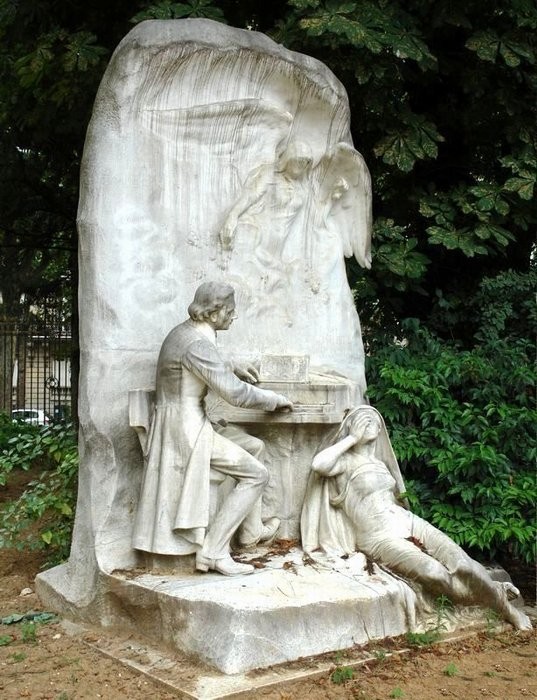
Fifty years later, at the height of fin-de-siecle expressive and decorative style of art nouveau, another portrait of Chopin was made and built in Paris in 1906. Jacques Froment-Meurice designed a scene with the elegant Chopin at the piano. The sculpture brings music to life, with an angel floating above the keyboard, and a female figure reclining at the feet of the pianist, lost to the world in rapture... This fascinating sculpture, an essay about the meaning of the music may be found at Parc Monceau - in the 8th arrondissement, at the junction of Boulevard de Courcelles, Rue de Prony and Rue Georges Berger (35 Boulevard de Courcelles, 75008 Paris).


LONDON, U.K.

While the images of Chopin in France are either romantic or post-romantic, and very expressive in their flowing lines, sorrow, and intensity of music-induced ecstasy, the two sculptures found in the United Kingdom are stark and modern. In one, Chopin is sliced into an abstract figure of many layers, in another, his piano is transformed into a sled, taking off on a cosmic flight...


According to information I found on the website of the Polish Heritage Society in London, "The statue, a gift of the Polish people to the British nation for its help in fighting Nazi tyranny and originally erected on this site in 1975, was restored by the Polish Heritage Society and unveiled on 18th May 2011 by HRH the Duke of Gloucester in the presence of The Ambassador of the Republic of Poland to the United Kingdom, Her Excellency Ms Barbara Tuge-Erecińska."

Furthermore, the report continues: "Chinese pianist Lang Lang laid flowers at the newly-unveiled statue of Fryderyk Chopin, on Sunday 22nd May, outside London’s Royal Festival Hall at the Southbank Centre to pay his respects to the Polish composer he describes as the 'perfect balance between romantic and classic'."

Nice, very nice...

MANCHESTER, U.K.


The top prize for the strangest Chopin monument visited so far goes to... the Sobocinski's sculpture built in 2011 in Manchester, U.K. According to a report in the Pianist Magazine

"Commissioned by The Chopin Memorial Monument Committee and The Polish Consulate, with Bruntwood as principal sponsor, the impressive monument marks the culmination of the celebrations of the bicentenary of Chopin’s birth. The creation of Polish sculptor Robert Sobocinski, the sculpture is a fitting tribute to the composer’s genius and marks the occasion when he performed in Manchester in 1848, shortly before his death. The work depicts Chopin at the piano gazing across at his muse Baroness Aurore Lucile Dupon. Carved into the work is an eagle in flight – the symbol of Poland for over one thousand years and a battle scene symbolising the Polish fight for freedom. The monument measures 4 metres high and 2.5 metres wide and is set on a sandstone plinth."

According to a blogger Chrissy Brand, "this recently unveiled monument of Fryderyk Chopin stands in Deansgate at the edge of the city centre's main shopping district.  It marks the occasion when the Polish genius performed in Manchester in August 1848 at the Gentleman's Concert Hall, despite his failing health. Chopin died not long afterwards aged 39."

Well, what can we say after that? The piano as the sled, the muse sitting at one of the ski-like appendages? The flags and national emblems waving on the other side? There is such a thing as an artistic overkill - too much food will make your sick, too much symbolism will make you dizzy.  However, strange, it is better to have this monument up in the streets of Manchester, than not to have one at all.  And even that female figure sitting at the bottom, below the body of the instrument has a historical justification: this is how George Sand loved to listen to Chopin playing the piano in Nohant: by lying down under the instrument, awash in waves of sound...


Monday, October 19, 2015

The 17th International Chopin Competition in Warsaw - Finalists and Awards (Vol. 6, No. 9)

The 17th Chopin Competition is now taking place in Warsaw, Poland.  The jury, led by Prof. Prof. Katarzyna Popowa-Zydroń , has announced the names of the ten Finalists on October 16, 2015.

Since October 18, the finalists appear before the jury, and the performances ended on October 20, 2015.  The finalists represent eight countries: two are from Canada, two from United States, and one each from Croatia, Japan, Latvia, Poland, Russia, and South Korea.

  • Mr Seong-Jin Cho (South Korea)
  • Mr Aljoša Jurinić (Croatia)
  • Ms Aimi Kobayashi (Japan)
  • Ms Kate Liu (United States)
  • Mr Eric Lu (United States)
  • Mr Szymon Nehring (Poland)
  • Mr Georgijs Osokins (Latvia)
  • Mr Charles Richard-Hamelin (Canada)
  • Mr Dmitry Shishkin (Russia)
  • Mr Yike (Tony) Yang (Canada)
The finalists performed one of Chopin's Piano Concerti, either the Concerto in E minor, Op. 11 or the Concerto in F minor, Op. 21. They were accompanied by the Symphony Orchestra of the Warsaw Philharmonic conducted by Maestro Jacek Kaspszyk. The names of the Competition’s laureates were announced on October 20, 2015:

  1. First Prize Winner: Seong-Jin Cho (South Korea), also Chopin Society Prize for Best Performance of a Polonaise
  2. Second Prize Winner: Charles Richard-Hamelin (Canada), also Krystian Zimmerman Prize for Best Performance of a Sonata
  3. Third Prize Winner:  Kate Liu (U.S.), also Polish Radio Prize for Best Performance of Mazurkas
  4. Fourth Prize Winner: Eric Lu (U.S.)
  5. Fifth Prize Winner: Tony Yike Yang (Canada)
  6. Sixth Prize Winner: Dmitry Shishkin (Russia)

Among Polish pianists, Szymon Nehring was the audience's favorite, and received a Distinction prize (also awarded to the remaining finalists).  Krzysztof Ksiazek did not qualify to the finals, but received Prof. Drzewiecki Prize for the Best Polish Participant.

The 2015 Chopin Competition Jury consisted of the following pianists and scholars:
  1. Dmitri Alekseev (Russia, b. 1947)
  2. Martha Argerich (Argentina, winner of the 7th Chopin Competition, 1965; b. 1941)
  3. Akiko Ebi (Japan and France, fifth prize winner in the 10th Chopin Competition, 1980, b. 1953)
  4. Philippe Entremont (France, pianist and conductor, b. 1934)
  5. Nelson Goerner (Argentina, b. 1969)
  6. Adam Harasiewicz (Poland, winner of the 5th Chopin Competition, 1955; b. 1932)
  7. Andrzej Jasinski (Poland,  b. 1936)
  8. Yundi Li (China, winner of the 14th Chopin Competition, 2000, b. 1982)
  9. Garrick Ohlsson  (USA, winner of the 8th Chopin Competition, 1970, b. 1948)
  10. Janusz Olejniczak (Poland, sixth prize winner in the 8th Chopin Competition, 1970, b. 1952)
  11. Piotr Paleczny (Poland, third prize winner in the 8th Chopin Competition, 1970, b. 1946)
  12. Ewa Poblocka (Poland, fifth prize winner in the 10th Chopin Competition, 1980, b. 
  13. Katarzyna Popowa-Zydron (Poland, honorable mention in the 9th Chopin Competition, 1975, b. 1948; Chairperson of the Jury)
  14. John Rink (U.K., musicologist)
  15. Wojciech Switala (Poland, winner of the prize for Polonaise performance, 12th Chopin Competition, 1990; b. 1967)
  16. Dang Thai Son (Vietnam, winner of the 10th Chopin Competition, 1980, b. 1958)
  17. Dina Yoffe (Latvia- Russia, second prize winner of the 9th Chopin Competition, 1975) 
Current information, video recordings of the auditions and concerts may be found posted on the Competition's website: http://chopincompetition2015.com/.


Tuesday, September 15, 2015

Eric Lu Plays Chopin, Chopin, Chopin....in South Pasadena (Vol. 6, No. 8)

Eric Lu, Photo by Maja Trochimczyk

It is such a pleasure to discover a new talent, a new way of hearing and interpreting Chopin's music. We have had this delightful opportunity during the all-Chopin concert by a young American pianist, Eric Lu, at the South Pasadena Library on August 30, 2015.

Mr. Lu, born in 1997 (gasp! he is merely 18!) has recently won the first prize and the concerto prize at the 9th National Chopin Competition in Miami, organized by the Chopin Foundation of the United States.  In August 2014, he won the first prize at the 9th Moscow International Chopin Competition for Young Pianists. A long list of his competition victories includes also the Minnesota International e-Piano Junior Competition in 2013 and the 12th Ettlingen International Piano Competition in Germany in 2010 (where he was "praised for a musical understanding far beyond his years").  He has also won awards at the Junior Academy Eppan in Italy, and performed in Germany, Italy, China, the U.S. (Boston, Philadelphia, Minneapolis, Birmingham, and more).  He started piano lessons at the age of six (Ms. Dorothy Shi). At the New England Conservatory Preparatory School he was a student of Alexander Korsantia and Mr. A. Ramon Rivera. In 2013 he enrolled at the Curtis Institute of Music in Philadelphia, where he currently studies with Jonathan Biss and Robert McDonald, while also studying with the famous Chopin Piano Competition winner in Warsaw, Dang Thai Son.

Lu's hands, Photo by Maja Trochimczyk

In accordance with its title, Chopin, Chopin, Chopin... Lu's recital featured only one non-Chopin work, an Impromptu by Franz Schubert, brilliantly played in its shimmering tranquility, an oasis of calm under the fingers of the master.  The contrast of the youthful appearance of the 18-years-old pianist and his musical maturity and technical prowess was one of the most striking characteristics of the entire recital. If you closed your eyes, and forgot that the pianist is this thin, tall boy in an elegant evening suit, with meticulously arranged white shirt cuffs  (a whiff of Chopin's dandy-ism and his focus on elegant attire could be felt here), you were transported to a grand 19th century concert hall, to listen to one of the grand, truly grand masters.  And I do not mean here, that his performance was somehow antiquated and old-fashioned. Not at all.

What I found most extraordinary alluring, was the full emotional span, intensity of expression, diversity of touch, richness of instrumental color, and perfectly crafted large-scale forms.  Of course, keyboard virtuosity... Asked later, what is the most remarkable characteristic of Chopin's music in his eyes, maybe his favorite, or the hardest or the easiest piece to play, he answered: "Everything is difficult. Chopin is unbelievably difficult, with the complexity of rhythms, internal polyphonies and intertwined melodies, that sing under the fingers, but especially the touch, the infinite variations of sound tone created through touch."

Polish Consul Ignacy Zarski welcomes guests and introduces the program.
Photo by Maja Trochimczyk. 

The first half of the program revealed Lu's scope of virtuosic technique, expressive range, and musicality.  How do you convey in music the depth of emotion? By subtle variations in tempo, dynamic, and rhythmic flexibility of motives and phrases, the flexibility known in Chopin's music as "tempo rubato" the "stolen time" - where one hand maintains a rhythm while the other "steals" microseconds and seconds from notes to add them to other notes and thus shift focus, create emotional arches, a play of expectations and resolutions.

The first piece on the program, Barcarole in F-sharp Major, Op. 60, composed in 1845/6 is the perennial favorite among Chopin's works for many pianists, especially outside of Poland. Its undulating rhythm captures the swaying of a Venetian gondola on the water, while an enchanting melody soars above, in the stratosphere of strange harmonies, embroidered figurations, and a mood of sublime tranquility, coupled with a "slightly wistful tone." For a pianist, whose task is to take his listeners into musical trance, the technical difficulties are formidable - parallel thirds and sixth in the right hand with long stretches of music flowing like water in the left. There are moments towards the end of the Barcarole, of harmonic uncertainties and moonlight beam ornaments, that give me shivers every time they are played right - truly otherworldly. Time shifts to a different dimension, it is raised to a power of two, could say composer Hanna Kulenty, who made construction of such times and trances, the crux of her compositional technique. But Chopin knew it too, and let us glimpse at this enchanted sonorous moonscape that Lu evoked so well.

Stylish auditorium at South Pasadena Library. Photo by Christopher Onzol

"So far, so good," I sighed getting ready for the series of Mazurkas from Op. 59 - No. 1 in A Minor, No. 2 in A-flat Major, and No. 3 in F-sharp Minor. Known for their capacity to embody the emotional category of "nostalgia" or, in Polish, "żal"- this nameless, wordless sorrow of having lost something one may never find again, the Mazurkas are also stylized national dances, from the slowest kujawiak to the fastest oberek. The three late Mazurkas Op. 59, composed in 1845, dwell in the middle of the tempo range and brilliantly portray the "sweetest sorrow" of a lost country, imagined in the beauty of its rural summers and dancing nights. Polish pianist Ludwik Bronarski, noted in the first Mazurka, in A Minor, the presence of "the most beautiful sounds that it is possible to produce from the piano." Indeed, the sounds created under Eric Lu's fingers were truly enchanting, even if the piano itself left something to be desired, providing to the disposal of the sublime virtuoso somewhat uneven and even slightly mistuned sonorities.

No matter. The second Mazurka, known for its tone of a ballade and moments of nearly heroic mood, coupled with incomparable sweetness, and folksy accompaniment patterns, straight from the dance floor of the Polish national mazur had its manuscript sent to Chopin's friend, Felix Mendelssohn-Bartholdy. The third Mazurka beautifully rounds up the set and pulls the listener into a summer evening mazur dance, with "its sweeping, unconstrained gestures, its verve, élan, exuberance, and also, more importantly, the occasional suppressing of that vigour and momentum, in order to yield up music that is tender, subtle, delicate" - as stated noted Chopin expert, Mieczyslaw Tomaszewski. Each Mazurka is different, and Eric Lu found in each diverse sonic and emotional treasures.

I'm starting to yield to a tendency to overuse such words as "delightful," "incomparable," and "exquisite" and veering into purple prose in a description of Lu's performance, for which I apologize in advance, but it is hard to avoid expressing delight after a concert that delightful. Here I go again...

Eric Lu performs. Photo by Krzysztof Onzol.

Mr. Lu followed the Mazurkas Op. 59 (that were composed in 1845 at the same time as the Barcarole and thus shared with the larger masterpiece some structural, textural and thematic ideas), with a sweet interlude in the form of the Waltz in A-flat Major, Op. 42. Written about five years before the Mazurkas (ca. 1839-40), the Waltz has been called a "dance poem" with its five distinct intertwined themes contrasting in their use of trills, figurations, and continuous, expressive melodies.

The first part of the recital ended with one of the best known Chopin's compositions, the Ballade No. 4 in F minor, Op. 52 (composed in 1842 in Paris and Nohant) and dedicated to Baroness Charlotte de Rotschild. A whole library of books and essays has been written about this monumental Ballade, that begins with delicate "bell"-like sonorities, to evolve into dramatic, and even, heroic arches and avalanches of sound.  Many commentators felt a compulsion to discover a hidden plot - a poetic ballade by Adam Mickiewicz, perhaps - underneath the masterly construction built from a mosaic of tones. Prof. Tomaszewski dismisses these efforts with by emphasizing that "the music of this Ballade imitates nothing, illustrates nothing. It expresses a world that is experienced and represents a world that is possible, ideal and imagined."

And much was possible in the interpretation of the Ballade by Eric Lu. Here his ability to construct large-scale forms, develop and intertwine themes, pull the listeners into a narrative that is at times melancholy, at times sorrowful, at times dramatic and turbulent, but ends in a tranquility of a reconciliation. No wonder, the citations for Lu's awards so often speak of a maturity far above his years. I admired, in this piece particularly, his ability to contrast and stretch tempi, his use of tempo rubato, accelerandos, and ritardandos, and his ability to maintain the sense of a continuous narrative, of a musical whole.

He received a standing ovation at the end of this performance, a well deserved accolade... What would be life worth, if we did not have these sunny summer afternoons when music speaks to us so eloquently and touches us so deeply?

After the concert, I asked Eric what he loved the most about Chopin, what was the trait that he cherished above all others. His response - like his interpretations - was unexpectedly mature. "Chopin's intimate, personal voice" - he said - "his music speaks to all of his listeners directly, as if each person was the only one, as if each was alone - immersed in, surrounded by the music. This delicate, wise, intimate and individual voice is the greatest asset of Chopin's music that carries it over the ages."  I had to agree, as I have seen in countless YouTube comments of very young listeners who admit that they "love this song" and rhapsodize about how it perfectly captures their uncontrollable emotions, that they cannot even name.

Intermission: Consul Ignacy Zarski, Maja Trochimczyk, Marzena Wisniewska (Polam), 
Maria Kubal (Modjeska Club). Photo by Christopher Onzol.

Two Presidents and a Star: Elizabeth Kanski (President of Polish-American Film Society) with
Linda Plochocki (President of the Modjeska Foundation of Orange County) with Jane Kaczmarek.
Photo by Maja Trochimczyk.

After the intermission, the summer sun outside barely started to fade when we were immersed in the moonlight of the Nocturne in D-flat Major, Op. 27, No. 2, also of a peculiar "ballade-like" quality.  This prepared us to the wild ride and exorbitant beauties of the entire cycle of 24 Preludes, Op. 28. Composed between 1835 and 1839, partly in Paris, and partly at Valldemosa, Majorca where Chopin spent the winter of 1839 with George Sand and her children, the cycle was inspired by Johann Sebastian Bach's Das Wohl-Temperierte Klavier (The Wel-Tempered Clavier), cycle of preludes and fugues.  The Preludes Op. 28 traverse the entire range of tonalities and harmonies, starting from C Major and visiting each of the keys possible on the piano for a brief sojourn and a vista of an entirely different musical climate. The cycle was compared to a mosaic a la sonata form, and to a grand narrative.

Photo by Christopher Onzol

Over the centuries, some individual preludes received nicknames, like the "Raindrop" that everyone knows about and almost everyone heard played, if not on the concert stage, at least in the movies (Prelude in D-flat Major, No. 15). This prelude is a rare example of Chopin himself giving a programmatic title to his composition: with a handwritten note in a sheet music belonging to one of his students, not in the actual publication.  While being so well known, this prelude's potential impact borders on boredom: we have heard it soo many times... But we never heard it played as Eric Lu interpreted it, and that is the difference. I was entirely enchanted by Lu's ability to create a portrayal of exquisite tranquility dissolving into equally exquisite sorrow in the infinitely quiet return of the theme after the tempestous middle part of the Prelude. I think that his use of dynamic shadings, precise articulation and delineation of phrases, fluid "tempo rubato" and the previously mentioned caressing "touch" had a lot to do with the unforgettable uniqueness of Lu's interpretation.

The cycle op. 28 contains many extremely difficult, dramatic and fast preludes, overflowing with passages of heavy, parallel chords thundering up and down the keyboard. In-between are moments of tranquility, funereal sadness, or whimsy. Mr. Lu exposed the raw richness of emotions, textures, and expressions contained in the whole cycle. In addition to the Raindrop - that I have never heard played so well before, and I heard it almost too many times... (and I played it myself, for my own edification), I would like to single out for praise his interpretations of the charmingly capricious Prelude G Major (No. 3), the extreme brevity of moto perpetuo in D Major (No. 5), the wild and eerie sonorities of the ghostly dark Prelude in E-flat Minor (No. 14)... so well contrasted with the following melancholy serenity of the Raindrop...

These numbers and descriptions could be multiplied, as the pianist took his audience on the trip of their lifetime.  However, all journeys come to a close and our Chopin journey ended, too.

While sad to let the pianist go, we were grateful for his revelatory "other" side - the Schubert Impromptu played as an encore - or rather, an extensive, wise, virtuosic, and expressive musical farewell, that dissolved into silence thus giving the listeners something to think about, instead of making them jump to their feet in a standing ovation after a thundering cadential passage. The enthusiastic applause continued for a while after the pianist left. More, more, more - and no doubt, there will be more, as Mr. Lu will continue his musical explorations and enchantments. We will be delighted to follow the career of this young contender in the 2015 International Chopin Competition in Warsaw, where he will encounter and compete with other precocious, brilliant talents.

Entrance to the Auditorium in South Pasadena. Photo by Maja Trochimczyk 

Eric Lu's Pasadena concert was organized by the Southwest Council of the Chopin Foundation of the United States, established in 2014, and dedicated to the support the young generation of American pianists, pursuing their studies and careers in the realm of classical piano. The Council focuses on the historical significance, creative implications, and a place in modern society for the music of Fryderyk Chopin and will organize concerts, recitals and competitions to spread the knowledge of classical music and Chopin,  in particular. President Christopher Onzol was joined by the creme-de-creme of California Polish-American society, including Consul for Cultural Heritage and Polonia, Hon. Ignacy Zarski, that started the event with an inspirational speech about Chopin's place in our lives and hearts, Artistic Director of Polish Film Festival in Los Angeles, Vladek Juszkiewicz, and a staunch supporter of Polish music, actress Jane Kaczmarek.

Vladek Juszkiewicz, Jane Kaczmarek, Maja Trochimczyk, Christopher Onzol and Consul Ignacy Zarski.
Photo by Katarzyna Pytlarczyk, Consulate's Intern.

At the end, Mr. Lu was surrounded by listeners, wishing the personally thank him for the afternoon of great music, and went home with a copy of our poetry anthology, "Chopin with Cherries" as seen in the picture below.  If you want to hear more performances or learn more about him, visit his channel on YouTube, listen to his version of solo piano part from Chopin's First Piano Concerto (2013), or the Nocturne op. 27 No. 2  (2015). No wonder he wins one competition after another...

Trochimczyk, Eric Lu and Consul Zarski with a copy of Chopin with Cherries.
Photo by Christopher Onzol.

To support the SW Council's work please visit the website: www.chopinswcouncil.com/membership-donation, or, to add your name to their mailing list contact: www.chopinswcouncil.com/contact-us.

Christopher Onzol, President of SW Council,Katarzyna Pytlarczyk, Eric Lu, 
Polish Consul for Cultural Heritage Ignacy Zarski, and Maja Trochimczyk.
Photo by Witold Sokolowski.