Showing posts with label Berceuse. Show all posts

Thursday, August 17, 2017

Summer with Gorecki, van Gogh, and Leonardo (Vol. 8, No. 8)

Henryk Mikolaj Gorecki with Maja Trochimczyk, Katowice, April 1998.

Amidst so much propaganda and deception all around us, it is time for return to reality. Time for Chopin. Except that my current book project is "Gorecki in Context: Essays on Music" - a project I started in 2011 and finally decided to complete - so I'm busily editing the composer's interviews and translating studies of his symphonies and other works... This leaves me preciously little time for Chopin, or poetry, or anything else that is not Henryk Mikolaj Gorecki (1933-2010)...

http://chopinwithcherries.blogspot.com/2010/11/gorecki-chopin-and-mountains.html

But, we should know that Chopin was Gorecki's first favorite composer, and his first purchases of music scores were: Karol Szymanowski's Mazurkas, Chopin's Impromptus, and Beethoven's Ninth Symphony.  He also loved using "secret quotes" - fragments of music so short that they were distilled to their essence. Just two chords from Chopin's Mazurka Op. 17, No. 4 appear in the second movement of Gorecki's Third Symphony... Just two chords...

https://www.youtube.com/watch?v=idbaPu1gDPg (Chopin by Artur Rubinstein, with an ad, alas)

http://en.chopin.nifc.pl/chopin/composition/detail/id/179 (Chopin from NIFC, with recordings, too)

https://en.wikipedia.org/wiki/Symphony_No._3_(G%C3%B3recki)  (with links to recordings)


I had published Chopin-related fragments of my 1998 interview with Gorecki, where he was excitedly sharing his delight with the study by Jan Wecowski claiming that all Chopin's music is rooted in Polish religious folk song. (Inspired by Gorecki's enthusiasm I published the article in the Polish Music Journal). Now that far-fetched study delighted Gorecki so much because that is what HE was doing, reaching to the tradition of faith, the prosody of Polish language, the simple melodies distilled through centuries, remembered and sung... He entitled his Third String Quartet "... songs are sung" - taking a line from a Polish translation of a Russian poem by Velimir Khlebnikov.

https://www.poemhunter.com/poem/when-horses-die/

When horses die, they breathe
When grasses die, they wither,
When suns die, they go out,
When people die, they sing songs.

And we all know how many songs and choral songs Gorecki has composed. Even symphonies with voices!

http://pmc.usc.edu/PMJ/issue/2.1.99/wecowski.html

It is because "songs that are sung" were so important to Gorecki that he wanted passionately to believe that Wecowski was right and that Chopin's music came straight from religious folk-song tradition of Poland. Yet, I find this theory a far-fetched one, as distant  from fact as the theory grounding Chopin's flowing melodies in the tradition of Bel Canto and the operas of Bellini.  The singing voice on the piano, the singing voice in the orchestra. Yes, of course, all great music is song, song of praise. But still...What is beyond any doubt whatsoever, is the impact of folklore on Gorecki's own music. His fascination with the "gorale" folk ensembles of the Podhale area, in the foothills of the Tatra Mountains. Look how he plays the second fiddle in an ad-hoc "kapela" formed to celebrate the 50th anniversary of the "Tatra Eagle" published by Thaddeus Gromada and Jane Kedron in New Jersey...  It is not easy for him to sit in the chair like this, with his bad leg and damaged hip...

"Goralska kapela" with Gorecki (center). L to R: Thaddeus Gromada, Andrzej Bachleda,
Jane Kedron, September 1997, New Jersey. Courtesy of Thaddeus Gromada.

If you know Gorecki's string quartets, especially the first and second one, you'll know what the goralska kapela sounds like... Chopin's music simply does not have that rough, intense quality of the mountain folklore...

So instead of spending time in the mountains, let's visit an aristocratic palace, in my poem about Leonardo da Vinci's portrait of "The Lady with an Ermine:"
http://www.maryevans.com/poetryblog.php?post_id=7032.
I was inspired to send it in to Mary Evans Picture Library - Poems and Pictures Blog, after seeing the Leonardo poem by Lois P. Jones on the same website:  http://www.maryevans.com/poetryblog.php?post_id=6852

Lady with an Ermine, Cecilia Gallerani, by Leonardo

Lady with an Ermine

              after Leonardo da Vinci’s portrait of Cecilia Gallerani, 
              in the Czartoryski Museum in Krakow, Poland


Her eyes follow me around the room
with that secretive smile she shares
with her famous cousin.

Filled with the knowledge of what was, what will be
she slowly caresses the smooth warm ermine fur.

Tesoro, amore mio, sii tranquillo, ti amo*

Leonardo’s brush made a space for her to inhabit,
a grey-blue sky painted black much later –
she was pregnant, her son – a Sforza bastard,
the white ermine – the emblem of her Duke.

Sheltered by Polish royalty, she revealed
her charms only to their closest confidantes.
In 1830, exiled in a precious wood box, to Paris,
In 1919, returned to taste the Polish freedom.

Amore mio, sii tranquillo, ti amo

In 1939, hidden again, found by the Nazis
for Hitler’s last dream, the Linz Führermuseum,
Art among red flags and swastikas, flourishing
in the dark cavern of his mind. Never built.

Berlin, occupied Krakow, Governor Frank’s
hunting lodge, Bavaria. The Red Army’s closing in.
Train tracks. Crisp winter air. American soldiers,
The cameras of Monument Men.

Sii tranquillo, ti amo

Back home in Krakow, she is safe
in the recess of a museum wall. Under a muted spotlight,
Children play a game: walk briskly from right to left,
don’t let your eyes leave her eyes, see how she is watching you.

Her eyes follow me around the room
Filled with the knowledge of what was, what will be
she slowly caresses the smooth warm ermine fur.
She knows that I know that she knows.

Amore mio, ti amo


* Tesoro, amore mio, sii tranquillo, ti amo – fragment of a love letter in Italian, “Sweetheart, my love, be quiet, I love you”

© Maja Trochimczyk, 2015

What Chopin's work would fit with this renaissance portrait? So much more beautiful than Mona Lisa? His music shared her fate during WWII, banned from public performances by the Nazis, it was played in home recitals, and kept the flame of resistance alive...

Perhaps, it is time for the Barcarolle, Op. 60, since it celebrates Italian music and Lady Cecilia was Italian. Young Krystian Zimerman plays the Barcarolle for a Polish TV recording, looking a bit like Obi Wan Kenobi... and as inspired as a Jedi master...


Let me round out my summer musings then, with summer poetry.  Recently, I had the honor of having three poems included in the anthology dedicated to the great painter, Vincent van Gogh: Resurrection of a Sunflower.  Paperback issued by Pski's Porch Publishing  and edited by Catfish McDaris  with Marc Pietrzykowski, the anthology of 546 pages includes hundreds of poems inspired by van Gogh's art.

Maja Trochimczyk reads from Resurrection of a Sunflower anthology, Montrose, July 2017.

 One of my poems was later revised and posted on Mary Evans Picture Library - Poems and Paintings blog, to accompany the image that inspired it: here's "Azure" and van Gogh's "La Siesta."  It is hard to find more vibrant blues, azures, and sunny yellows than on this painting. The original is at d'Orsay Musee in Paris.

La Méridienne oú La sieste, d'apres Millet by Vincent van Gogh
Azure

   ~ after , La Méridienne oú La sieste, d'apres Millet by Vincent van Gogh

The harvest noon – the sun’s polished 
disc above broad fields of yellow.
Half of the day’s work is done.
She falls asleep, curled by his side.
     
He stretches up, thinking of the bread
slices they’ll butter for children.
Tired by the richness of wheat, they rest,
two pieces in a puzzle of ancient wisdom.

Solemn among rolling waves of wheat ocean
she had picked the first stems, a fistful, 
pleated into a figurine, placed high on the fence 
overlooking the fields. She learned it 

from her mother, her mother before her.
Mother before mother, back to that first 
handful of grain, droplets of milk and honey 
spilled in an offering to the Goddess. 
  
After measured strides of the harvest 
working in consort under the sky’s eye,
wide open in the expanse of the azure – 
they breathe the earthy scent of the grain. 

Noon rays dance on the dry straw
silenced by the blades of their sickles. 
They moved together, they rest together –
blessed by the white gold of silence.


© 2014 rev. 2017 by Maja Trochimczyk

What Chopin piece would fit with this lovely, languid and luxurious siesta? Perhaps his Berceuse, Op. 57? A lullaby for tired harvesters... Here are several version strung out into a sequence on YouTube:


The Great American Eclipse on August 21, 2017

While it is not specific to Chopin's music or any music, in fact, the Great American Eclipse will be seen from just about everywhere in North America, and thus, it is worthy of our attention. Here are the maps of the pathway from NASA. It will happen in the morning, with the total eclipse as outlined, lasting for one or two minutes and racing through space, and the partial eclipse seen as indicated on the globe and map...

https://eclipse2017.nasa.gov/eclipse-who-what-where-when-and-how


Tuesday, August 16, 2016

From Vivier's Kopernikus in Ojai to Stravinsky's Firebird at the Bowl - Music in the Light (Vol. 7 No. 6)


Blessed are the blue skies of California, not a cloud in sight, and not a chemtrail... Sometimes the sky is completely crisscrossed with these puzzling patterns; sometimes it is foggy, almost white, but in July there were many days of glorious azure above our heads in the foothills of the San Gabriel Mountains. 

I do not know why I feel such joy at the wide expanse of pristine, spotless azure sky... Maybe because I'm from another planet, where the sky was always blue and everyone was always happy? Maybe because I found the key to my happiness that I will not give up?  These keys are lost and found and lost and found again, and endless story, and more and more often found, than lost. First were the Gnostics, Buddhists, all the Boddhisattvas, then Egypt, the Emerald Tablets of Hermes Trismegistos. Or maybe, the other way around. Like St. Germain, Manly P. Hall and Dolores Cannon, they felt enlightened, on a quest to possess keys to unknown human powers. The Templars found the Holy Grail. The Rosicrucians could walk through walls. The alchemists had their Philosopher's Stone and turned base metals into gold, but these were not metals and it was not gold, but a pure spirit and a spotless mind. 
Photo by Bonnie Wright. The Roomful of Teeth performs Vivier.

It is interesting to report that I found someone who found the keys to secret knowledge among modern composers, someone I should have known better, but his music is rarely played, so it is kind of hard. Claude Vivier (1948-1983), a Quebec composer, an abandoned baby, adopted at the age of three, died young, like Chopin. Or even younger, in tragic circumstances, murdered at 34. He was from Montreal where I lived for eight years, heard his music, and was completely oblivious to what it really meant: Awakening, the immortality of the soul. Love and Light. Amazing! 

Anemones and Asters in Ojai, photo by Maja Trochimczyk

His mysterious ritual opera, Kopernikus (1979, premiered in 1980), will not die. It will be heard on this Earth, if the Earth will still exist, a hundred years from now, two hundred, more. It will bring peace and revelation, through its discoveries and secret wisdom.  The ritual of death, it describes the passage of a divine Child, Agni, from one world to another, death being the door.  The spiritual dimensions of this profound and profoundly inspired work have so far evaded music historians and music critics, and rightly so. 

They have not spent years studying Tibetan Buddhism, the Emerald Tablets of Thoth, an Egyptian deity of unsurpassed wisdom, represented as a blue being with bird's head, a "Blue Avian" of sorts. His writings were transmitted through a much later mystic sage, Hermes Trismegistos, the writings of the medieval alchemists, or the Egyptian Book of the Dead. Like great philosophers-magicians of the past, Vivier uses a secret language, that appears to the critics as a "babble of children" with abstract repeated syllables. To find out what it was, a trip to the library of the Philosophical Research Society founded by Manly P.  Hall is required, or another repository of esoteric, hermetic knowledge. 

However, I suppose, and hereby put forward the hypothesis that the unknown language in Claude Vivier's libretto is ancient Egyptian, and the text that of the Book of the Dead, with repeated syllables denoting the Oversoul or Higher Self - "ka" - and the incarnated soul in an individual sojourn on Earth - "ba."  Only after the "ba" rises up to reunite with the "ka" does the "entity" or Higher Self reach true immortality and reunites with the Divine, in eternal love, peace, and happiness. Sounds pretty good, doesn't it. So now... let's find the Book of the Dead in English or French transliteration and compare Vivier's libretto with the book.... A challenge for a doctorate in musicology. Sadly, if anyone picks up this idea from me and goes ahead with the study, I can be sure that they will unerringly fail to mention this blog or my source of inspiration. It has been the fate of many ideas of mine that they went out and were taken over by authors that failed to cite my brain power. As poet Alice Pero recently said to me, "Maja, your brain is a steel trap." Whatever that means...

Claude Vivier. Photo from Boosey & Hawkes

Back to Vivier, then.  His texts are glorious and inspiring. Galileo, Kopernikus and Kepler describe what they were seeking in the stars. We know that Kopernikus (Nicolai Copernicus, or Mikolaj Kopernik, 1473-1543) a Polish astronomer, was the first in the modern era to openly write about the Heliocentric system, with the Sun at heart, displacing the Ptolemaic Earth-centered world. De Revolutionibus Orbium Coelestium is remembered for this monumental feat: "He stopped the Sun, he moved the Earth, he was born in Polish land." But it is much more than that, and certainly Vivier did not care whether Kopernikus was Polish or not. The esoteric and astrological content of Kopernikus's treatise has never been studies, neither has this issue been explored in depth in the treatises by Johannes Kepler or Isaak Newton. We should remember, looking at them from our "purely scientist" and heretical perspective denying any spiritual existence to anything, that they were all alchemists, in search of the Philosopher's Stone: the perfect refinement of one's Soul, their Spiritual Ascension. 


Mark Swed, in a Los Angeles Times review, writes; "Vivier’s libretto reads like a phantasmagoric dreamscape. A dying figure, Agni, is surrounded by the countenances of mythic beings, including Mozart, Lewis Carroll, a witch, the Queen of the Night, Copernicus, Tristan and Isolde. Seven singers become their voices on occasion, but mostly they sing Dadaesque nonsense syllables. Oboe, three clarinets, trombone, violin and a trumpet (as a voice calling from the beyond) make up the instrumental ensemble, which is enhanced by electronics. There are recognizable musical formulas, and there is unrecognizable musical chaos, just as there are recognizable words and unrecognizable ones, recognizable singing styles and all kinds of weird vocal sounds." 

Swed continues: "For Sellars this is simply the Balinese ceremony for the dead, so for his ritualistic staging, instrumentalists and singers dressed in white were placed on a high stage over the body of dancer Michael Schumacher. He remained immobile for an hour (devastatingly so during the moment of silence), then rose to the call of the trumpet from behind the audience and began his journey. Allusions in word and music to this world, past and present and future, appeared to enter into his being. The effect was utterly transfixing."  

Anemones and Asters in Ojai

The staging of Kopernikus by Peter Sellars highlighted the ritual and transformative aspects of this unique work and took the audience into a world of purity, sonic richness, expressive abundance, punctuated by percussions, bells, and silence.  I wish every opera house staged this ritual opera every year. As my Godmother - Nun used to say, there's nothing more important in life than prepare yourself for a good death. Whatever else we'll do here, for sure we'll die, and it is best to die well. 

Eyes of the Anemones

The tragic and premature departure of Claude Vivier prevented him from continuing to share his spritual discoveries of the highest importance for human civilization. His preferred venue was music - inspired by his trips to Bali and other Asian countries, his works resounded with echoes of gamelan, and his childhood as a boarder in Catholic schools, singing and listening to the flexible melodies and fluid richness of Gregorian Chant. This inspiring marriage of East and West in music resulted in the creation of a unique body of work, however limited in number. His website, ClaudeVivier.com, presents the following list:
  • Ojikawa for soprano, clarinet and percussion (1968)
  • Prolifération for ondes Martenot, piano and percussion (1969)
  • Musik für das Ende for twenty voices and percussion (1971)
  • Deva et Asura for chamber orchestra (1972)
  • Chants for seven female voices (1973)
  • O! Kosmos for soprano and choir (1973)
  • Désintégration for two pianos, four violins and two violas (1974)
  • Lettura di Dante for soprano and mixed septet (1974)
  • Liebesgedichte for voices and ensemble (1975)
  • Hymnen an die nacht for soprano and piano (1975)
  • Siddhartha for orchestra (1976)
  • Learning for four violins and percussion (1976)
  • Pulau Dewata for any combination of instruments (1977)
  • Shiraz for piano (1977)
  • Journal for voices and percussionist (1977)
  • Paramirabo for flute, violin, cello and piano (1978)
  • Greeting Music for flute, oboe, percussion, piano and violin (1978)
  • Kopernikus: Rituel de la Mort opera in two acts (1979)
  • Orion for orchestra (1979)
  • Lonely Child for soprano and orchestra (1980)
  • Zipangu for string orchestra (1980)
  • Cinq chansons pour percussion (1980)
  • Copernicus, opera which premiered in Montreal on 8 May 1980
  • Bouchara for soprano and chamber orchestra (1981)
  • Prologue pour un Marco Polo for thirteen instruments, four voices and narrator (1981)
  • Samarkand for wind quintet and piano (1981)
  • Wo bist du Licht! for mezzo-soprano, orchestra and tape (1981)
  • Et je reverrai cette ville étrange for ensemble (1981)
  • Trois Airs pour un opéra imaginaire for soprano and ensemble (1982)
  • Glaubst du an die Unsterblichkeit der Seele for voices and ensemble (unfinished) (1983)
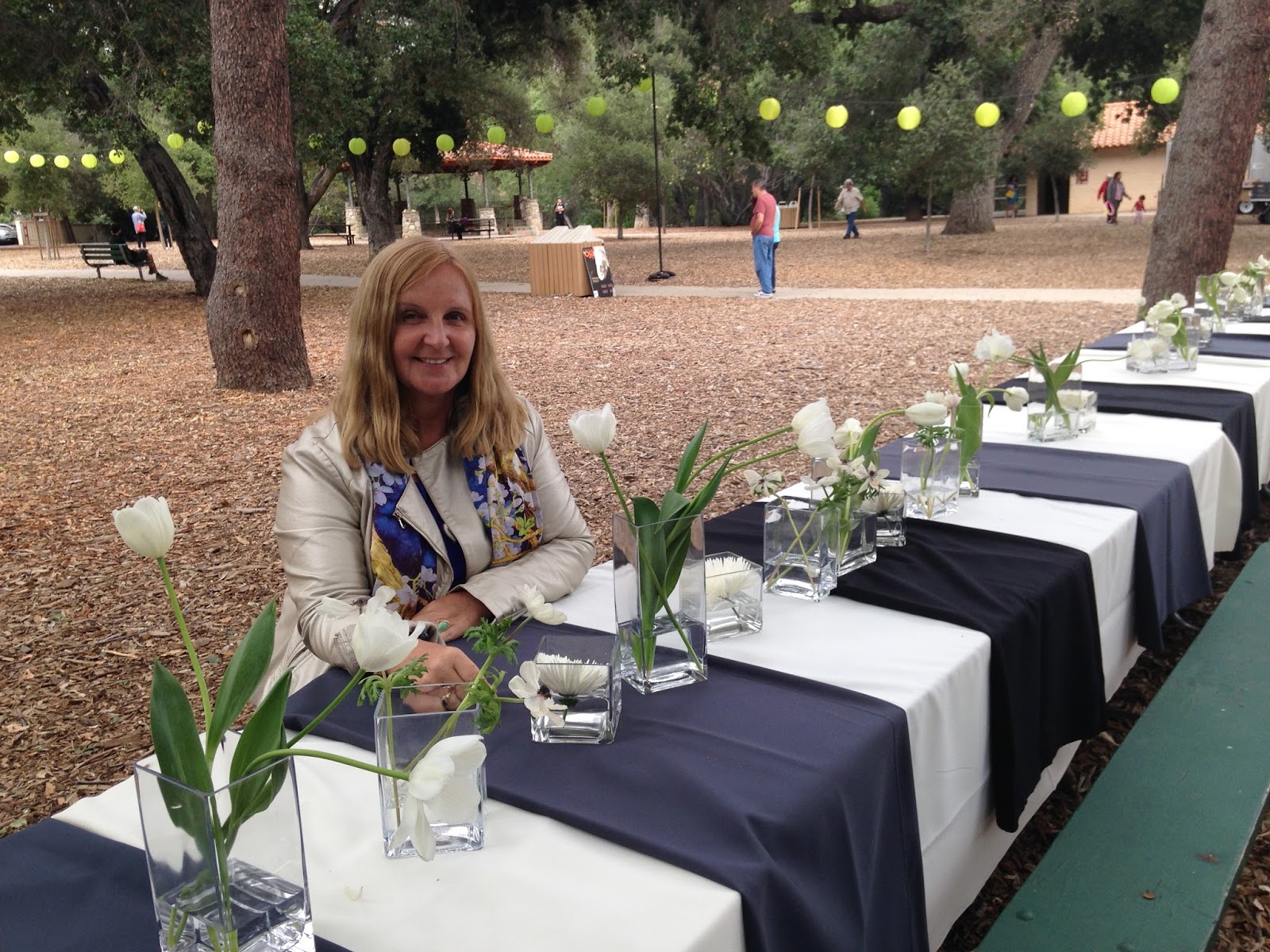
Please note that the last, unfinished work by Vivier was "Believe in the Immortality of the Soul" for voices and ensemble.  I do hope to hear a recording of these fragments some day... Meanwhile, let's comfort our souls with flowers, found in the black-and-white arrangement at the Gathering Place in Ojai - set up for the audience and festival participants to gather and converse. 

White Diamond Star

At hoto by Maria Kubal

And what about Chopin, then? Does he make an appearance? I'm afraid he does not. Besides the parallel of a beautiful, young talent succumbing to death at an early age, and the tragic loss to humanity - what if they lived longer? What gems we would have been able to enjoy and share! There is the sheer, sonorous beauty of harmonies and sound. If Vivier took anything from Chopin, it was the magic of his Berceuse....and some Nocturnes, maybe.


After visiting such lofty heights of musical and spiritual inspiration as the Ojai Festival June 12, 2016 performance of Vivier's timeless masterpiece, it his hard to come down to earth and be crashed by crass and frankly ridiculous politics and reptilian propaganda on the stage of the Hollywood Bowl. The staging of Igor Stravinsky's Firebird, with dancers, projections and puppets, may be politically correct, and may have cost a pretty penny, not to mention the wholly laudable efforts of the artisans and dancers. The all worked so hard! 

Nonetheless, I left the Bowl in a state of profound distaste, as if the creators of the spectacle were drinking Kool-Aid from a different cup than the inspired, Olympian composer. At the end of the majestic score, the gigantic egg above the stage opens to reveal an enormous dragon or a skeleton of a dinosaur with wings, on which a human puppet is promptly seated in a union of humans and the sol-called good dragons that seems to permeate popular culture at this strange time, from children's animation, to Sci-Fi. 

There is nothing there that's truly spiritual, or uplifting, or, indeed, great. Well, lots of people found lots to praise there, so let me be different. There are grandiose ambitions and an un-intelligible story of the reconciliation of opposites and merging of good with evil that's needed for the final victory, of what? Not the glorious transfiguration of the immortal Phoenix, the Fire Bird of Russian folklore and Stravinsky's piece. All the way through, I was closing my eyes and imagining colorful khorovods of Russian doll-like dancers, moving swiftly and smoothly in twists and turns, and preparing the stage for the appearance of magic. No magic there, yet again.

[Maybe the LA Phil really was taken over by Reptilians? First Andriessen's shameful caricature of the great Athanasius Kircher, thrown in his recently staged opera into the perennial flames of Hell. The aging composer is seeking a second youth and the enjoyment of earthly paradise of fame and power, so he subjects himself to the powers that were and will not be. Only he does not know it. Spending all this money for an elaborate depiction of the flames of hell, devils with and without heads, and other monstrosities seems so entirely pointless that even writing a critique of it was a waste of time.]

Two spiritual and aesthetic flops in a row, with missing the most important ingredients of any work of art: beauty, harmony, balance, sublime expression, and spiritual inspiration. At the end of a concert, your heart has to beat and you have to smile even though you have nothing to laugh about, because the music has taken you to a different universe, an altogether "unexcelled" realm of serenity and spiritual, enlightened existence. If it does not, it is not worth playing or listening to. Stravinsky's music is all that and more... But in this staging we experienced a flatline: a full-frontal attack on Stravinsky and everything that's beautiful and true.  And so it continues, the battle of Darkness and Light. But the victory is decided already, Victory of the Light. 


Distaste - that's what I feel at the excessive "modernisation" of classics. What is my escape? The garden, of course, with hibiscus and crape myrtle tree filled with busy, busy bees. Their music, heard way back when during the Polish summer in tall, majestic linden trees, was the soundscape of my childhood vacations. A time of respite and sweetness. The bees' buzzing music heard on my California patio, calms my heart. Like the beloved Berceuse. Listen and enjoy!


Good night, my bees in the trees. Make some honey, let's all make some honey.


Saturday, September 20, 2014

Revised "Chopin - A Guide to Research" Is Coming Soon - Relax with the Berceuse! (Vol. 5, No. 11)


The poet disappeared, the music historian took over - I spent the last two months, all my free time outside of work (almost all, with some exceptions for family and friends) editing the second version of William Smialek's Chopin: Research and Information Guide, first issued by Routledge in 1999, and after 9 editions to 2006, in need for a major overhaul.  This is the fourth most popular book on Chopin in the world's libraries, owned by 972 libraries (the top three are biographies by Arthur Hedley, James Huneker and Herbert Weinstock). A new edition with current research information will be extremely useful to scholars.   See OCLC WorldCat Identities:

 http://www.worldcat.org/wcidentities/lccn-n79127769

I do not know what the cover will be like, but I know that the book will be essential for all starting their research projects about Chopin's life, music, reception, portraits, or poetry. The revised Guide has over 1000 book entries and lots of information organized into six chapters, from Researching Chopin, to Reception and Peformance Studies, with Letters, Biographies, Manuscript and Editions, Studies of Works in between. The book will include an updated Calendar of Life and a List of Works.

Look for it, when it is finally ready. In the meantime, enjoy some Chopin. Listen to the astounding version of my current Chopin favorite, the Berceuse, Op. 57, with its totally insane flights of harmony into realms from out of this world... Starts from the tranquility of midnight with stars in indigo sky and flies off into realms beyond... Listen to the "Real Chopin" recording on the website of the National Fryderyk Chopin Institute in Warsaw. Tatiana Shebanova is my personal favorite!

http://en.chopin.nifc.pl/chopin/composition/detail/name/berceuse/id/121

Composed in the summer of 1843 and dedicated to Chopin's student Elise Gavard, the work was among Chopin's favorites to play in concerts, and also has a following among contemporary pianists.

Mieczyslaw Tomaszewski, who wrote the essay on the Berceuse for the NIFC Website, cites two experts, whose names and books are to be found in our Chopin Guide. 

Polish musicologist, Zdzisław Jachimecki, described the flow of the work, a set of variations on a theme, originally called Variants:

‘At first the melody of the Berceuse shows itself in its entirety. It is joined by the middle voice, which with its syncopations banters with the theme [bars 7–10]. Subsequently, the theme sounds solely in grace notes [bars 15–18]. Finally, it is pulverised into some luminous dust, transformed into a volatile state of almost immaterial little passages, trills and fioriture [bars 44–46]. Then (in the ending) it returns in its original form [bars 63–66]’.

British Chopin expert, author of the most popular book about Chopin in the world, Arthur Hedley, wrote the following:

‘The Berceuse is one of those happy inspirations which can never be repeated. A rocking ostinato bass, a short melodic phrase dissolving into sixteen variations – and there we have the cradle-song to discourage any one from attempting to write another.’