Showing posts with label Czartoryski. Show all posts

Tuesday, September 27, 2016

Finding More Chopin Sites in Warsaw (Vol. 7, No. 8)


Inspired by the "eye of an aspen tree" found in one of Warsaw's parks, I went on to seek more traces of Chopin in Warsaw, and found some places I did not see before. . . 

The Krasinski Palace, view from the Krasinski Park

A famous aristocratic family of Chopin's time that had a palace in Warsaw was the Krasinski family, today mostly remembered for its most famous son, Zygmunt Krasinski (), poet, philosopher, essayis, and drama writer.  Zygmunt Napoleon Stanisław Adam Ludwik Krasiński - was the son of General Wincenty Krasiński who served in Napoleon's army and was the Commandor of the Legion of honor, the count of Napoleonic empire, but laster also the general for Tsars Alexander I and Nicolas I. The Emperor Napoleon was the Godfather to the son of his favorite general.  Krasinski was raised in this palace and studied at the University of Warsaw.  Since 1929 contuned to study in Geneva and moved to Paris after the uprising (that he did not participate in  and was ostracized by his colleagues). A friend of fellow great romantic poets, Adam Mickiewicz, Cyprian Kamil Norwid and Juliusz Słowacki. In 1838-1846, he was in a romantic relationship with Countess Delfiną Potocką, one of Chopin's staunchest supporters. It is Delfina who provides the link between Chopin and the Krasinskis.


The National Theater where Chopin gave his public concert and attended opera performances in the late 1820s was located at Krasinski Square across the street from the Krasinski Palace. According to Chopin's Life on NIFC website,  Chopin's works performed there included "the Concerto in F minor, Op. 21 and Fantasy on Polish Airs, Op. 13, performed with the accompaniment of an orchestra directed by Karol Kurpiński. A second performance, with a similar repertory, was held several days later, on 22 March, 1830 and Chopin's farewell concert, his last in Poland, took place on 11 October 1830."

The Concerto in F minor, composed in 1829-1830, was dedicated to Delfina Potocka, the beloved of Zygmunt Krasinski, mentioned above. More information can be found on NIFC website:
 http://en.chopin.nifc.pl/chopin/composition/detail/name/concerto_in_f/id/66
You might also want to listen to this work in one of the many renditions on YouTube:
http://en.chopin.nifc.pl/chopin/youtube/search/composition_id/66.

The building of the National Theater has not survived and the Monument to the Warsaw Uprising of 1944 is now located in this space.  To the left is the tall columnade of the Warsaw Courts,surrounded by tents of protesters these days...

Plac Krasinskich (Krasinski Square)

Please note that while Chopin's biographies point out that his family lived in the Krasinski Palace in 1827-1830, it was another palace in a different location, on Krakowskie Przedmiescie, across the street from the main gate to the University of Warsaw. A small museum of the Chopin Salon is now housed inside the building which serves as the Academy of Fine Arts.

From the Krasinski Square let's walk towards the Old Town along the Miodowa Street, lined with palaces of Polish aristocracy, some of them with links to Chopin, pointed out by signs. The Mlodziejowski Palace at Miodowa 10 (also called Morsztyn Palace), was the site of Chopin's first public concert in December 1829.


The only Mlodziejowski appearing in Chopin-related "persons" on the website of National Fryderyk Chopin Institute in Poland was an artist active in the early 20th century, so there were no personal Mlodziejowski friends or connections worthy of being noted.


The Mlodziejowski Palace, at Miodowa 10, was built in 17th century and expanded in 1766-1771. Its 1804-11 reconstruction changed it into a classicist design that stands now. Interestingly, the design was by Fryderyk Albert Lessel (1767-1822) of the same name, but unrelated to Franciszek Lessel (1780-1838) a Polish composer and administrator of the Czartoryski family estates.


Right next to it, at Miodowa 6-8, is the Branicki Palace, now closed to the public and serving as a seat for Warsaw City government. It was built by the aristocratic Branicki family for Prince Jan K. Branicki in 18th century.  Burnt down during the bombing of Warsaw by Germans in 1939, it was rebuilt after the war (completed in 1967) on the basis of detailed paintings by Bernardo Belotto Canaletto, whose views of Warsaw helped rebuilt the destroyed city.


While Chopin has not performed in this palace while in Warsaw, his links to the Branickis is through Countess Katarzyna Branicka (1825-1907), to whom he dedicated his last published Waltz,, Op. 64, No. 3, in A flat major, composed in 1846-47. The Countess was just 21 at that time and lived in Paris. She later married Count Adam Jozef Potocki, in 1854, returned to Poland, and went on to become a notable art collector.

According to Mieczyslaw Tomaszewski, this waltz "at first glance, is cheerful, high-spirited, boisterous even. The next moment, however, those first impressions are dispelled. What remains is music that seems to be seeking – relentlessly, but hopelessly – its proper tone, or perhaps a way out, repeating the same pattern on successive tonal planes: in F minor, in B flat major, then in G flat major. Yet the narration does eventually arrive at its goal, which is the music of the trio (in C major), filled with a simple, hushed song in cello timbres. In keeping with the laws of the form (the dance with trio), the music of the beginning, that path-seeking music, returns. Before that, however, transitional music is heard: sketched with a subtle line and endowed with the harmonic half-light of chromatic hues."

Here are various performances of this Waltz, posted on YouTube: http://en.chopin.nifc.pl/chopin/youtube/search/composition_id/261

Plac Zamkowy near former location of Warsaw Conservatory.

Just a couple block further down Miodowa Street, if you turn left towards the Castle Square - Plac Zamkowy, you will stand where the Warsaw Conservatory used to be and Chopin's teacher, Jozef Elsner used to live. The street no longer exist, as it was demolished during the post-WWII reconstruction of the Old Town that partly changed the configuration of streets.

                             
                                 Teatr Wielki Opery i Baletu - Grand Theater of Opera and Ballet

From Miodowa Street it is just a short walk to the Plac Teatralny, known in Chopin's time as Marywilski. The monumental building that now stands in the middle of it was rebuilt after its total destruction by Germans during WWII; it was bombed in 1939 during the siege of Warsaw.  In 1945-1965 performances took place in other location while the Grand Theater rose from ruins. It was not only rebuilt but modernized and expanded.

The original Teatr Wielki was erected in 1825-1833  based on a design by Antonio Corazzi. When Chopin lived in Warsaw, National Opera performed at another stage, on Plac Krasinskich, and only the walls of the Teatr Wielki were rising up in this place.  The building currently houses National Opera, Polish National Ballet, National Theater, and Opera Museum.


Once you walk through the Plac Teatralny to Senatorska and you reach the Plac Bankowy, you may miss a now neglected palace associated with two aristocratic families closely linked to Chopin, of the Princes Czartoryskis and Counts Zamoyskis. Prince Adam Czartoryski was the leader of post-1830 emigration in Paris and his Palace Lambert was the site of many Chopin's concerts and visits through his Parisian years.  The Czartoryski palace in Warsaw, called the Azure Palace (or Blue Palace), is located at the corner of Senatorska Street and the Plac Bankowy (Bank Square). First built in the 17th century, it was reconstructed and expanded in accordance with a design by Fryderyk A. Lessel in 1812-1819.  In 1808-1816 it was used by Princess Maria Czartoryska for her Azure Salons, frequented by poets and writers dedicated to the promotion of Polish language and culture. Julian Ursyn Niemcewicz was one of the guests and his "Historical Chants" arose in this circle of patriotic aristocracy, with many countesses and noble ladies composing music or illustrations for the volume of Niemcewicz's poetry that was to determine the image of Polish history for the next hundred years. 

The Azure Palace on Senatorska Steet, left wing.

Chopin dedicated his Rondo a la Krakowiak in F major, Op. 14 from 1828 to Princess Anna Czartoryska, the wife of Prince Adam Czartoryski mentioned above.  She was especially close to Chopin in their years of Parisian exile. He enjoyed performing during their "musical evenings" and often "improvised delightful fantasies on Polish melodies."  Another, more famous Princess Czartoryska associated with Chopin, Marcelina, was actually a Princess due to her marriage to the son of Prince Adam Alexander, and grandson of Prince Adam, that is Prince Alexander Romuald. Princess Marcelina studied piano with Czerny in Vienna and with Chopin since 1844 or 47 in Paris. She performed as a pianist in solo recitals and charitable events, and traveled widely through Europe. Remembered for taking care of Chopin during his last illness, she later become one of the principal guardians of his oeuvre and tradition as a performer and composer, a Chopin institution in her own right. 

You may listen to various renditions of the Rondo a la Krakowiak on YouTube: 
And find out more about this work (its manuscript is in the Czartoryski Museum in Krakow):

To return to Warsaw, the Azure Palace, since 1811 later served as the home to Countess Zofia Zamoyska, one of Czartoryski sisters, daughters of Princess Izabela Czartoryski Fleming. Chopin gave many performances in Zamoyska's salons prior to his departure from Warsaw in November 1830. According to NIFC, "Chopin, who is believed to have first played at the Zamoyski salon as a sixteen-year-old, was invited to the Blue Palace many times as a young man. One of these recitals took place in May 1826. Chopin recalled that evening in a letter to Jan Białobłocki: 'On Sunday, a week ago to the day, I was at the Zamoyskis', where Długosz's aeolopantalon was admired virtually the whole evening long.'." The building now seems abandoned as it waits for its reconstruction by new/old owner after it was returned to private hands. 

The Azure Palace, corner of Senatorska Street and Plac Bankowy.

In addition to spending evenings with the aristocracy, the young composer also frequented cafes in the area of Miodowa, Kozia, and Krakowskie Przedmiescie. According to his biography on NIFC Website: "he also occasionally dropped in to some famous Warsaw cafes: to ‘Kopciuszek’ [Cinderella] or to the ‘Dziurka’ [Hole], both on Miodowa street (in the Tepper Palace), to the ‘Honoratka’ opposite, and to Brzezińska’s cafe on Kozia Street. This last establishment was mentioned by Wójcicki: ‘During Podczaszyński’s stay in our city, this cafe began to be frequented by Maurycy Mochnacki, Konstanty Gaszyński, Leon Zienkowicz, the last two editors of the Pamiętnik dla Płci Pięknej, and Dominik Magnuszewski, together with his friend Fryderyk Szopen, who was setting off on a journey abroad’. The cafes were the focus for political and literary life, and the birth-place of the trend of ‘dynamic romanticism.’"

Mural with the history of Brzezinska Cafe, later known as Telimena 

Visiting Chopin in Brzezinska Cafe, where Chopin was "almost daily" - per the inscription.

While walking from palace to palace, I traversed two beautiful parks, Park Krasinskich and Ogrod Saski (Saxon Garden in English translations of Polish maps, but better stick to "Saski")  filled with majestic ancient chesnuts and maples. Some of them probably date back to Chopin's time, such as the chesnut with green lichen on its trunk below, found in the Saski Garden (Ogrod Saski). At the  end of this alley the Saski Palace once stood, now only the Tomb to the Unknown Soldier remains while the entire palace is gone.

This chesnut tree looks huge and ancient. Was it there when Chopin played in the Ogrod Saski?


Ogrod Saski, main alley towards the former Saski Palace.

Chopin spent first seven years of his life in the Saxon Palace (Palac Saski), that was destroyed during WWII and not rebuilt after the war. His father was a teacher in Warsaw Lyceum located in one of the Saxon Palace's wings and the family stayed there until 1817. According to NIFC Website, "Mrs Justyna Chopin will certainly have taken Ludwika and little Frycek to the nearby park. Given Fryderyk's fondness for walks around the city, we can assume that a dozen years or so later he visited this beautiful spot on many occasions in the company of friends. Some biographers have even held that he used to come here with Konstancja Gładkowska, although there is no information regarding such romantic walks in mentions of Fryderyk's contacts with his first love. The Saxon Garden was part of the 'Saxon Axis'-a complex of royal residences and gardens belonging to Augustus II the Strong, created in the years 1713-33 to the king's commission by Jan Krzysztof Naumann and Mateusz Daniel Pöppelmann. By 1727 the Garden had become the first public park in Warsaw. During Chopin's lifetime, it was redesigned by James Savage in the spirit of an English landscape garden."

After walking along Krolewska Street on the right side of the gardens, all the way back to Krakowskie Przedmiescie, you may see the Church of Visitation (Kosciol Wizytek) where the young Chopin played the organ.  The church is next to the statue of poet Adam Mickiewicz, another famous emigre who spent half of his life in Paris, from 1830 to 1855.

Wizytki Church next to Adam Mickiewicz Monument, Krakowskie Przedmiescie.


Turn right, walk towards Nowy Swiat,  and stop in front of the University of Warsaw (where Chopin lived with his family in the Kazimierzowski Palace). Across the street is the former Krasinski Palace, i..e. the Academy of Fine Arts, and a Chopin Piano Bench marks this spot. You can listen for a while to the Minute Waltz, in the middle of a busy street...


If you continue to walk along, soon you will stand in front of Church of the Holy Cross (Kosciol Sw. Krzyza) where Chopin's heart rests in one of the pillars in the main nave. 

Chopin's heart is in this pillar in the Church of the Holy Cross.


The location of these and other landmarks of Chopin's Warsaw may be found on the website: 

CHOPIN AT THE CHOPIN AIRPORT

The last encounter with Chopin during my trip was at the Chopin Airport, when I noticed a piano and a pianist practicing his Chopin amidst all the commotion and crowds of passengers running to catch the planes, or resting between flights... 


Monday, May 19, 2014

On Virtues of Musicians and Romances of Aristocrats, or Szymanowska in Paris (Vol. 5, No. 8)

Maria Szymanowska by Walenty Wankowicz

On April 28-29, 2014, in the elegant palace of the Paris Section of the Polish Academy of Sciences the Second International Conference “Maria Szymanowska (1789-1831) and her Times” took place. The conference was organized by Elisabeth Zapolska-Chapelle, the president of the Societe Maria Szymanowska in Paris.  Following the pattern created for the first Conference in 2011, that is, two days of presentations, a mini-recital and an artistic salon at the end, this meeting of scholars created an opportunity for a review of the state of research about the life and work of Maria Szymanowska, in the context of the contemporary culture, including her connections to eminent artistic personalities from Germany (poet Johann Wolfgang von Goethe), Denmark (sculptor Bertel Thorvaldsen) and Poland (historian-writer-politician Julian Ursyn Niemcewicz, and his sponsor Duchess Maria Czartoryska de Wurttemberg). 

Conference Attendees, with Anna Kijas in the foreground.

Participants of the conference came from many countries: the U.S. (Halina Goldberg, Anna Kijas, and Maja Trochimczyk), Poland (Jerzy Miziołek, Hubert Kowalski and Adam Gałkowski representing the University of Warsaw, as well as Irena Poniatowska from the  National Fryderyk Chopin Institute), Germany (Maria Stolarzewicz from the Instytute of Weimar-Iena), Denmark (Karen Busk Jepsen from the Thorvaldsen Museum), Sweden (Benjamin Vogel), and France (Piotr Daszkiewicz from the Natural History Museum, and  Jean-Marc Warszawski from the Musicology Instytute).

Elizabeth Zapolska-Chapelle, Dr. Jerzy Miziolek and Dr. Maja Trochimczyk

The session was opened by Prof. Zbigniew Kuźnicki, director  of the PAN Section in Paris, and the participants were warmly welcomed by Ms. Zapolska Chapelle, before scholars ventured into their presentations and discussions in three languages: French, English and Polish (the latter in discussions only).  Two presentations were dedicated to general stylistic topics: Jean-Marc Warszawski discussed the aesthetic and stylistic trends in Polish music of Szymanowska’s time and afterwards, while Prof. Irena Poniatowska presented an analysis of the concept of “salon music” – contrasted with serious, concert music, that this genre shared only some features with, being a predecessor of hit songs and popular musics of today.  Dr Jerzy Miziołek, the director of the Warsaw University Museum presented a fascinating panorama of artistic culture of Warsaw and its surroundings, emphasizing the connections to neo-classical revival of Roman art, especially those recently discovered in Pompea.  After the concert, with great interest, he studied in the Museum at the Polish Library in Paris a portrait of Maria Szymanowska painted by Walenty Wańkowicz (the portrait-maker of Adam Mickiewicz). Posed as a Roman goddess, in a fashionable 19th century evening gown, but with a little angel holding a book for her, the pianist is seated in an opulent music room, with a smoking volcano visible through a window. In my 2011 paper, I identified the location of this portrait as Naples, where Szymanowska traveled in early 1825, after a visit to Rome. In terms of setting, this portrait is a twin of a portrait of the composer as  a Queen of Tones (described by Dr. Benjamin Vogel), created in Rome by Aleksander Kokular in 1824.  
With his broad knowledge of Roman and classical iconography and the arts of 19th century, Dr. Miziołek undoubtedly will all a lot to my interpretation of the painting. Such artistic-scholarly dialogues were at the core of the conference’s activities.


Maja Trochimczyk and Halina Goldberg on the way
to their guest rooms at the Polish Institute in Paris.

Prof. Goldberg, well known from her studies of reception, milieu, and performative aspects of Chopin’s music, presented a fragment of a larger project dedicated to the study of 19th century albums as a medium for preserving and shaping memory.  In the albums of autographs, music fragments, and poetry collected by Maria Szymanowska and her daughter Helena Malewska, Prof. Goldberg found examples of music that illustrates the multilevel connections of albums and memory – the constructs of half-private and half-public self images, recorded in a intimate, personal voice, but for posterity, to be seen by others.   She found examples of three aspects of memory – its psychological aspect, national-patriotic memory, and nostalgic emotional dimensions of memory and memorabilia found in personal albums. 

Dr. Benjamin Vogel of Lund, Sweden talks about pianos in 19th-c. salons.

Dr. Vogel, specialist in the history of pianos revealed places where this “memorialization” of the past took place, that is aristocratic and middle-class salons and parlors where the piano had the place of honor.  These pianos took the strangest shapes, including square, upright, cabinet, and giraffe, but they were always in the central spot in the home, where meetings focused on performances of songs, dances, and a variety of miniatures. The piano was once the “heart” of the home –by now replaced by the multiplicity of electronics connected to omnipresent Wi-Fi. It is a sad testimony to the change of musical culture – from participatory and performative to passive and receptive – that in the period that separated the two Szymanowska conferences, the renowned piano maker based in Paris, Pleyel, went bankrupt.  The demand for pianos is not what it used to be even 50 years ago, let alone in the 19th century where everyone had to have a grand instrument in the salon and a smaller one in the separate living room for women. Broadly outlined cultural context for the stellar career of Maria Szymanowska was provided in papers by Prof. Adam Galkowski, who discussed  famous women of her time, and Dr. Piotr Daszkiewicz who talked about the connections between natural history and the arts in the early 19th century, starting from scientific interests of Johann Wolfgang von Goethe. 

Elizabeth Zapolska-Chapelle with Dr. Maria Stolarzewicz

In the next paper, Maria Stolarzewicz discussed the connections of Maria Szymanowska and her sister Kazimera Wolowska with the famed German poet, Johann Wolfgang von Goethe.  This topic was earlier extensively studied by a New York-based scholar, Anne Swartz, but Stolarzewicz added a lot to her predecessor’s research, including a handout that featured a comprehensive collection of excerpts in Goethe’s letters, writings and diaries with mentions of the great pianist. To bring this poetic-musical friendship closer to the listeners, at the final Salon, Elizabeth Zapolska Chappelle recited the poem that Goethe dedicated to Szymanowska, Aussohnung – with musical accompaniment of Szymanowska’s pieces, in the “melodrama” style popular in 19th century salons.  Stolarzewicz highlighted the many different aspects of the friendship of the aging poet and the beautiful pianist, and corrected mistakes made by previous biographers of both in the interpretation of the nature of this artistic relationship.  


Karen Busk-Jepsen of Thorvaldsen Museum in Copenhagen.

At least this friendship was never hidden by either party – something that surprisingly happened to the relationship of Szymanowska with a Danish sculptor, Bertel Thorvaldsen.  The prudish and suspicious biographer of the sculptor, Just Mathias Thiele decided to omit from the artist’s biography and editions of letters all mentions of Szymanowska’s 15 letters, but also correspondence with two other artistic women that were close friends with Thorvaldsen: “ Zinaïda Volkonskaia (Russian princess, singer, writer, arranged salons first in Moscow, then Rome), and Adelgunde Vogt (Danish sculptor, animalière, virtually forgotten)” (cited from an email by Ms. Busk-Jepsen). According to Karen Busk-Jepsen neither of these women had an affair with the talented Dane, but Thiele thought otherwise and removed them in order to “purify” and “sanctify” the national artist of Denmark.  How easy it is to vilify women!  The fact that a romance with anyone was completely out of place in the life of a virtuous, though divorced, pianist with three children and siblings to support, never crossed the mind of Mr. Thiele.  The affectionate tone of Szymanowska’s letters indicated an emotional relationship that was not revealed in the only preserved letter of Thorvaldsen to her.  In any case, leaving romances aside, we should pay more attention to Thorvaldsen's influence on Polish culture.


Jean Marc Warszawski  jazzes up a Helena Wolowska's melody.

An important step in this direction was made in the research of  Hubert Kowalski, deputy director of the Museum of Warsaw University. In his presentation (read by his boss, Dr. Miziolek), Kowalski discussed the impact of neoclassical style of Thorvaldsen on the artistic landscape of Warsaw, going far beyond the two known monuments that beautify the capital: Prince Jozef Poniatowski and Mikolaj Kopernik (Copernicus). The unveiling of the latter monument was one of the tasks performed by the then President of the Society of the Friends of Learning, Julian Ursyn Niemcewicz. 


Maja Trochimczyk, Photo by Judyta Nowak.


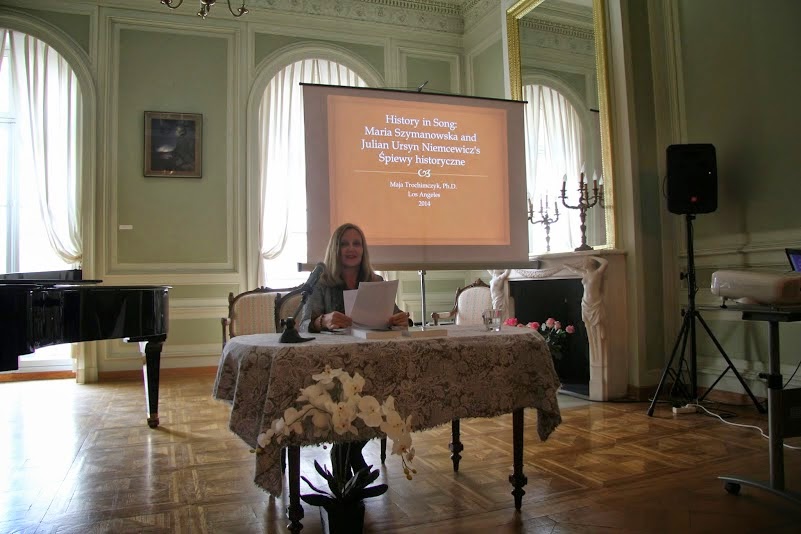
Niemcewicz was the author of the famous Historical Chants (Śpiewy historyczne”) - a bestseller of the 19th century, present in every patriotic Polish home, including the Chopin family salon in Warsaw. This volume and Szymanowska’s contribution to it was the subject of my presentation, illustrated by engravings of  scenes and songs from the lives of the kings and heroes published in the original edition and its subsequent reprints.  The author, poet, journalist and politician and one of his main sponsors, Duchess Maria Czartoryska de Wurttermberg (Wirtemberska) are fascinating personalities in Poland’s artistic and musical history, and deserve a lot more attention that could be bestowed on them in my overview. The reading and singing of chants that were being assembled for publication took place in Czartoryska’s Azure Saturdays, literary gatherings in the Czartoryski Azure Palace in Leszno near Warsaw  (1806-1816).  The salons provided a venue for meetings of Warsaw’s literary elite, with Kajetan Kozmian, Maksymilian Fredro, Franciszek Lessel, Karol Kurpinski, Niemczewicz and Szymanowska as frequent guests.  The Czartoryski and Zamoyski families were among the main sponsors- subscribers to the first edition of the Historical Chants, also supported by Potocki and Tarnowski magnates, Warsaw school professors, the cleargy and minor gentry.  In PRL-period histories, the role of aristocracy in the creation of Polish culture was under-appreciated for obvious ideological reasons. Only now,  25 years after the fall of the system we can approach this topic anew, without “socialist” prejudices.


In  “Śpiewy historyczne” the song about hetman Chodkiewicz was penned by Duchess Chodkiewiczowa, the song about Hetman Zamoyski was written by Duchess Zofia Zamoyska (nee Czartoryska).  Maria Wirtemberska set to music a song about  Stefan Potocki and the whole project was inspired by a setting of Duma o Stefanie Zolkiewskim by Konstancja Narbutt, composed thirty years earlier and popular in the nobility’s salons.  The greatest number of songs was by professional composers Karol Kurpiński (6) and  Franciszek Lessel (10 plus a two-voice version of Bogurodzica).  Ewa Talma’s contribution to the discussion was invaluable as she has shown that the first edition of 1816 was incomplete. Prof. Irena Poniatowska relayed the information found by Zofia Chechlinska about the fact that two composers, Cecylia Beydale and Lessel, were siblings and could not marry, as they had intended to. They were, apparently, out-of-wedlock children of the adventurous and amorous Maria Wirtemberska. 
Irena Poniatowska, Maja Trochimczyk and Ewa Talma. Photo by Judyta Nowak.

These relationships and others between the various persons in Szymanowska’s life, as well as archival documents about them could be plotted in an open, free access website that could be developed, as Anna Kijas proposed in the closing paper of the conference. A trained librarian as well as musicologist, Kijas has published a bio-bibliography of Szymanowska that showed some previously unknown letters of her daughter to an American friend, preserved in a library in North Carolina.  Indeed, it would be beneficial to have these letters scanned and made public –  the letters in Thorvaldsen Museum are already posted online. 

Anna Kijas with Prof. Halina Goldberg

A visit to the Polish Library in Paris, to see the notebooks and letters of Szymanowska family in the Museum of Adam Mickiewicz provided me with a proof of the importance of this step for the future of research.  The archives, always crowded by researchers, have amazing resources and I discovered, to my great pleasure the vast scope of patriotic songs copied by hand for personal use by Szymanowska’s children, Helena and Romuald.  The little hand-made notebooks, that can fit in the palm of a hand and be used for group singing in the salon, included hundreds of krakowiaks, mazurs, polonaises, as well as various versions of the Dabrowski Mazurka, Bogurodzica, and other patriotic hymns.  My study of the history of Polish anthems will find a follow up in these documents. 

Prof. Irena Poniatowska, Ewa Talma and Prof. Halina Goldberg at the Polish Library
archives of the Adam Mickiewicz Museum in Paris. 

While was reviewing the content of children’s notebooks, Halina Goldberg focused on the famous albums with composers’ manuscripts, in wonderful leather bindings, made to be kept and shown. She started her own album, and I had the pleasure of writing a personal note for her, as well as a silly little collage with a rain poem, inspired by our wanderings around Paris and a story by Slawomir Mrozek... 


Parisian entry in Halina Goldberg's album by Maja Trochimczyk

The conference was supported by the Paris Station of the Polish Academy of Sciences that hosted the events, provided excellent audiovisual support and lovely, French-and-Polish style luncheons and receptions for the scholars. Some of the conference attendees could stay in PAN guest rooms, while the Polish Institute in Paris hosted the rest of the scholars. Air France and KLM offered discounted air flights, and the Polish Library in Paris welcomed scholars for archival visits. 

Karen Busk-Jepsen, Anna Kijas, Elizabeth Zapolska-Chapelle, Maja Trochimczyk
Adam Galkowski and Benjamin Vogel with Halina Goldberg at the piano. 

None of that would have been possible without the energetic and talented organizer, Ms. Zapolska Chapelle who, in addition to moderating all the sessions and introducing the speakers, delighted the audience with her rendition of all five songs of Szymanowska and fragments of two songs by others (Paris and Kurpinski) that replaced Szymanowska's versions in the published Niemcewicz edition. The singer has already issued all of Szymanowska’s songs on a CD (Acte Prealable) that is a must for all 19th century music scholars, as well as those studying the biographies and work of Adam Mickiewicz and Fryderyk Chopin.  Pianist Małgorzata Kluźniak-Celińska aptly accompanied Ms. Zapolska-Chappelle and performed solo pieces by Szymanowska at the close of the conference and at the final Salon – where we heard Goethe’s poem dedicated to Szymanowska, as well as two poems of mine, along other assorted productions, as the case may be in an impromptu performance, of a dramatically varied artistic quality.  Next time, it will be better, we promise.

Elizabeth Zapolska-Chapelle with Małgorzata Kluźniak-Celińska at the piano
and Prof. Zbigniew Kuznicki. 

Participants surround Prof. Irena Poniatowska at the end of the conference.
Photo by Judyta Nowak. 

Participants receive flowers from the Director of PAN Paris Section, Prof. Zbigniew Kuznicki.
Photo by Judyta Nowak.


Monday, April 21, 2014

Maria Szymanowska and Her Times - 2nd International Symposium in Paris, April 28-29, 2014 (Vol. 5, No. 7)

After three years, scholars specializing in early Romantic music of Poland and Europe, are reconvening in Paris, for the 2nd Symposium "Maria Szymanowska and Her Times" - under the patronage of the Président de l’Académie Polonaise des Sciences a Paris.


 The events will take place on April 28-29, 2014 at the  Centre Scientifique de l’APS à Paris (74, rue Lauriston, Paris 16e).  The main organizer of the symposium will host and moderate the proceedings: Elisabeth Zapolska Chapelle, Présidente de la Société Maria Szymanowska, will add to her accomplishment editing the book of research studies that will be the tangible outcome of the presentations and discussions at the symposium.

PROGRAM

MONDAY, 28 APRIL

10:00 am  Meeting of participants and presentations of their work in the cafe.
10:30 am   Opening Address by Professor Zbigniew Kuźnicki – Director of the Centre Scientifique de l’APS  à Paris and by Elisabeth Zapolska Chapelle

11:00 am  Jean-Marc Warszawski – Institut de recherche en Musicologie, Paris
Mutations, mouvements, évolution dans le monde de la musique au temps de Maria Szymanowska

11:30 am Jerzy Miziołek – Université de Varsovie
Artistic culture of Warsaw in the time of Maria Szymanowska and Frederic Chopin

12:00 am Paweł Maciejko - The Hebrew University of Jerusalem
The Wolowskis/Shorrs and the Frankist disputations

12:30 pm – 2:30 pm   Lunch break

2:30 pm Halina Goldberg – Indiana University, Bloomington
The Topos of Memory in the Albums of Maria Szymanowska and Helena Szymanowska-Malewska

3:00 pm Maria Stolarzewicz - Institut für Musikwissenschaft Weimar-Iena
Johann Wolfgang von Goethe's connections to Maria Szymanowska and her sister Kazimiera Wołowska

Break 3:30 pm - 4:00 pm

4:00 pm Benjamin Vogel – Swedish Society for Musicology, Lund
Piano – the main atraction of the Polish and Russian drawing rooms during the Maria Szymanowska time

4:30 pm Irena Poniatowska – Institut National Frédéric Chopin, Varsovie
Lumières et décadence de la musique de salon au XIX e siècle


WEDNESDAY, 20 APRIL 2014

10:00 am  Meetings of presenters in the cafe

10:30 am  Hubert Kowalski – Université de Varsovie
Legacy of Thorvaldsen in nineteenth-century Warsaw

11:00 am  Karen Benedicte Busk-Jepsen - Musée Thorvaldsen à Copenhague
A for Amity, Admiration and Attachment. On the Neglected Contact between Maria Szymanowska and Bertel Thorvaldsen

11:30 am Piotr Daszkiewicz - Muséum national d'Histoire naturelle, Paris
Humboldt, Cuvier, Jarocki et les autres - les naturalistes et les salons artistiques au temps de Maria Szymanowska

12:00 pm Adam Gałkowski – Université de Varsovie
Femmes de talent, femmes d’action au temps de Maria Szymanowska

2:30 pm – 2:30 pm Lunch break

2:30 pm  «  Madeleine musicale » par Małgorzata Kluźniak – Celińska - piano

Maja Trochimczyk - Moonrise Press, Los Angeles
History in Song: Maria Szymanowska and Julian Ursyn Niemcewicz's Spiewy Historyczne
avec illustrations musicales par Elisabeth Zapolska – chant et Małgorzata Kluźniak – Celińska - piano

3:30 pm  Anna Kijas - University of Connecticut, Storrs
Szymanowska Scholarship: Ideas for Access and Discovery through Collaborative Research

4:00 pm Discussion libre et Mot de la fin du Colloque

4:30 pm - 5:00 p.m  Break

5:00 pm Salon musical et littéraire Maria Szymanowska par les Participants au Colloque

5:30 pm Reception  (Un verre d’amitié)


Tuesday, February 12, 2013

On Chopin's Roses for Valentine's Day (Vol. 4, No. 2)

The association of roses with love goes back to the times of Sappho, an ancient Greek poet (or, rather as 19th century writers would say, poetess), whose fragments of love poems have inspired countless poets with their vehement passion and colorful metaphors since her death more than two and a half thousand years ago. In Elizabeth Barrett Browning’s translation, Sappho’s rose is “the eye of the flowers… the grace of the earth” and “the lightning of beauty that strikes through the bowers / On pale lovers that sit in the glow unaware.” Sappho’s rose “breathes of love” and its petals “laugh with the wind…”

The Song of a Rose

By Sappho, translated by Elizabeth Barrett Browning

For Zeus chose us a King of the flowers in his mirth,
He would call to the rose, and would royally crown it;
For the rose, ho, the rose! is the grace of the earth,
Is the light of the plants that are growing upon it!
For the rose, ho, the rose! is the eye of the flowers,
Is the blush of the meadows that feel themselves fair,
Is the lightning of beauty that strikes through the bowers
On pale lovers that sit in the glow unaware.
Ho, the rose breathes of love! ho, the rose lifts the cup
To the red lips of Cypris invoked for a guest!
Ho, the rose having curled its sweet leaves for the world
Takes delight in the motion its petals keep up,
As they laugh to the wind as it laughs from the west.


The roses that Sappho and Browning wrote about blossomed once a year and had much smaller, though often much more fragrant flowers than the roses we know today. Our long-stemmed hybrid tea roses are the offspring of repeatedly blooming china roses, hybridized by artificial pollination and often grafted onto sturdy rootstock of the common dog rose that is resistant to cold and disease. We pay for the year-round abundance of flowers with their fragrance…

Here’s a lovely simple variety of Rosa Gallica, called by the French Rosier d’Amour and the Germans rose d’Autriche, or the Austrian rose. Its description in a book of rose images by Pierre-Joseph Redouté (Les Roses, 1817-1824) penned by Claude-Antoine Thory is poetic in its own right, especially for readers who do not know botanical terminology:

 “Its stems are armed with thorns… that break off easily, leaving numerous scars. The leaves consist of five… oval leaflets… doubly dentate with glandulous edges… The Rose of Love has a corolla of five petals … The aromatic flowers grow singly or in clusters or two or three at the end of the secondary branches… The pyriform and slightly hairy fruits are reddish or orange when ripe. They last well into the winter.”

The Latin name of this variety is “Rosa gallica pumila” and it refers to the small size of the shrub, graced with enormous, bright red flowers. But how does “glandulous” look like? And what about “tomentose” (not to mistake for “comatose”)? The meaning of “Pyriform” we can guess – it probably refers to the shape of the flame, that, just like the flame of true love, lasts well into the winter.

Apparently, this is a wild rose widespread in Germany and growing with vigor: “it can reappear and multiply almost as rapidly as it is uprooted.” How does it do it? In three ways: “through self-sown seeds, offshoots, and subterranean roots.” (from Frank J. Anderson’s commentary, 1979). For the farmers, it was worse than a weed, because its branches were thorny and when they took it out once, it kept coming back with a vengeance.

Now, isn’t it just like real love? Even the unwanted one? If it is real, it will survive anything and everything. It will be unchanged from the day it miraculously appeared, to bless a life that was empty without it, to the last breath on Earth, well into the winter of life. Will it survive beyond the grave? I think it will, but let us return to the roses.

Another simple type of rose (with one layer of petals, typically 5 to 8) was known in Chopin’s time as “The Rose of May” (Rosa cinnamomea). Its blossoms had five red, heart-shaped petals around a yellow heart. It blossomed just once a year, in May.  

By the time Chopin arrived in Paris in 1831, though, the beauty of such fragrant, once-blooming roses had found new, foreign competition. 

He had with him his two Piano concerti, the first composed and second published Piano Concerto in F minor, Op. 21 (1829-1830) included a lovely Larghetto, the apotheosis of love in music. 


The Rose Garland

I thought roses.
I thought rich, velvet blossoms.
I thought a red rainbow
from deep crimson to delicately pinkish.

The secret was underground
where the roots sustain
the multi-hued orgy of sensuous allure –
flowers opening to dazzle and fade.

The strength of the rose
is invisible – you see the blush
of seduction in each leaf and petal,

 You admire their charms.
Yet, you care for what’s out of sight,
not for the obvious.

I thought your love.
I thought how you adore me.
I went deeper down to the source.

The rose, Sappho’s lightning
of beauty, breathes love,
laughs at the wind and wonders.

The mystic rosebush dances,
crowned with the royal
garland of fire.

(c) 2008 by Maja Trochimczyk


Roses Out of This World – Bengal? China? 

The European rose gardens greatly benefited from the conquests made by the British in India and China - and from the Egyptian adventures of Napoleon himself. When English officers and merchants went to China in the middle of the 18th century, they came back with rose varieties they named after themselves. Thus, Slater and Parson in 1752, followed by Hume and Park around 1792, entered the History of the Rose. Thanks to these Oriental newcomers, English and French gardens were filled with rose blossoms from spring through winter frost.

Napoléon’s first wife, Empress Joséphine de Beauharnais (1763-1814, crowned in 1804, and divorced in late 1809), loved roses so much she dedicated a garden at her residence of Chateau de  Malmaison to these magnificent flowers. Assisted by dedicated and talented gardeners, she managed to gather over 250 varieties in a formal rose garden that survived her death in 1814 and the fall of Napoleon in 1815. Apparently, during Napoleonic wars, containers with Hume Blush Tea-Scented China Rose imported for Empress Joséphine’s Rose Garden were let through the English naval blockade.

The spectacular blossoms from Empress Joséphine’s collection at Malmaison were immortalized in painting. Pierre-Joseph Redouté (1759-1840) recorded the shapes and hues in splendid engravings and watercolors, while Claude-Antoine Thory (1759-1827) provided their vivid, botanical descriptions. The images from Les Roses (1817-1824) still delight with their exotic beauty – I call these roses “exotic” because many varieties found on these colorful pages had died out and no longer exist.

 Redouté’s roses have strange names: the cottony rose, the moss rose, the great cabbage-leaved rose… Sometimes the names reflect the roses’ convoluted history. Let’s take as an example the Bengal Rose with blood purple flowers (Rosa indica cruenta). Brought to England from China by T. Evans, it flowered for the first time in an English garden in 1810. Despite its Indian name, it was a true China rose; Chinese gardeners, no doubt, spent centuries perfecting its blossoms.

I love the abstractness of its description: “The bifid stipules are bordered with pendiculate glands. The flowers, which can sometimes be quite big, are terminal… The corolla consists of five or six rows of petals with that slightly velvety purple-red or blood-red color which Professor de Candolle has likened to the color of arterial blood.” Oh, the poetry of bygone science!

 A Chopin’s Rose? Roses? 

Here’s another imperial conquest: a Sultana’s Rose, also known as La Maheka or Rosa gallica maheka. Apparently, it came to Europe at the end of the 18th century via Holland. It may have something to do with Dutch holdings in Indonesia, or maybe it was found in India, or Persia, or China… The genealogy of this rose remains shrouded in mystery. Yet the French loved it so much that Redouté’s botanist, Thory, wrote: “this fine rose is so well-known to rose-lovers that we hardly feel a need to describe it.”


 If it was so well-known perhaps Chopin saw it, too. A Sultana’s Rose blossom may have been contrasting with the jet-black tresses of a woman he noticed at a ball in 1841. He was going to describe this “goddess that enchanted him with a rose in black hair” when he received a letter from his friend, Julian Fontana and started thinking about home, family and his past in Poland.


He then may have remembered the roses worn a decade earlier by a charming singer, Konstancja Gładkowska (1810-1889), whom he admired to the point of infatuation. She sang during his farewell  concert in Warsaw, held in October 1830. On this occasion, Ms.  Gładkowska was “in white, with roses on her head, dressed beautifully to enhance her charm” and sang better than ever before (Chopin's letter to Tytus Wojciechowski, 12 October 1830).


Were roses Chopin’s favorite flowers, then? Perhaps… His description of his room in George Sand’s mansion at Nohant in a famous letter to his family, written on 18-20 July 1845, is revealing:

 “In the middle stands my desk, where I write, on the left there are some music papers of mine – Mr. Thiers and poetry (with a moustache), on the right Cherubini, in fron of me this “repetier” that you sent in its screen (Four o’clock). Roses and carnations, pens and piece of sealing lacque, left by Kasalanty. – I’m always with one leg with you – and with another in the room next door – where the Lady of the House works – and not at all here in this moment – only, as usual, in some strange space. — These are, probably the “espaces imaginaires” (imaginary spaces) – but I am not ashamed of that. . .”

Kasalanty Jedrzejewicz was the husband of Ludwika, Chopin’s beloved sister. In 1848, feeling lonely and homesick in Scotland, Chopin returned, in his thoughts, to the beautiful gardens he remembered from his youth (Chopin's letter from Edinburg, 10 August 1848): “It is so good that Ludwika went to the countryside! Both my dearest Mommy and good old Isabel (“i Mameczka, i Izabelisko”) should also drive by a garden, in which I can see all the flowers, fruit, and the wood of the fence.”

Rose Anna Czartoryska

These “imaginary spaces” blossomed into music, Chopin’s nocturnes and mazurkas. In real life, this sick and lonely émigré found a substitute family among friends that included Princess Marcelina Czartoryska (1817-1894), his most famous disciple who kept the memory of his pianistic style alive long after his death.

Another Princess from Chopin’s circle, Anna  Sapieha, Princess Czartoryska (1799-1864) was the elegant and wise wife of the leader of Polish émigrés in Paris, Prince Adam Jerzy Czartoryski (1770-1861). After a long career in Polish politics that ended with chairing the national government during the November Uprising in 1830-31, Prince Czartoryski emigrated to Paris and ruled over the émigré community from his residence, Hotel Lambert. Among other achievements, Prince and Princess Czartoryski founded the Polish Library and Museum in Paris, and, of course, patronized Chopin.

Princess Anna dedicated her life to supporting culture and charitable endeavors; her name frequently appears in Chopin correspondence. On 27 February 1835 General Jozef Bem wrote to Chopin about a well attended evening at the Princess Czartoryska who was showing off Chopin’s still unframed portrait that she intended to also display at the court.

While living in Paris, Chopin often visited Princess Czartoryski’s salon and played for her, but their association dates back to Chopin's early career in Warsaw. The young composer purposefully sought the Princess's patronage before they both left Warsaw; this may be seen from the fact that Princess Anna Czartoryska is the dedicatee of his Rondo a la Krakowiak in F Major, Op. 14, composed in 1829. Her name appears on the manuscript (in Czartoryski Museum in Krakow, Poland) and on all the printed first editions of this piece: the French published by Schlesinger, the German by Kisnter, and the English by Wessel and Co.


No doubt, the Princess admired Chopin’s music. As George Sand noted in a letter to her son, Maurice Dudevant (May 1, 1846), the Czartoryskis attended a concert given by Chopin at his home: “Yesterday, at his home, Chopin gave us his music, flowers, and lots to drink. Prince and Princess Czartoryski attended, along with Princess Sapieha, Delacrois, Louis Blanc, as well as D’Arpentigny, Duvernet with his wife, D’Aure, and Paulina with Viardot.” Apparently, Chopin also greatly enjoyed the smaller musical soirees at the Czartoryski salon, where he “performed enchanting fantasies made from Polish melodies.”

 At the end of his life, the ailing composer gratefully accepted help from Princess Anna, in the form of a certain Mrs. Matuszewska sent to keep him company at night and care for him in his illness (Chopin’s letter of July 2, 1849 to Wojciech Grzymala, with news about his failing health written four months before his death).

What is the reason that I talk about Princess Czartoryski in an essay on Chopin’s Roses? She had her own rose, of course. Rose historian, Yuta Arbatskaya discovered its history. The rose “Anna Czartoryska” was created in 1845 by Jean Pierre Vibert (1777-1866), an expert rosarian and a wounded veteran of Napoleonic army, who received a rose collection with its records from another famous gardener, Jacques Louis Descemet (1761-1839). Descemet, in turn was forced off his land by the British troops and went to live in Russia; his rose will soon make an appearance.

As Arbatskaya writes, the Czartoryska rose belonged to the family of “Gallica/Provins.” It had red flowers with a violet tint, and full corollas of up to 40 petals. Unfortunately, this rose did not survive. It may have been similar to the rose reproduced above. With "magnificent purple-red semi-double" flowers the Provins roses (Rosa gallica) have earned the most unusual description by Thory (in Redouté's Les Roses): "The finely dentate, pointed leaflets grow on hispid leafstalks on which some glands and a few small hooked thorns may be seen, and which have at their base pointed, denticulate, glandulous bifid stipules. The penduncles of the flowers are hispid."  Yes, hispid, indeed...

To return from botany to history, it is important to note that the aristocratic “Anna Czartoryska” was not an aberration, but rather an element of a larger pattern in the history of French rose names. After the Polish émigrés displaced by the fall of the November Uprising in 1831 descended upon Paris, French sympathy for the Polish cause gave rise to a great variety of charitable efforts and high society fashions – such as dance (the mazurka and cracovienne became quite popular), and the roses.

According to Arbatskaya, the French gardener Vibert created and commercially distributed such Polish-named rose cultivars as:

  •  'Sobieski' (1836, named after King Jan Sobieski who defeated the Turkish army at Vienna in 1683), 
  • 'Sulkowski' (1841, named probably after Antoni Pawel Sulkowski, 1785-1836, an army general in the Duchy of Warsaw, and an officer in Napoleon’s army), 
  •  'Dabrowski' (1848, dedicated to General Henryk Dąbrowski, the leader of the Polish Legions, immortalized in Poland’s national anthem of 1794, Dąbrowski’s Mazurka), and 
  •  'Nowalinska' (1852, the identity of this Polish woman is unknown).


 Rose Belle Aurora Poniatowska 

Redoute’s portraits of roses were not limited to those from Empress Josephine’s rose garden at Malmaison. He also documented, with biological exactness, the specimens from other notable rose collections in France, such as Paris’s botanical garden where he taught painting. (He had been the teacher of Marie Antoinette and survived, as rose painter, the French Revolution, to serve new dynasties). As Arbatskaya writes, his favorite student was a young Polish noblewoman, Aurora Poniatowska. Not surprisingly, there’s a rose of this name among the engraved plates of his book.

Known also as Belle Aurore, this delicate pink rose belongs to the family of Alba roses and was created in 1820 by a French rosarian, Jacques-Louis Descemet (1761-1839), a friend of Redouté who named the beautiful rose after the painter’s most favored and talented student.

Aurora Poniatowska (1800-1872) was not, as some commentators wished, an illegitimate daughter of Poland’s last king Stanislaw August Poniatowski. Thanks to the research of Yuta Arbatskaya, a rose historian from Crimea, we know that Aurora came from a minor branch of the Poniatowski family and studied painting in Paris. Her father, Count Józef Ignacy Poniatowski was a colonel and served under the famous Prince Józef Poniatowski, a general in Napoleonic Army.

Did she manage to meet Chopin in Paris, before returning to her family estates in the Ukraine? Probably not. Her studies and her rose name date her Parisian sojourn back to ca. 1820, when Chopin was merely 10 years old. He came to Paris in 1831. His biographical sources do not name her, a forgotten beauty who enjoyed her 15 minutes of fame, to be remembered only by a rose named in her honor.

In order to create beautiful, large, and fragrant blossoms, such as the Belle Aurore, gardeners crossed the “new” arrivals (whose thousand-year Chinese history was not known in the West) with their own roses. Thus many new varieties appeared, the tea rose among them. Josephine’s gardener, Andre Dupont is sometimes credited with inventing this novel art of hybridization, though we have noticed the names of Descemet and Vibert among his colleagues. Through artificial pollination, Dupont created 25 of the varieties found in Empress Josephine’s Rose Garden. Some sources attribute the Poniatowska rose to his creations (Arbatskaya favors Descemet, and I'll take her word for it).

Rosa Aurora Poniatowska from Yuta Arbatkskaya

Gallicas, Hybrid Teas and Chopin Roses

The shapes of most blossoms in Redouté’s paintings are quite different from the tall, tubular flowers we see in delicately fragrant or scentless hybrid teas of our times. These were the gallicas, albas, damask, china, and moss cultivars of Old Garden Roses. Many ancient roses blossomed just once a year and had a lovely fragrance; they were all the more precious for it. Chopin was particularly sensitive to scents; he could not stand foul odors and loved fragrant flowers, such as roses or violets. We may guess that for him the exact shape of the flower was less important than its ability to freshen the air with a beautiful scent. The rose was an aromatic symbol of a connection to his beloved family in Poland…

Roses and carnations were George Sand’s favorites, and these delightful flowers could be found on Chopin’s desk in Nohant… What about romance, then? In 1838, George Sand (whose given name, to close the circle of roses, was also “Aurora”) compared the composer himself to a rose: “Chopin arrived this evening from Perpignan, fresh as a rose and rosy as a beet” (“frais comme une rosé et rosé comme un navet”) she wrote to a friend, Carlotte Marliani, in Paris (Sand's letter of November 1838). This letter was sent from Mallorca where, alas, Chopin’s health suffered a major setback. On December 3, 1838, the composer wrote from Palma to Julian Fontana in Paris: “I was sick as a dog for the last two weeks: I caught a cold despite the 18-degrees warmth, roses, oranges, palms, and figs.”

The fragile beauty of roses did not save him. He died young. His music survived. And look at roses today! How different they are from those of the past. Let anyone who ever saw a rose deny the truth of Evolution, and let them deny the human role in creating evolution… The world is still unfinished and we have a role to play in shaping it, in defining what it will become. For proof, we do not need to look further than a rose and its magnificent blossoms. . .

It takes courage and persistence to create a new rose. According to the gardening site Help Me Find (www.helpmefind.com), three rosarians had this courage as they strove to express the romantic beauty of Chopin’s music in their roses:

  • In 1980, a Polish rosarian, Stanisław Zyła created a large, yellowish-white hybrid tea, with a warm, sunny center. Its ivory petals have the hue of old piano keys. This rose appears with three different names: Chopin, Frédéric Chopin and Fryderyk Chopin. 
  • In 1968 Charles W. Ellick created a red hybrid tea rose "Chopin" with large flowers of up to 40 petals, of moderate fragrance. This rosebush flowered "in flushes" through the summer. 
  • In 2008, to honor the old-fashioned variety of Gallica/Provins (like the Anna Czartoryska rose), Pirjo Rautio created another “Chopin” rose, which was medium-large, with very large and very full blossoms. Its petals, described as “cherry-red with violet-red edges” had “cherry-red flecks,” they aged to violet. Like Old Garden Roses, this Chopin bloomed once, in late spring or summer.


It is perhaps the same Gallica-variety roses (Sultanas, Bengal, India, of May?) that enchanted Chopin’s friend, painter Eugène Delacroix in June 1842 at Nohant, as he listened to Chopin’s music: “At times, through an open window overlooking the garden, mixed with the singing of nightingales and the fragrance of rose blossoms the melodies of Chopin’s music reach me, because he never stops working here…” [“Par instants, il vous arrive par la fenêtre entr'ouverte sur le jardin des bouffées de la musique de Chopin qui travaille de son côté; cela se mêle au chant des rossignols et à l'odeur des rosiers.”] (Letter of Eugène Delacroix of 7 June 1842 from Nohant to J.B. Pierret in Paris)


A Summer Rose Dream 

Rose petals float down 

Onto the desk covered with music 
Pages of notes and ink blots 

Chopin looks out the window 

A carmine blossom in her black hair
Exotic beauty at the ball 

He sees the eglantine roses 

The picket fence of long ago 
His sister smiling 

Fragrance spills on the velvet 

Of night, notes scatter 
On a canvas of his thoughts 

His fingers search for memories 

On smooth ivory keys 
Roses and nightingales, roses

(c) 2013 by Maja Trochimczyk


What joy it would have been to join Delacroix and listen to Chopin’s music among the nightingales and roses of Nohant… Perhaps he'd be playing his Impromptu no. 3, or maybe the Nocturnes op. 55? A perfect Valentine's Day dream for the lovers of music and roses!
Rosa  Celeste, photo by Yuta Arbatskaya, from "Aurora Poniatowska" article.
_____________________________________________________
_____________________________________________________

ACKNOWLEDGMENTS:

Special thanks to Yuta Arbatskaya for her articles on Aurora Poniatowska and Anna Czartoryska roses (www.kajuta.net). I wish to thank Daphne Filliberti of Rose Gathering (rosegathering.com) for the information about Chopin roses on How to Find it website and other rose material. I also thank Ewa the Gardener from EwaInTheGarden blog for her lovely Chopin roses. Certain Redouté roses were scanned, other ones found on Wikipedia - English, German, French and Dutch editions. With gratitude to everyone who posts information and pictures free of charge!

_____________________________________________________
_____________________________________________________

NOTES: 

Poem by Sappho, translated by Elizabeth Barrett Browning, in Greek Poets in English Verse, William Hyde Appleton, ed., Cambridge: The Riverside Press, 1893.

 Pierre-Joseph Redoute (1816-18), Les Roses, 168 plates with descriptions by Thory. The originals burned with the Louvre in 19th century. Copies were published and continue to be reproduced. The text quoted above is attributed to Delanuay and translated into English, in an album P.-J. Redouté – Roses, Liber, 1986.

 Frank J. Anderson, ed. The Complete Book of 169 Redouté’s Roses, New York: Abbeville Press, 1979.

Yuta Arbatskaya, “Fair Aurora Poniatowska rose: History of the name” paper presented at the 18th Tsarskoye Selo Academic Conference, “Russia – Poland: Two Aspects of European Culture” at the Catherine Palace of Tsarskoye Selo, 26–28 November 2012. In Russian.

Yuta Arbatskaya, "Rose Anna Czartoryska" online entry, at www.kajuta.net/node/2791

Philippe Gentil (1982). Chateau de Malmaison. Imprimerie Moderne du Lion, France.

Chopin's Letter on the Website of the National Institute of Fryderyk Chopin, Poland www.nifc.org. In Polish, English translation by Maja Trochimczyk.

Chopin Rose Photo from a Polish gardener's website: Ewa in the Garden, http://ewainthegarden.blogspot.com

______________________________________________________________

COMMENTS
______________________________________________________________

From Lois P. Jones (via FB, February 13):

An astonishing collection of insights into the history of roses interlaced with delicious 
selections of Chopin and poetry on the subject of roses. Gorgeous indulgence and 
no calories from chocolate. hmmm Thank you!
______________________________________________________________

From Sharon Chmielarz (via email):

Feb. 22 and I've just found the time to read through your blog, Maja.  
What a wonderful creation–words, poems, photos, music, lush red background.  
Thank you for alerting me to it.

______________________________________________________________________