Showing posts with label Szymanowska. Show all posts

Wednesday, February 11, 2015

Venetian Love Songs - Barcarolles by Chopin and Szymanowska (Vol. 6, No. 2)

First there was Venice,..

The Grand Canal in Venice from Palazzo Flangini to Campo San Marcuola, 
Canaletto, about 1738. The J. Paul Getty Museum, Los Angeles

... and then there was the most exquisite of love's songs, permeated with the lilting motion of the gondolas on the canals in Venice: Chopin's Barcarolle...


...
 

In the introduction to Chopin's Op. 60 (in F-sharp Major, composed in 1845-6), Prof. Mieczyslaw Tomaszewski calls it "a work that intoxicates with the beauty of its sound and thrills with its seethingly ardent expression."  As the case should be for a piece both searing and soaring, the Barcarolle evoked a whole range of nearly ecstatic descriptions from typically rather somber scholars. Tomaszewski himself wrote:

Musicologist Hugo Leichtentritt called it "a work of bewildering beauty;" Marceli Szulc heard in the music "a duet between a couple of lovers – threatened for a moment by death." Writer Andre Gide was attunted to its "languor in excessive joy." A fellow composer, Maurice Ravel found it to be “the synthesis of the expressive and sumptuous art of this great Slav.”

Chopin was well aware of the barcarolle as a genre, primarily from the operas of Rossini (Guillaume Tell, and Daniel Auber (Fra Diavolo), but also from its rendition by Mendelssohn in his Songs without Words. Yet, his take is thoroughly different and completely modern, especially in its seemingly pointless wondering, loss of continuity, and suspensions of musical narrative at the end of the central section.  This is one of the most sublime moments in all pianistic repertoire. It occurs deep in the piece, where the score is marked with "dolce sfogato" - a rare Italian expression, "sweet like a breeze" - that has not been known to grace the pages of other compositions. He reaches the boundaries of atonality in this prophetic moment of timelessness.

The overall formal scheme is traditional for a nocturne: ABA' song-form, with the main sections in F-sharp Major and the central episode in A Major and a prominent 12/8 lilt. This is music overflowing with light - reflections, waves, interference, brief, passing shadows and a myriad of stars scattered on the water at midnight...

The Fryderyk Chopin National Institute in Poland (NIFC) selected a recording by Tatiana Shebanova, that fully modernizes the Barcarolle, emphasizing is modernist discontinuities, interruptions and irruptions, while sustaining an overall tone of  melancholy mixed with passion.

There are many other interpretations of this sublime piece of music. Five are gathered in one YouTube post by a music lover, Ashish Xiangyi Kumar: Pollini, Zimerman, Kissin, Argerich.... (I wish he skipped Horowitz...). Over 40 minutes of otherworldly romanticism. A perfect gift for St. Valentine's Day, especially for musicians: the recording is accompanied by the score.

As Kumar writes, placing the recordings in a chronological order:

00:00 -- Pollini (Warm and lyrical. He has a reputation for technicality and coldness that is not deserved.)
08:37 -- Zimerman (Hushed and worshipful, occasionally rising to majesty)
17:30 -- Kissin (Tender and surprisingly meditative)
26:23 -- Horowitz (Scriabinesque, aching, enigmatic, some nice voicing)
35:21 -- Argerich (Intimate, and as you would expect, relatively free and occasionally tempestuous.)


Listen for yourself. And let the music take you to the breathtakingly beautiful and melancholy canal-streets of Venice - that Chopin never visited himself... Here's the gift of

As an encore, let us turn to another Barcarolle, far less known and much smaller in size:


Maria Szymanowska wrote her Barcarolle as a farewell gift to the poet Adam Mickiewicz on the day of his departure from St. Petersburg, in May of 1829.  He left for Paris, banished from his temporary residence in Russia, destined for exile until his death 25 years later. She gave him recommendation letters to famous poets and influential nobility that earlier delighted with her performances.

The work has never been published and was preserved only in manuscript. Elisabeth Zapolska-Chapelle, President of the Société Maria Szymanowska, Paris, France, provided a copy of the sheet music of this unknown composition to pianist Slawomir Dobrzanski, a Szymanowska specialist. This is a live recording from October 11, 2014, his concert in Paris.

Szymanowska's Barcarolle is just a violet, compared with the glorious bouquet of velvety red roses blossoming in Chopin's... still both are welcome in the perennial world of Valentines:


Na gorze roze
Na dole fijolki
Kochajmy sie
Jak dwa aniolki!

Monday, May 19, 2014

On Virtues of Musicians and Romances of Aristocrats, or Szymanowska in Paris (Vol. 5, No. 8)

Maria Szymanowska by Walenty Wankowicz

On April 28-29, 2014, in the elegant palace of the Paris Section of the Polish Academy of Sciences the Second International Conference “Maria Szymanowska (1789-1831) and her Times” took place. The conference was organized by Elisabeth Zapolska-Chapelle, the president of the Societe Maria Szymanowska in Paris.  Following the pattern created for the first Conference in 2011, that is, two days of presentations, a mini-recital and an artistic salon at the end, this meeting of scholars created an opportunity for a review of the state of research about the life and work of Maria Szymanowska, in the context of the contemporary culture, including her connections to eminent artistic personalities from Germany (poet Johann Wolfgang von Goethe), Denmark (sculptor Bertel Thorvaldsen) and Poland (historian-writer-politician Julian Ursyn Niemcewicz, and his sponsor Duchess Maria Czartoryska de Wurttemberg). 

Conference Attendees, with Anna Kijas in the foreground.

Participants of the conference came from many countries: the U.S. (Halina Goldberg, Anna Kijas, and Maja Trochimczyk), Poland (Jerzy Miziołek, Hubert Kowalski and Adam Gałkowski representing the University of Warsaw, as well as Irena Poniatowska from the  National Fryderyk Chopin Institute), Germany (Maria Stolarzewicz from the Instytute of Weimar-Iena), Denmark (Karen Busk Jepsen from the Thorvaldsen Museum), Sweden (Benjamin Vogel), and France (Piotr Daszkiewicz from the Natural History Museum, and  Jean-Marc Warszawski from the Musicology Instytute).

Elizabeth Zapolska-Chapelle, Dr. Jerzy Miziolek and Dr. Maja Trochimczyk

The session was opened by Prof. Zbigniew Kuźnicki, director  of the PAN Section in Paris, and the participants were warmly welcomed by Ms. Zapolska Chapelle, before scholars ventured into their presentations and discussions in three languages: French, English and Polish (the latter in discussions only).  Two presentations were dedicated to general stylistic topics: Jean-Marc Warszawski discussed the aesthetic and stylistic trends in Polish music of Szymanowska’s time and afterwards, while Prof. Irena Poniatowska presented an analysis of the concept of “salon music” – contrasted with serious, concert music, that this genre shared only some features with, being a predecessor of hit songs and popular musics of today.  Dr Jerzy Miziołek, the director of the Warsaw University Museum presented a fascinating panorama of artistic culture of Warsaw and its surroundings, emphasizing the connections to neo-classical revival of Roman art, especially those recently discovered in Pompea.  After the concert, with great interest, he studied in the Museum at the Polish Library in Paris a portrait of Maria Szymanowska painted by Walenty Wańkowicz (the portrait-maker of Adam Mickiewicz). Posed as a Roman goddess, in a fashionable 19th century evening gown, but with a little angel holding a book for her, the pianist is seated in an opulent music room, with a smoking volcano visible through a window. In my 2011 paper, I identified the location of this portrait as Naples, where Szymanowska traveled in early 1825, after a visit to Rome. In terms of setting, this portrait is a twin of a portrait of the composer as  a Queen of Tones (described by Dr. Benjamin Vogel), created in Rome by Aleksander Kokular in 1824.  
With his broad knowledge of Roman and classical iconography and the arts of 19th century, Dr. Miziołek undoubtedly will all a lot to my interpretation of the painting. Such artistic-scholarly dialogues were at the core of the conference’s activities.


Maja Trochimczyk and Halina Goldberg on the way
to their guest rooms at the Polish Institute in Paris.

Prof. Goldberg, well known from her studies of reception, milieu, and performative aspects of Chopin’s music, presented a fragment of a larger project dedicated to the study of 19th century albums as a medium for preserving and shaping memory.  In the albums of autographs, music fragments, and poetry collected by Maria Szymanowska and her daughter Helena Malewska, Prof. Goldberg found examples of music that illustrates the multilevel connections of albums and memory – the constructs of half-private and half-public self images, recorded in a intimate, personal voice, but for posterity, to be seen by others.   She found examples of three aspects of memory – its psychological aspect, national-patriotic memory, and nostalgic emotional dimensions of memory and memorabilia found in personal albums. 

Dr. Benjamin Vogel of Lund, Sweden talks about pianos in 19th-c. salons.

Dr. Vogel, specialist in the history of pianos revealed places where this “memorialization” of the past took place, that is aristocratic and middle-class salons and parlors where the piano had the place of honor.  These pianos took the strangest shapes, including square, upright, cabinet, and giraffe, but they were always in the central spot in the home, where meetings focused on performances of songs, dances, and a variety of miniatures. The piano was once the “heart” of the home –by now replaced by the multiplicity of electronics connected to omnipresent Wi-Fi. It is a sad testimony to the change of musical culture – from participatory and performative to passive and receptive – that in the period that separated the two Szymanowska conferences, the renowned piano maker based in Paris, Pleyel, went bankrupt.  The demand for pianos is not what it used to be even 50 years ago, let alone in the 19th century where everyone had to have a grand instrument in the salon and a smaller one in the separate living room for women. Broadly outlined cultural context for the stellar career of Maria Szymanowska was provided in papers by Prof. Adam Galkowski, who discussed  famous women of her time, and Dr. Piotr Daszkiewicz who talked about the connections between natural history and the arts in the early 19th century, starting from scientific interests of Johann Wolfgang von Goethe. 

Elizabeth Zapolska-Chapelle with Dr. Maria Stolarzewicz

In the next paper, Maria Stolarzewicz discussed the connections of Maria Szymanowska and her sister Kazimera Wolowska with the famed German poet, Johann Wolfgang von Goethe.  This topic was earlier extensively studied by a New York-based scholar, Anne Swartz, but Stolarzewicz added a lot to her predecessor’s research, including a handout that featured a comprehensive collection of excerpts in Goethe’s letters, writings and diaries with mentions of the great pianist. To bring this poetic-musical friendship closer to the listeners, at the final Salon, Elizabeth Zapolska Chappelle recited the poem that Goethe dedicated to Szymanowska, Aussohnung – with musical accompaniment of Szymanowska’s pieces, in the “melodrama” style popular in 19th century salons.  Stolarzewicz highlighted the many different aspects of the friendship of the aging poet and the beautiful pianist, and corrected mistakes made by previous biographers of both in the interpretation of the nature of this artistic relationship.  


Karen Busk-Jepsen of Thorvaldsen Museum in Copenhagen.

At least this friendship was never hidden by either party – something that surprisingly happened to the relationship of Szymanowska with a Danish sculptor, Bertel Thorvaldsen.  The prudish and suspicious biographer of the sculptor, Just Mathias Thiele decided to omit from the artist’s biography and editions of letters all mentions of Szymanowska’s 15 letters, but also correspondence with two other artistic women that were close friends with Thorvaldsen: “ Zinaïda Volkonskaia (Russian princess, singer, writer, arranged salons first in Moscow, then Rome), and Adelgunde Vogt (Danish sculptor, animalière, virtually forgotten)” (cited from an email by Ms. Busk-Jepsen). According to Karen Busk-Jepsen neither of these women had an affair with the talented Dane, but Thiele thought otherwise and removed them in order to “purify” and “sanctify” the national artist of Denmark.  How easy it is to vilify women!  The fact that a romance with anyone was completely out of place in the life of a virtuous, though divorced, pianist with three children and siblings to support, never crossed the mind of Mr. Thiele.  The affectionate tone of Szymanowska’s letters indicated an emotional relationship that was not revealed in the only preserved letter of Thorvaldsen to her.  In any case, leaving romances aside, we should pay more attention to Thorvaldsen's influence on Polish culture.


Jean Marc Warszawski  jazzes up a Helena Wolowska's melody.

An important step in this direction was made in the research of  Hubert Kowalski, deputy director of the Museum of Warsaw University. In his presentation (read by his boss, Dr. Miziolek), Kowalski discussed the impact of neoclassical style of Thorvaldsen on the artistic landscape of Warsaw, going far beyond the two known monuments that beautify the capital: Prince Jozef Poniatowski and Mikolaj Kopernik (Copernicus). The unveiling of the latter monument was one of the tasks performed by the then President of the Society of the Friends of Learning, Julian Ursyn Niemcewicz. 


Maja Trochimczyk, Photo by Judyta Nowak.


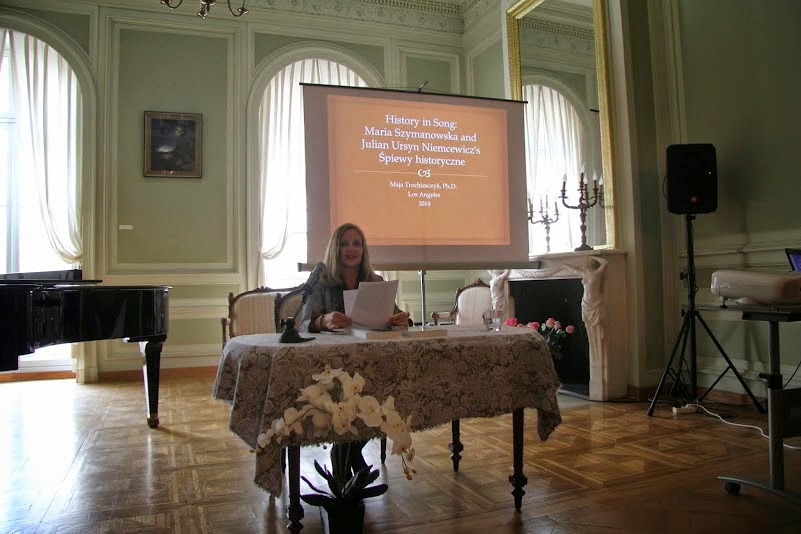
Niemcewicz was the author of the famous Historical Chants (Śpiewy historyczne”) - a bestseller of the 19th century, present in every patriotic Polish home, including the Chopin family salon in Warsaw. This volume and Szymanowska’s contribution to it was the subject of my presentation, illustrated by engravings of  scenes and songs from the lives of the kings and heroes published in the original edition and its subsequent reprints.  The author, poet, journalist and politician and one of his main sponsors, Duchess Maria Czartoryska de Wurttermberg (Wirtemberska) are fascinating personalities in Poland’s artistic and musical history, and deserve a lot more attention that could be bestowed on them in my overview. The reading and singing of chants that were being assembled for publication took place in Czartoryska’s Azure Saturdays, literary gatherings in the Czartoryski Azure Palace in Leszno near Warsaw  (1806-1816).  The salons provided a venue for meetings of Warsaw’s literary elite, with Kajetan Kozmian, Maksymilian Fredro, Franciszek Lessel, Karol Kurpinski, Niemczewicz and Szymanowska as frequent guests.  The Czartoryski and Zamoyski families were among the main sponsors- subscribers to the first edition of the Historical Chants, also supported by Potocki and Tarnowski magnates, Warsaw school professors, the cleargy and minor gentry.  In PRL-period histories, the role of aristocracy in the creation of Polish culture was under-appreciated for obvious ideological reasons. Only now,  25 years after the fall of the system we can approach this topic anew, without “socialist” prejudices.


In  “Śpiewy historyczne” the song about hetman Chodkiewicz was penned by Duchess Chodkiewiczowa, the song about Hetman Zamoyski was written by Duchess Zofia Zamoyska (nee Czartoryska).  Maria Wirtemberska set to music a song about  Stefan Potocki and the whole project was inspired by a setting of Duma o Stefanie Zolkiewskim by Konstancja Narbutt, composed thirty years earlier and popular in the nobility’s salons.  The greatest number of songs was by professional composers Karol Kurpiński (6) and  Franciszek Lessel (10 plus a two-voice version of Bogurodzica).  Ewa Talma’s contribution to the discussion was invaluable as she has shown that the first edition of 1816 was incomplete. Prof. Irena Poniatowska relayed the information found by Zofia Chechlinska about the fact that two composers, Cecylia Beydale and Lessel, were siblings and could not marry, as they had intended to. They were, apparently, out-of-wedlock children of the adventurous and amorous Maria Wirtemberska. 
Irena Poniatowska, Maja Trochimczyk and Ewa Talma. Photo by Judyta Nowak.

These relationships and others between the various persons in Szymanowska’s life, as well as archival documents about them could be plotted in an open, free access website that could be developed, as Anna Kijas proposed in the closing paper of the conference. A trained librarian as well as musicologist, Kijas has published a bio-bibliography of Szymanowska that showed some previously unknown letters of her daughter to an American friend, preserved in a library in North Carolina.  Indeed, it would be beneficial to have these letters scanned and made public –  the letters in Thorvaldsen Museum are already posted online. 

Anna Kijas with Prof. Halina Goldberg

A visit to the Polish Library in Paris, to see the notebooks and letters of Szymanowska family in the Museum of Adam Mickiewicz provided me with a proof of the importance of this step for the future of research.  The archives, always crowded by researchers, have amazing resources and I discovered, to my great pleasure the vast scope of patriotic songs copied by hand for personal use by Szymanowska’s children, Helena and Romuald.  The little hand-made notebooks, that can fit in the palm of a hand and be used for group singing in the salon, included hundreds of krakowiaks, mazurs, polonaises, as well as various versions of the Dabrowski Mazurka, Bogurodzica, and other patriotic hymns.  My study of the history of Polish anthems will find a follow up in these documents. 

Prof. Irena Poniatowska, Ewa Talma and Prof. Halina Goldberg at the Polish Library
archives of the Adam Mickiewicz Museum in Paris. 

While was reviewing the content of children’s notebooks, Halina Goldberg focused on the famous albums with composers’ manuscripts, in wonderful leather bindings, made to be kept and shown. She started her own album, and I had the pleasure of writing a personal note for her, as well as a silly little collage with a rain poem, inspired by our wanderings around Paris and a story by Slawomir Mrozek... 


Parisian entry in Halina Goldberg's album by Maja Trochimczyk

The conference was supported by the Paris Station of the Polish Academy of Sciences that hosted the events, provided excellent audiovisual support and lovely, French-and-Polish style luncheons and receptions for the scholars. Some of the conference attendees could stay in PAN guest rooms, while the Polish Institute in Paris hosted the rest of the scholars. Air France and KLM offered discounted air flights, and the Polish Library in Paris welcomed scholars for archival visits. 

Karen Busk-Jepsen, Anna Kijas, Elizabeth Zapolska-Chapelle, Maja Trochimczyk
Adam Galkowski and Benjamin Vogel with Halina Goldberg at the piano. 

None of that would have been possible without the energetic and talented organizer, Ms. Zapolska Chapelle who, in addition to moderating all the sessions and introducing the speakers, delighted the audience with her rendition of all five songs of Szymanowska and fragments of two songs by others (Paris and Kurpinski) that replaced Szymanowska's versions in the published Niemcewicz edition. The singer has already issued all of Szymanowska’s songs on a CD (Acte Prealable) that is a must for all 19th century music scholars, as well as those studying the biographies and work of Adam Mickiewicz and Fryderyk Chopin.  Pianist Małgorzata Kluźniak-Celińska aptly accompanied Ms. Zapolska-Chappelle and performed solo pieces by Szymanowska at the close of the conference and at the final Salon – where we heard Goethe’s poem dedicated to Szymanowska, as well as two poems of mine, along other assorted productions, as the case may be in an impromptu performance, of a dramatically varied artistic quality.  Next time, it will be better, we promise.

Elizabeth Zapolska-Chapelle with Małgorzata Kluźniak-Celińska at the piano
and Prof. Zbigniew Kuznicki. 

Participants surround Prof. Irena Poniatowska at the end of the conference.
Photo by Judyta Nowak. 

Participants receive flowers from the Director of PAN Paris Section, Prof. Zbigniew Kuznicki.
Photo by Judyta Nowak.


Tuesday, November 26, 2013

The Fourth Salon Maria Szymanowska in Paris on December 3, 2013 (Vol. 4, No. 12)


If you are in Paris next week, do not forget to stop by the Salle des Fêtes of the Fourth District of Paris on December 3, 2013 at 7:30 p.m. to participate in the Fourth Salon of Maria Szymanowska.

This poetic-musical event, subtitled Female Voices, Infinite Dreams (Voix de femmes, rêves inachevés) has been designed and planned by Elżbieta Zapolska, and directed by Ella Jaroszewicz. This is yet another cultural event in the International Project Maria Szymanowska (1789-1831) - The Woman of Europe, realized by the Parisian Société Maria Szymanowska together with many sponsors and cooperating partners.

The Szymanowska Society also manages a website in several languages, noting all events world-wide relating to the Polish composer and pianist, still delighting us with the modernity of her talent. www.maria-szymanowska.eu.

The program of the December 3rd Salon features songs and poetry by female artists of Szymanowska's time: Fanny de Beauharnais, Marceline Desbordes-Valmore, Christine Lavant, Louise Labé, Anna de Noailles, Joy Morgan, Christine de Pisan, Catherine Sayn-Wittgenstein, Aviva Shavit-Wladkowska and, of course, Maria Szymanowska.

 The Salon will be presented by Florence Rigollet, Monique Stalens, Elżbieta Zapolska (musicians) as well as actors Katarzyna Wolf, Hye Min Yang and Alexandru Pribeagu – from the theater of Ella Jaroszewicz called Studio MAGENIA.

 The Salon has been produced by the Société Maria Szymanowska with the cooperation of: Mairie du 4 e Arondisement of Paris, Historical Literary Society / and Polish Library in Paris, publishing house Les Editions Noir sur Blanc, the Polish Institute in Paris, Studio Magenia and Gazeta Paryska.

__________________________________

The Szymanowska Society is preparing the Second International Conference on Maria Szymanowska, planned for April 28-29, 2014 in Paris.  Live performances and lectures by scholars will be on the program. Prof. Slawomir Dobrzanski will show detailed relationships between works by Szymanowska and Chopin (Szymanowska's were composed and published at least 10 years earlier). I will focus on Szymanowska's songs to Julian Ursyn Niemcewicz's Spiewy Historyczne and their relationship to other songs from the same volume. Details about the Conference will be announced later.


Szymanowska specialist, pianist Slawomir Dobrzanski recently released a complete recording of all of Szymanowska's piano music, while Elizabeth Zapolska has recorded all of Szymanowska's songs. Both recordings, - two sets of 2 CDs each - are available from Acte Prealable in Poland and online via major booksellers.

Here's a preview of Dobrzanski's performing Szymanowska for the Kansas Public Radio:

http://www.kansaspublicradio.org/music/live-studio/classical-live/7213-slawomir-dobrzanski-piano


Dobrzanski's book on Szymanowska, with a CD Sample of her music is available from Polish Music Center at the University of Southern California and published by Figueroa Press associated with USC.

_____________________________________________________________


MUSICAL WORLDS OF POLISH JEWS IN ARIZONA AND TANSMAN


A mini-reunion happened at the International Conference "The Musical Worlds of Polish Jews, 1920-1960" at the Arizona State University in Tempe, where Prof. Dobrzanski performed some of piano solo pieces by Tadeusz Zygfryd Kassern.

Through October  I worked on my music history project, "Jewish Composers of Polish Music in 1943" -  a paper invited for the conference at the Arizona State University.  It was an amazing gathering of minds, with a keynote address by Prof. Antony Polonsky of Brandeis University, live music by the ART Ensemble of the Royal Conservatory of Music in Toronto, and many fascinating lectures by scholars from Poland, U.K., Australia, Canada and the U.S.  

In my project this time I decided to count the names, this time: from 173 composers listed in 1939, 101 were still alive abroad (most of them have emigrated before the war) and 12 in Poland. Looking through the outlines of the composers' lives - destroyed and twisted by absolute evil, tossed around the world by winds of history... It is not an easy topic. We want to hear about the winners, the survivors, the heroes: we do not want this senseless, absurd, pointless death. 


I was not even born then, so what I can do? The only thing - remember: Koffler and Gold who died, Tansman, Palester, Kassern, Laks who survived... And be thankful for their gift of music.


Alexandre Tansman (1895-1986), the most famous Polish composer between the wars, a friend of Stravinsky, Ravel, Koussevitzky, Rodzinski, Mitropoulos, and Segovia, wrote more mazurkas than any other composer after Chopin. His symphonies were toured around the world by major orchestras. In 1940, he composed Rapsodie Polonaise dedicated to the defenders of Warsaw and major performances of the Rapsodie took place in Washington, Baltimore, Cleveland, under the baton of Rodzinski, Mitropoulos and Tansman himself.  

Tansman's love and knowledge of Polish folklore was expressed throughout his life, not only in pieces entitled "mazurka"  but also in in using elements of rhythm and melody from polonaises and mazurkas in various orchestral pieces.  A slow movement could be a kujawiak, a fast one - an oberek.  Seventy years of composing in Polish style! With many direct tributes to Chopin.

Here is Hommage a Chopin for guitar by Alexandre Tansman performed by Frederic Zigante: 


http://www.youtube.com/watch?v=DuUOLaBDFYs

That's definitely something to be thankful for! Tansman's friendship with Andre Segovia, the master of classical guitar, and his intense musicality, resulted in creating the most important body of music for this instrument, beloved by guitarists world-wide, as can be witnessed on youtube.

_________________________________________

Szymanowska and Tansman. Two musicians, two approaches to Chopin - before his time and long after. A predecessor who influenced Chopin's musical ideas and artistic aspirations, and a disciple, breathing a thorough knowledge of his oeuvre. Two musicians, two expressions of talent - a romantic virtuoso, a neoclassical master. Both were composer-pianists. Both toured internationally and had their music published throughout Europe.  Both are vital to the history of Polish music. 


Wednesday, June 12, 2013

Szymanowska and Chopin at the Bowers Museum, Santa Ana (Vol. 4, No. 7)

On June 30 at 1:30 p.m. at the Norma Kershaw Auditorium of the Bowers Museum in Santa Ana (2002 N Main St, Santa Ana, CA 92706; tel. 714 567 3600) I will present a lecture about "Maria Szymanowska - Court Pianist to the Tsarinas" and pianist Wojciech Kocyan will play piano music by Szymanowska and Chopin. This lecture performance is one of the events associated with an exhibit The Tsar's Cabinet: Two Hundred Years of Decorative Arts Under the Romanovs on display at the Bowers Museum through the summer. The event will be sponsored by the Helena Modjeska Arts and Culture Club, with a small reception to follow. Books about Szymanowska by Slawomir Dobrzanski and a CD set with all of her piano music recorded by Dobrzanski in Poland will be available for purchase at the event.

The lecture will be richly illustrated with portraits of Szymanowska and European nobility, while the musical performance will bring her sound world to life, under the masterful fingers of Prof. Kocyan.  He will juxtapose Szymanowska's nocturnes and etudes with smaller works by Chopin, especially his waltzes - created for the same world of aristocratic salons that were inhabited by Szymanowska. The presentation is loosely based on my paper, read at the International Szymanowska Symposium in Paris, and published in the Annales de Centre de Academie Scientifique Polonaise a Paris, in 2012.

Fee: $7 Member/ $10 Non-member. Advance reservations: Visitor Services Desk, Tuesday – Sunday, 10 AM – 4 PM; bowers.org/tickets or bowers.org/calendar and fill out the reservation form or e-mail education@bowers.org. The event will begin promptly, please leave sufficient travel time.


Szymanowska's portrait by Walenty Wankowicz.
Collection of the Polish Library, Paris 

On Fashion, Portraits, and the Professional Image of Maria Szymanowska (1789-1831)


Fashion choices of classical musicians have recently attracted the interest of Mary E. Davis (Classic Chic, 2006). I bring this topic to the biography of Maria Szymanowska (1789-1831), a Polish pianist-composer who after her 1810 Parisian debut toured Europe in 1822-1826 before settling in St. Petersburg for the rest of her short life. A daughter of a Warsaw brewer, and a divorced mother of three (daughters Celina and Helena, and son Romuald), Szymanowska was able to ascend to an elevated position of the Court Pianist of the Tsarinas, and support her extended family with her music (i.e., concertizing and teaching children from aristocratic families). The pianist’s career benefited from ability to shape her “professional image” as a high-society lady of elegance and multiple talents. My project builds on the research of Anne Schwartz (2009), Sławomir Dobrzański (2007), and Benjamin Vogel (2012) that focused on Szymanowska’s talents as a savvy businesswoman and a musician with a love for English pianos. Through an analysis of her portraits by French and Polish artists (Henri Benner, Nicolas Jacques, Aleksander Chodkiewicz, Józef Oleszkiewicz, Aleksander Kokular, and Walenty Wańkowicz) revealing Szymanowska’s personal image and her fashion choices, I demonstrate that in this pianist we encounter one of the earliest instances of “professional image-making” (term from Laura Morgan Roberts, 2005).

Szymanowska's litograph based on Oleszkiewicz portrait
Collection of the Polish Library, Paris

Szymanowska created her positive image through “impression management” and “social re-categorization”- shifting the attention away from her humble roots to her preferred aristocratic milieu. The means for this transformation included appearance (clothing, hairstyles, and jewelry), carefully cultivated social networks, and virtuous conduct befitting a single mother of three, a teacher of princesses and nobles. The pianist was exposed to the attire of the nobility as a performer in aristocratic salons in Warsaw (in 1805-1806; 1812, 1823, 1827, and 1828), Paris (in 1810, 1824, 1825, and 1826), London (in 1818, 1824, 1825, and 1926), and St. Petersburg (in 1820, 1822, 1827, and 1828-31). The portraits provide an opportunity to compare her white muslin gowns, shawls, turbans, double sleeves, and jeweled belts with the predominant and changing French, Polish, English and Russian fashions of her time, including those of her mentors – Countess Zofia Zamojska, Duchess Maria Czartoryska Wirtemberg, and Empress Alexandra Feodorovna – as well as Queen Hortense, Duchess Laura Junot d’Abrantes, and Madame de Stael, among others.

The striking features of portraits by Kokular and Wańkowicz, both painted in Italy in 1825, point to a possible artistic “Agon” of the two artists who envisioned the pianist as a Queen of Tones in Rome (Kokular, the phrase was coined by Adam Mickiewicz) and a mythological goddess in Naples (Wańkowicz), thus furthering her elevated professional and social status. The ramifications of Szymanowska’s image creation that helped her to become a teacher and a role model for daughters of Russian aristocracy touch upon the concepts of “female genius” and “modesty” (the preferred virtue of society women in the early 19th century). The research for this paper, conducted at the Muzeum Literatury in Warsaw, Poland and Bibliothèque Polonaise in Paris was supported by Maria Szymanowska Society in Paris.

WOJCIECH KOCYAN

Wojciech Kocyan and Maja Trochimczyk after
a Chopin with Cherries Concert, Ruskin Art Club, May 2010

Wojciech Kocyan was praised for his “highly distinctive performances (…) superb, intelligent artistry (…)” (ClassicsToday.com) and “incisive temperament, impeccable technique and sumptuous tone” (Le Monde de la Musique.). He was born in Poland. He studied with two of the world’s most esteemed piano pedagogues: Andrzej Jasinski in Poland, where he received his Masters Degree and with John Perry at the University of Southern California, where he received a Doctor of Musical Arts Degree.

He is a laureate of several international piano competitions, including F.Busoni and Viotti, as well as a special prizes winner of the XI International Chopin Competition and the First Prize winner of the Paderewski Piano Competition. He performed in Europe, America, Australia and Japan, participating in music festivals such as Musica Antiqua Europae Orientalis, Capri Festival, Bydgoszcz International Music Festival, H.M.Gorecki Festival, Beethovenfest, Paderewski Festival, Liszt Festival in Vienna, San Francisco Liszt Festival, Cervantino International Music Festival, Morelia International Music Festival and the Chopin Festival in Paris. He has recorded for television, radio and film and his performances were broadcast in Europe, United States and Australia. His solo and chamber music recordings can also be found on DUX label. He was a subject of press articles in Poland, France, Italy, Germany, Mexico, United States and Japan.

In September 2007 the Gramophone magazine, published in London and considered the world’s most prestigious classical music journal, chose Mr. Kocyan’s recording of Prokofiev, Scriabin and Rachmaninoff as one of 50 best classical recordings ever made, alongside recordings of such luminaries as Leonard Bernstein, Dietrich Fisher-Dieskau, Nicolaus Harnoncourt and Arthur Rubinstein. It also featured the cover headline “The genius of Wojciech Kocyan”. His latest CD, of music by Robert Schumann was released in June 2012.

Dr. Kocyan is much in demand as an adjudicator and lecturer. He has been invited to give masterclasses in France, Hungary, Austria, Poland, Mexico and the United States, including such prestigious venues as the Colburn School. He is the Artistic Director of the Paderewski Music Society in Los Angeles and the Artistic Director of the American Paderewski Piano Competition in Los Angeles.

Maja Trochimczyk, Jane Kaczmarek and Wojciech Kocyan,
First American Paderewski Piano Competition, 2010