Sunday, January 20, 2013

Did Chopin Like Donuts? A Culinary Travelogue (Vol. 4, No. 1)

http://upload.wikimedia.org/wikipedia/commons/thumb/4/45/Polish_paczki.jpg/733px-Polish_paczki.jpg
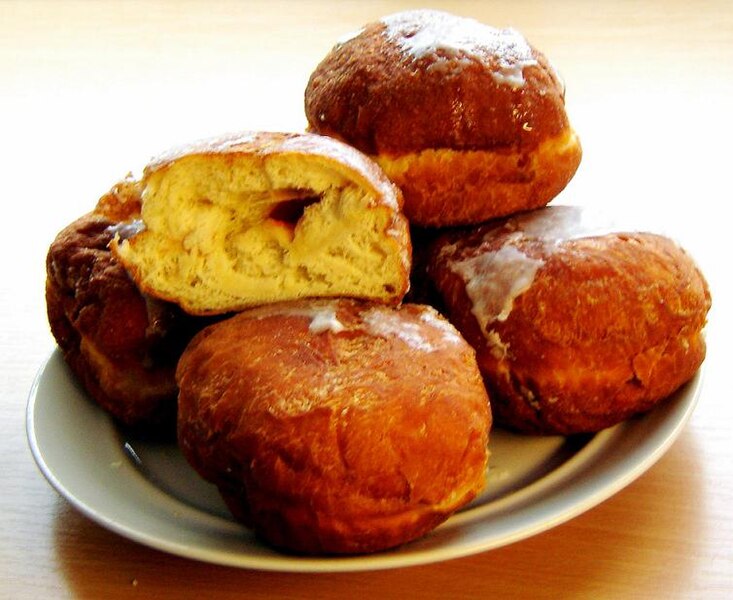
Polish donuts, photo from Wikipedia Creative Commons

Just about every aspect of Chopin's life has been subjected to scholarly scrutiny. His music, his love life, his family background all the way back to those small Alpine villages of his distant ancestors... (See: Piotr Myslakowski and Andrzej Sikorski, Fryderyk Chopin: The Origins, 2010; I discussed Polish versions of these studies in a previous blog). 

Scholars research Chopin's taste in opera, in women, in clothes. .. his daily habits, the sources of his income, the layout of furniture in his rented rooms... his letters...


On March 27, 1830 Chopin wrote from Warsaw to his friend Tytus Wojciechowski, describing the triumphs of his two concerts presenting the First Piano Concerto and other works.  The Concerto's slow movement, Adagio, completely delighted the musicians and critics. The use of a better Viennese piano at the second concert was also noted to Chopin's advantage: "What applause, praise that each note articulated like a little pearl..."  
The young pianist was justifiably proud of the compliments for his virtuosity and precocious compositional talent, though slightly apprehensive of all this admiration being "too much all at once." For instance, he protested the specter of having a portrait made for someone he hardly knew, and, thus, "being wrapped in butter"... The latter expression ("nie mam ochoty, żeby we mnie masło owijano") is an example of Chopin's lively and idiosyncratic language. 


Donuts, pastries, and gingerbread for Mother's Day, Warsaw, Poland
Photo (c) 2012 by Maja Trochimczyk

The composer ends the confessional letter with protestations of undying affection for his dearest friend and reveals that he was "hiding everything for dessert, and I have no other dessert than the most sincere embrace, because I only have you..." ("Wszystko chowałem na deser, a tymczasem nie mam innego deseru, jak tylko uściśnienia najszczersze, bo ja Ciebie tylko mam.") 

So here's Chopin's butter and desert. . .  And now, for his favorite dishes. During the Third International Chopin Congress Wojciech Bonkowski discussed "Chopin as Gourmand" (February 2010, Warsaw). What difference does it make whether Chopin liked the Viennese Sacher torte, or had a favorite brand of wine?  We know, however, that in his teen years, he was most impressed by the Toruń gingerbread (piernik).  In early August 1825, the 15-year composer wrote a report from a trip to Toruń in a letter to his friend, Jan Matuszyński, discussing Copernicus's museum, various fortified buildings, and the local specialty:

"According to the custom of gingerbread makers, gingerbread stores are entryways filled with boxes kept under key and lock; in these large wooden boxes gingerbread rests, divided into different types and arranged into dozens.  This is all I am able to write to you about Toruń, maybe I'll tell you more, but now I will only write that it was the gingerbread that made on me the greatest impression, or impact." [Podług zwyczaju tutejszego piernikarzy, sklepy do pierników są to sienie obstawione skrzyniami na klucz dobrze zamykanymi, w których rozgatunkowane, w tuziny ułożonepierniki spoczywają....To jest wszystko, co Ci o Toruniu napisać jestem w stanie, może więcej opowiem, ale to tylko Ci napiszę, iż największą impresję, czyli alias[2] wrażenie, pierniki na mnie uczyniły. ]

Torun piernik from Wikipedia (en.wikipedia.org)

Chopin liked his carbs - he admitted spending quite a lot of money on Viennese "strudels" at his favorite "Wild Man" restaurant (letter to family from Vienna, 1 December 1830). But no taste nor the most elegant company at fancy dinners and parties could replace the lost family that he sorely missed, feeling sad and gloomy (letter to Jan Matuszynski, 26 December 1830).  Still, he enjoyed traditional Polish cuisine and admitted stuffing himself on "cabbage and beef cutlets" ("kapusta i zrazy") at a hospitable Viennese home of Dr. Johann Malfatti (1775-1859)who served traditional Polish delicacies to his Polish guests. 

We could safely assume that the desserts included donuts in the mix. Chopin was familiar with the dish and saw it in favorable light, as we can infer from the following quote from his letter to Tytus Wojciechowski, written on 10 April 1830 from Warsaw: "I saw Karol's brother, he as cute as a donut..." (i brata Karola widziałem, ślicznie jak pączek wygląda). The increasingly difficult stay in Vienna ended with Chopin's departure for Paris, via Salzburg and Stuttgart.  He arrived there on 11 September 1831 and lived there ever since,  leaving only for vacations with George Sand and concert tours in England. Chopin's first descriptions of the metropolis reveal the overwhelming impression that the city made on the young visitor from provincial Poland:

"Here exist the greatest luxury, the greatest wickedness, the greatest virtue, the greatest sin, posters about sexually transmitted diseases are everywhere! - there is more screaming, yelling, noise and mud than you could possibly imagine - you can disappear in this crowd and it is comfortable because nobody asks you how you live. You can walk during wintertime down the street in rags, and then visit company of the highest rank - one day you will eat the most abundant and satisfying dinner for 32 sous in a restaurant with mirrors, gold and gas lamps - and the next day you can go to have breakfast where you'll get food for a bird and you'll pay three times as much, as it happened often to me, until I paid my dues...". (Letter to Norbert Alfons Kumelski in Berlin, written in Paris on 18 November 1831)


Soon, Parisian elegance improved his mood with countless dinner invitations that helped expand his network of supporters and students. At times, though, these invitations interfered with Chopin's friendships. For instance, in 1837 he apologized to Wojciech Grzymala, cancelling their get-together because of an "extremely boring dinner even without truffles at someone else's."  The composer-pianist made a living from teaching and concert appearances at aristocratic salons; he could not afford to refuse these "boring" invitations.  
As for the wine and coffee, the consumptive composer had to replace them with warm milk, as he admitted in a letter to his good friend Julian Fontana, who took care of his Parisian errands while the composer was travelling: "I do not drink coffee, nor wine - only milk; I stay warm and look like a maiden..." (7 March 1839).  

Nonetheless, two years later the composer asked Fontana to run a wine-related errand and find out the price of Tokay from a certain Dr. Roth in Paris; with Chopin's approval of the cost, Fontana was asked to then pass on the payment from and ship the boxes of Tokay to Marseille (24 August 1841).


Sand's Nohant estate in Berry, France, (c) 2010 by Scotiana.com

In the same letter, the composer admitted to having profound feelings of internal distress, covered up by outward cheerfulness:

 "I'm joyous outside, especially among my own (my own I call the Poles), but I'm tortured by something inside - some misgivings, anxieties, dreams or sleeplessness - longing - indifference - will to live and a moment later will to die - a certain sweet peace, apathy, unconsciousness of the mind, and sometimes an exact memory exhaust me. I feel sour, bitter, salty - what a horrid mixture of feelings is tormenting me! I feel more stupid than ever." But then, Chopin admitted, he had to cast such feelings aside in order to not miss his social obligations. That evening he was planning to dress up and go to a special dinner for Ramorin and Langerman: "there will be several hundred [guests] in the enormous restaurant 'Au Rochercancal'" (Chopin's letter to Julian Fontana, 24 August 1841).  

This restaurant, Au Rocher de Cancale, the second of this name, since 1846 in this location, is still open, you can visit it at 78 rue Montorgueil, Paris 75002.

  • Chopin's Waltz in D-flat Major, Op. 64 no. 1, composed in 1846-47, dedicated to Countess Delfina Potocka (National Institute of Fryderyk Chopin website), the Minute Waltz
  • Chopin's Waltz in C-sharp Minor, Op. 64, no. 2, composed in 1846-47, dedicated to Charlotte de Rothschild (National Institute of Fryderyk Chopin website)
  • Chopin's Waltz in A-flat Major, Op. 64, no. 2, composed in 1846-47, dedicated to Countess Katarzyna Branicka (National Institute of Fryderyk Chopin website)
Chopin also liked to eat at Cafe de Foy, located on his street. (It was open in that location in 1749-1854).  Then, of course, there was Cafe Tortoni, the most famous of Parisian restaurants of the century.  Since George Sand liked it (she met her husband Baron Dudevant in 1822 in that Cafe), she may have visited the fashionable restaurant with Chopin. But most of his dinners were taken with friends, admirers, students, benefactors, and fellow musicians in his or their homes, during elegant parties, often filled with music.  There are more than 60 mentions of dinners (obiad) in Chopin's letters, documenting a range of social engagements that mixed business with pleasure and often lasted well after midnight. 


Cafe Tortoni by Eugene Guerard,  1854 from Wikimedia Commons
Cafe Tortoni by Eugene Guerard, 1854

The busy social calendar  filled with never-ending invitations to dinners, parties and visits continued after Chopin went on a tour of England and Scotland.  On 16 October 1848, during his tour of England, Chopin wrote to his friend in Heidelberg, Adolf Gutmann:

"I wander around from one lord to another, from one count to another. Everywhere I'm welcomed with a heartfelt sincerity and infinite generosity; everywhere I find perfect pianos, beautiful paintings, and choice libraries, as well as hunting, dogs, endless dinners, as well as cellars, of which I have the least use. It is hard to imagine the sophisticated luxury and comfort of English castles."  


______________________

As a fourteen-year old spending his vacations in Szafarnia, Chopin begged his father for permission to eat the local village bread, that he was forbidden to taste for health reasons. His pean to the glories of home-baked bread of Szafarnia reaches the level of culinary poetry... If only his doctor would have tasted this white bread made of beautiful flour, he certainly would have allowed his patient to eat it. At the same time, the young musician admits that he drinks a little bit of sweet wine and eats only the ripest fruit, with the approval of his sister, Ludwika (Letter to his "Most Beloved Parents," 10 August 1824). 

No doubt, his Polish childhood included also the donuts with rose filling and candied orange peel garnish, just like the ones seen and described below.  


Donuts and pastries at an airport in Krakow
Photo (C) 2012 by Maja Trochimczyk

On Eating a Donut at the Kraków Airport


I am moved to tears by the taste of a donut
Polish donut at a Kraków airport

Puffy, oval, brown yeast ball with sticky white icing
of lukier, dotted with candied orange peel

And the aroma of the rose confiture, a delight
I found in a café with a pretentious English name

One “Morning Coffee” in an ancient city of a hundred
Kawiarnias – alive with the dark fragrance of kawa

That black powder looted from the Turkish army
After the victory of Polish cavalry ended the siege of Vienna

Ah, forgotten stories, secrets, tastes of my childhood
My mom’s lessons how to properly peel an orange

Cook slices in syrup, add just enough vodka to the dough
To keep grease away… I bite into the soft, white flesh

My eyes fill with tears I had swallowed
When I walked into her antique-filled condo

And I saw her - frail, dove-white, forgetful
A shadow of the boisterous woman I feared

She ruled over her family with iron resolve
And made perfect donuts with rosehips and orange

I cry over my donut on this cloudy morning
Grey Polish skies open to let sunrays through

A dazzling hole in heaven, like the triangular eye
Of the Trinity resting on a stack of puffy clouds

On the ceiling of the Baroque church on Skałka
The nation’s shrine with gold angels on sandstone walls

It saw generations pass on their pilgrimage
To the agate-columned altar and the eye of infinity

This Divine Eye looks at me from beyond
when I bite into the teary saltiness of my donut  

Sweet Polish donut at a Kraków airport –
Full, round donut as it should be 

(C) 2013 by Maja Trochimczyk


Friday, December 21, 2012

On Chopin and Polish Christmas Carols (Vol. 3, No. 13)


Time for Christmas, again...and time to remember "Lulajze, Jezuniu" - the beloved Christmas lullaby that Chopin quoted in his first Scherzo, Op. 20 in B Minor, while staying in Vienna after leaving Poland forever in 1830. The drama of the November uprising and the distance from his beloved family, coupled with anxiety and a foreboding of no return, put the young composer in an emotional turmoil, expressed most poignantly in his famous Stuttgart Diaries.

Like the private journal entries, the Scherzo provides an outlet for outpouring of emotion and is permeated with flights of desperation. The sweet lullaby provides a moment of serenity in the midst of this emotional onslaught. It is a symbol of tranquility of home and familial love that, as Chopin felt in 1830, may have been lost forever...


           Lulajże, Jezuniu

1. Lulajże, Jezuniu, moja perełko,
Lulaj, ulubione me pieścidełko.
          Ref. Lulajże, Jezuniu, lulajże, lulaj!
A ty Go, Matulu, w płaczu utulaj. 

2. Zamknijże znużone płaczem powieczki,
Utulże zemdlone łkaniem usteczki.  
          Ref. Lulajże, Jezuniu, lulajże, lulaj!
A ty Go, Matulu, w płaczu utulaj. 

3. Lulajże, piękniuchny nasz Aniołeczku,
Lulajże, wdzięczniuchny świata Kwiateczku. 
        Ref. Lulajże, Jezuniu, lulajże, lulaj!
A ty Go, Matulu, w płaczu utulaj.  

Hush, Little Jesus

Hush, Baby Jesus, my little pearl
Hush, my beloved sweet-pea doll
   Hush, Little Jesus, hush, do not cry
   And you, dear Mommy, comfort him now

Close your tiny eyelids tired of crying
Close your little mouth faint of sobbing
   Hush, Little Jesus, hush, do not cry
   And you, dear Mommy, comfort him now

Hush, our beautiful cherub so sweet
Hush, our graceful bloom of the world
   Hush, Little Jesus, hush, do not cry
   And you, dear Mommy, comfort him now

(trans. Maja Trochimczyk)


Poles around the world celebrate the beloved holiday starting on Christmas Eve, with a formal "Wigilia" dinner, that though sumptuous and featuring 12 different dishes, like the 12 apostles, is supposedly a "fasting" meal, without meat or meat products. When the first star is seen on the horizon, families sit down to a dinner with one empty place setting left for Divine Presence, or an uninvited guest who might show up on the doorstep on this most holy of nights.

Polish composers of carols and Nativity-themed polyphonic music in the Middle Ages and the Renaissance included Cyprian Bazylik (1535-1591), the author of "Mądrość Ojca Wszechmocnego" (the Wisdom of the Almighty Father). Wacław z Szamotul (or Szamotulski), Wacław of Szamotuły (Venceslaus Samotulinus, Schamotulinus, Samotulius, 1520-1560) wrote a carol, Pieśń o narodzeniu Pańskim (Song about the Lord's Birth) among many sophisticated polyphonic compositions. Mikołaj Zielenski (1550?-after 1616) composed magnificent, large-scale polychoral pieces that have little in common with the humble carols, except the sentiment of praising the birth of Christ ("Adoramus Te") and the love of his dedicated Mother ("Magnificat" and "O Gloriosa Domina").

The dinner on a white tablecloth covering a bit of hay, starts with sharing best wishes for the next year, breaking a white rectangular wafer called "oplatek" and with the Christmas carol, "Wsrod nocnej ciszy..." (In the Silence of the Night). The dishes include pickled herring, pumpernickel, kapusta wigilijna (sourkraut stewed with dried mushrooms, prunes, and raisins), various mushroom and fish dishes, beet soup with mushroom-stuffed pierogi and "uszka" (mini-pasta), a variety of gingerbread, shortbread, and poppy-seed desserts, and "kompot wigilijny" (a compote made with several kinds of dried fruit).

The Polish Christmas carols provide a unique soundtrack to this celebration and having these carols along with early Polish music provides an unforgettable atmosphere at the Wigilia table. "Lulajze, Jezuniu" (Hush, little Jesus), though dating back to the 17th century, is not the oldest Polish carol. It belongs among a genre especially popular in Poland, that of tranquil Christmas lullabies, that include also "Gdy sliczna Panna" (When the Lovely Virgin), "Jezus Malusienki" (The Tiny Baby Jesus), "Mizerna cicha stajenka licha" (The Poor, Still, Humble barn), and "Oj Maluski" (Oh, the Tiny One), the latter one in the "gorale" dialect of the foothills of Tatra Mountains.

Songs about Nativity retelling the various stories from the Gospels, have been sung since the introduction of Christianity to the kingdom; and rose in popularity in the 15th century, thanks to the efforts of Franciscans following in the footsteps of St. Francis of Assisi who made the first Nativity Scene and wrote several carols.
In Poland, Christmas-themed songs are divided into koledy (carols) and pastoralki (shepherd's songs), the latter with humorous or sentimental texts bringing the Nativity home to poor shepherds of Polish villages. The word "koleda" comes from the Latin Calendae, the "first day of the month".

"W Zlobie Lezy" (He Lies in a Manger), dating back to the fifteenth century, is one of the earliest Polonaises. Its text is attributed to the Polish Jesuit and famous patriotic preacher, Piotr Skarga, while the melody resembles the coronation polonaise of King Wladyslaw IV Waza.  The most famous of Polish carols - Polonaises is the magnificent "Bog Sie Rodzi" (God is Born), with text by Franciszek Karpinski dating back to 1792 and the melody reputedly used for the coronation of Polish kings back in the 16th century. These two Polonaises and "Lulajze Jezuniu," as well as many other Polish carols are in a lilting triple meter that suffuses Polish folklore with its characteristic flowing and graceful rhythm.

Not all the carols are in triple meter, of course. Here's a stately "march" about the angel and the shepherds:


The officially approved religious carols were gathered in a variety of Church Songbooks, for instance in the early 19th-century songbook "Śpiewnik kościelny" (Church Hymnbook, 1838-53) edited by Michał Marcin Mioduszewski. The very first recorded Polish Christmas carol was "Zdrow bądź, krolu anjelski" (Hail, the Angelic King) from the 14th century.


Other earliest koledy were based on Latin melodies with texts adapted into Polish. "Chwalmyż wszyscy z weselem" (Let Us All Praise with Joy) and "Pieśń o narodzeniu Pańskim" (Song about the Lord's Birth) were both based on the melody of the Latin "Dies est laetitiae." The Polish carol "Ojca niebieskiego" (Of Heavenly Father's) used a melody known in the whole Europe. "Dzieciątko dostojne z błogosławionej Dziewice Maryjej" (The Honourable Child From Blessed Virgin Mary) was based on Latin carol "Salve parvule." "Narodził się nam dziś niebieski" (Today, the Heavenly Lord was born unto us) was a version of medieval "Angelus Domini ad pastores." "To-ć czas wdzięczny przyszedł" (A Graceful Time Has Come) was a variant of the Latin hymn of praise of angels, "Ave hierarchia."


We should not forget the "Melodie na Psałterz Polski" (Melodies to Polish Psalter), a pearl of Polish Renaissance music by the Protestant Mikołaj Gomółka (1535 - 1591?), though these lovely pieces are not carols at all... A very popular evening prayer by Waclaw of Szamotuly, "Juz sie zmierzcha" (Already it is Dusk) inspired Henryk Mikolaj Gorecki (1933-2010) to write his first String Quartet, extensively quoting from the tranquil Renaissance melody.


Stanislaw Niewiadomski (1859-1936), Feliks Nowowiejski (1887-1946), and Stanislaw Wiechowicz (1893-1963) made choral arrangement of Polish traditional carols that are popular until today. In 1946, in newly "liberated" and completely devastated Poland, Witold Lutosławski (1913-1994) made an arrangement of "Dwadzieścia kolęd" (Twenty Carols) for voice and piano. Forty years later, in 1984-89, he arranged these carols for soprano, female choir and chamber orchestra; this version often graces the concert stages around the world.

Henryk Mikolaj Gorecki used echoes of "Silent Night" in the ending of his String Quartet no. 2 (1991). Krzysztof Penderecki (b. 1933) extensively quotes "Silent Night" in his Second Symphony, subtitled the Christmas Symphony and marking his return to neo-Romanticism after cutting-edge experiments of the earlier years.


There are many more Polish carol settings by classical composers, and multiple versions of carols by popular musicians, including even such giants of Polish jazz as Urszula Dudziak, or of Polish rock as Slawomir Krajewski (who wrote several carols to texts by Agnieszka Osiecka that became classics in their own right).

Merry Christmas, everyone!


___________________________

SOURCES OF INFORMATION:

I'm quoting the titles of the earliest Polish carols from an outstanding website Completorium Polish Early Music Collection, created by Boguslaw Krawczyk and featuring Polish earliest Christmas Carols. This site is included in the Kunst der Fuge international site on Medieval and Renaissance Music.

 More in-depth studies and comments on Polish music may be found on the blog of Prof. Adrian Thomas,
"On Polish music and other Polish topics."

For a study of "Religious Folklore in Chopin's Music" by Jan Wecowski, including the incipit of the "Lulajze Jezuniu" carol copied above, see the article in the Polish Music Journal of 1999.

Academic studies of Polish carols include: Polskie kolędy i pastorałki by Anna Szweykowska (Krakow: PWM Edition, 1985), in Polish, out of print.

Photos and stories from family albums of Maja Trochimczyk

Monday, November 26, 2012

Chopin at the AMS/SMT Conference in New Orleans (Vol. 3, No. 12)

References to Chopin's music abounded during many sessions of the Joint Meeting of the American Musicological Society, Society for Music Theory, and Society for Ethnomusicology held recently in New Orleans, LA.

Special AMS Session on Chopin's music was scheduled for Thursday, November 1, 2012. Chaired and organized by Prof. Jeffrey Kalberg (University of Pennsylvania), the sessionw was called "Chopin Revisited" and featured three papers by Chopin scholars:

1. Nationalizing the Kujawiak and Constructions of Nostalgia in Chopin’s Mazurkas - Halina Goldberg (Indiana University)

"Chopin used the slow mazurka—the kind widely but anachronistically called kujawiak—to summon nostalgia for the spatially and temporally distant—and mythical—Poland. But rather than referencing his homeland through the supposed identity of this dance, Chopin invokes it through musical styles and gestures typical of then-popular characteristic pieces typically marked by the adjectives pathétique, elegique, lugubre, triste, or mélancolique." (Halina Goldberg)


2. Ferruccio Busoni and the “Halfness” of Fryderyk Chopin: A Study about Gender Perception and Performance Interpretation - Erinn Knyt (University of Massachusetts)

"My analysis of a previously unpublished and un-translated essay by Busoni, “Chopin: eine Ansicht über ihn,” in conjunction with analyses of recordings, concert programs, and recital reviews, connects Busoni’s unconventional Chopin interpretations to an idiosyncratic perception of Chopin’s character. Busoni’s essay shows that he too acknowledged a “poetic,” “feminine,” and “emotive” side in the music commonly attributed to effeminate perceptions of Chopin at the time. Yet he simultaneously perceived “half- manly” and “half-dramatic” elements in the music and in Chopin’s character—that is, a heroic monumental side—as well. What he strove to portray in his interpretations was the “whole” of Chopin and his music. He sought to distance himself from the gendered “halfness,” as he called it, which informed contemporaneous interpretations. In so doing, he became a pioneer of Chopin programming and interpretation." (Errin Knyt)

3. The Institution of the International Chopin Piano Competition and Its Social and Cultural Implications -
Tony Lin (University of California, Berkeley)

"By examining the competition’s founding, sponsorships, participants and public reception, I show that what began as an effort to understand Chopin’s music better became much more than a musical affair. I argue that Poles continue to appropriate Chopin for political purposes, as they did in partitioned Poland, where cultural artifacts such as Chopin’s music were critical because they came to constitute the “Polishness” for which the Poles were desperately searching. .. Even though Chopin is now a household name internationally, his music was less popular both inside and outside of Poland prior to 192 7. The competition has played an instrumental role in strengthening the image of Chopin as Poland’s national “bard” while exporting this image to the wider world." (Tony Lin)

Also on November 1, 2012, the Society for Music Theory featured a session on "Schumann and Chopin" with two papers on Chopin:

1. Sonata Form in Chopin: An Evolutionary Perspective - Andrew I. Aziz (Eastman School of Music, University of Rochester)

2. Modeling a Physical Dominant Transformational Relation in Chopin—the Handnetz - James Bungert (University of Wisconsin-Madison)

Another session, on "Gesture and Music", held on November 2, 2012, started from a paper about Chopin by Margaret Britton (University of Texas at Austin): Four Gestural Types in Chopin’s Mazurka in C-sharp Minor, Op. 50, no. 3.

Those who wanted to hear Chopin played, instead of listening to scholars talking about him, had a treat on Saturday, November 3, 2012. The noon Lecture Recital by Sezi Seskir (Bucknell University) was entitled "Stolen Time: Temporal Shaping through Musical Markings in the Nineteenth Century." The lecture-recital used examples of tempo rubato in the music of Chopin, Schumann and Brahms.

"After 1828 Chopin started using the term rubato in his scores, yet this was not the only license he gave the performer in matters of flexible time. Similar to Schumann and later Brahms, he provided a richer vocabulary of markings in his scores to inform the performers more precisely about his musical intentions. A close study of these markings in light of treatises from the early nineteenth century reveals indications not only about change of dynamic and touch but also about a flexible treatment of time that can help the performer shape music expressively, enabling moments of intimacy to be created in a threshold of regular pulse. The fantasy as a genre welcomes the use of tempo rubato more than any other, owing to its looser, more flexible form. The Polonaise-Fantasie, op. 61 of Frédéric Chopin,  the first movement of Schumann’s Fantasy in C major, op. 17, and Seven Fantasias op. 116, nos. 1 and 4 of Johannes Brahms offer interesting examples of the rich and detailed use of accentuation markings that serve to inspire the player to use a subtle amount of flexibility of time." (Sezi Seskir) 

Saturday, October 6, 2012

On the Gifts of Krakow – Hejnal and Krakowiak (Vol. 3, No. 11)

The Marian Basilica, Krakow, Poland, photo by Maja Trochimczyk
Hejnal Mariacki

The silver tones of the trumpet brighten the crisp morning air. The trumpeter, unseen, plays from the top of the tower of the Marian Church in the Main Square of Kraków, Poland. It is still foggy and the streets are almost empty, save for delivery trucks and the most courageous flower sellers filling their vases with water in the market. The melody is called “Hejnal Mariacki” and named after the Marian Church where it is played four times at every hour from tower windows opening to the four directions of the world. The Hejnal flows and echoes off the rooftops until it suddenly ends, as if interrupted. This abrupt end, repeated each hour, every day (96 times per day, if all repetitions are counted) is a memorial of sorts.
A legend has it that during a Mongol invasion in the 13th century the Hejnal, played as a warning by the town’s guard, was cut short by an arrow that killed the trumpeter and the melody has been played the same way ever since. Actually, as documented by historian Jerzy Dobrzycki (Hejnal Krakowski, Kraków: PWM, 1983), there is no historical proof of that story and the first record of the melody’s existence dates back to 1392; it was initially played at dawn and dusk, to mark the opening and closing of the town’s gates. It has sounded daily since 1810, and the performances were institutionalized in 1873 when the professional Fire Brigade was created in Kraków and the firemen were given the task of playing the Hejnal. Since 1927, the Polish Radio has broadcast the noon performance nationwide. During my Polish childhood in the 1960s and 1970s, the noon performance was broadcast by Polskie Radio 1 (“Jedynka”); it is still on air daily.

The four repetitions of the melody, separated by the steady steps of the trumpeter walking from window to window, appear after the 12 strokes of the bell announcing noon. The bell, the steps, the squeaking windows, and the trumpet melody are all part of the performance on air. I regularly heard it only during summer vacations at my grandparents’ houses, since we did not listen to “Jedynka” at home, in Warsaw. I have always liked it, with its overtones of freedom and fun of the summer, with its air of mystery – What was that noise? Who’s walking?

Church Towers in Krakow, Poland, by Maja Trochimczyk
Krakow rooftops, with towers of Marian Basilica, by Maja Trochimczyk


In Kraków’s Main Square at 7. a.m.


The trumpet’s silver notes
Glisten in morning sunlight
Scatter over the rooftops
Cascade to the cobblestones
In waves of bejeweled music


Arise! This is a lovely day
Wake up, wake up with a smile
Give thanks and remember...

The crowned church towers
Fingers grasp clouds in the sky
Conceal the pattern of gold stars
Painted on indigo ceiling
Inside the gothic interior

In an ancient Basilica
Wit Stwosz’s medieval altar
Shines among incense and shadows
The forest of columns stretches
Back and forward in time

The trumpet’s silver notes
Glisten in morning sunlight
Scatter over the rooftops
Cascade to the cobblestones
In waves…

Ceiling of Marian Basilica, Krakow, Poland, by Maja Trochimczyk
Ceiling of the Marian Basilica, Krakow, (c) 2012 by Maja Trochimczyk

____________________________________________________________


Chopin and Krakow

It is not clear if Chopin ever heard the Hejnal. He was from Mazowsze and the mazurka, not the krakowiak was close to his heart. When emigrating in 1829, he traveled via Krakow, but without stopping for long, he moved on to Vienna…By that time, the melody was played several times per day.

The best known of Chopin’s Krakowiak’s is Rondo à la Krakowiak in F major, Op. 14 for piano and orchestra. composed in 1828, with quotations from Paganini’s Caprices and  its virtuosity featuring stile brillante ornaments. The "Albosmy to jacy tacy" Krakowiak is quoted here. Stylistically similar is the krakowiak in the last movement of the Concerto in E minor, Op. 11 (written 1830, published 1833), as in the Rondo, it sparkles with stile brillante and youthful bravura.

There is only one study of Chopin krakowiak’s – “The Problem of the Krakowiak in Chopin’s Oeuvre” by Ludwik Bielawski (Problem krakowiaka w twórczości Chopina), published in The Book of the First International Musicological Congress devoted to the Works of F. Chopin: 16-22 II 1960 in 1963, edited by Zofia Lissa (Warszawa: PWN). Since the article takes only four pages (100-103), the topic is not exhausted.
_________________________________


Krakowiak or the Cracovienne

Krakowiak is a Polish dance from the region of Kraków, the old capital of Poland (used by the Piast and the Jagiełło dynasties) and the center of southern part of the country, called Małopolska (Little Poland). The common name used in English is cracovienne (from the French); in German the dance is known as Krakauer Tanz. The term refers to a group of dances from southern and central Małopolska, which are known by their places of origin (proszowiak from Proszów), or by the particular figures used in their choreography. According to the entry in The New Grove Dictionary of Music and Musicians (1980 ed.), "in its origins, the krakowiak seems to be connected with courtship ritual." The dance dates back to the 16th and 17th centuries when it was included in organ and lute tablatures, as well as songbooks, under such titles as Chorea polnica or Polnish Tanz

However, the first time that the name itself appeared in print was in Franciszek Mirecki's 1816 piano album, Krakowiaks Offered to the Women of Poland (Warsaw, 1816). In the mid-19th century, the krakowiak became a popular ballroom dance in Austria and France and grew to be regarded as a "national dance" of Poland (it competed with the polonaise). For Poland, this was the time of partitions and the unsuccessful uprisings (1831, 1848) which sought to regain the country's independence. The krakowiak, polonaise, and even mazurka, appeared in the Parisian salons as symbols of solidarity with the oppressed nation. At the same time, the krakowiak became a choice of composers who transformed it into an extensive and even virtuosic form, beginning from Fryderyk Chopin's Krakowiak (grand rondeau de concert) for piano and orchestra (op. 14, 1828; including a quotation of the popular "Albośmy to jacy tacy"), and including pieces by Zygmunt Noskowski, Ignacy Jan Paderewski, and Roman Statkowski. As the result of this increased artistic stature, even the ballroom form of the dance grew in scope and the dance was transformed into a three-part form, with the music featuring a contrasting central section, and modulations to other keys.

Krakowiak woodcut by Zofia Stryjenska
The krakowiak is a fast dance in duple meter; it uses a characteristic syncopated pattern of short-long-short (or eight-note - quarter-note - eight-note) which allows one to recognize the dance form quite easily. Another variant is an eighth-note followed by an accented dotted quarter-note; both are illustrated below:

This pattern alternates with the simpler rhythm of two eighth-notes, plus one quarter-note (or: short-short-long). The phrases are symmetrically arranged in pairs of four measures each, though the texts of songs used in the krakowiak are grouped in four lines of six-syllables each. The melodies feature a great variety of patterns, with added extra notes, dotted rhythms, and passages based on triads.

The great popularity of the krakowiak among the American Polonia has antecedents in its widespread presence in American popular music since mid-19th century. A famous Austrian dancer, Fanny Elssler, presented the Cracovienne for her debut in New York: dressed in red boots, blue shirt, white jacket and velvet cap, she delighted her audiences and secured the position of this dance in the American popular repertoire. Aleksander Janta lists 32 Cracoviennes, 4 songs Cracovian Maid, and 5 Krakowiaks in his inventory of Polish dances composed in the U.S. at that time (A History of Nineteenth Century American-Polish Music, p. 114-124).

The krakowiak is set for several couples, among whom the leading male dancer sings and indicates the steps. According to the description in the New Grove Dictionary of Music and Musicians, the krakowiak is directed by the leading man from the first pair. As they approach the band, "the man, tapping his heels or dancing a few steps, sings a melody from an established repertory with newly improvised words addressed to his partner. The band follows the melody, and the couples move off in file and form a circle (with the leading couple back at the band). Thereafter verses are sung and played in alternation, the couples circulating during the played verses." There are several figures which appear in the different stages of the dance: the invitation phase, the running, the shuffling, the passing, etc. The three most characteristic steps are: the galop (fast running forward), the hołubiec (jump with clicking the heels and stamping; pl. hołubce), and the krzesany (this term is used as a name of a separate dance in the Podhale area, but here refers to a sliding motion of the feet with stomping).

_____________________________________________________


The description of "Krakowiak" is from my entry on this topic on the Polish Dance in California website and in the Polish American Encyclopedia, McFarland, 2011.

The impressions from Krakow and listening to Hejnal appear in brief articles in the Ecomusicology Newsletter and the PAHA Newsletter (Fall 2012).

Photograph of Krakusy in Krakow, 1996, courtesy of Krakusy Polish Folk Dance Company.
Zofia Stryjenska "Krakowiak" - postcard from Maja Trochimczyk collection.
Kosciol Mariacki by Maja Trochimczyk, May 2012.

Tuesday, September 25, 2012

Living in the Present with Chopin, Pianists, and Poetry (Vol. 3, No. 10)

The three studies of Chopin's endless lists of relatives, friends and close of kin, that I selected for my summer reading, have completely exhausted me, so instead of finishing the third book (Chopinowie: Krag Rodzinno-Towarzyski, in Polish [The Chopins: A Familial-Social Circle] by Piotr Myslakowski and Andrzej Sikorski, wyd. Familia, 2005), I decided to write some poetry. 

The first poem is about poets and pianists, and is dedicated to the ghost of Fryderyk Chopin, hovering above the fingers of all aspiring pianists and haunting their dreams... The poem recently appeared in the San Gabriel Valley Poetry Quarterly Vol. 55 (Fall 2012).

Willows in Water, Boston, September 2012 photo by Maja Trochimczyk
Waves and Willows, (C) 2012  by Maja Trochimczyk

The Art of the Fugue

I prefer pianists to poets
passages of fancy on the keyboard
to the wool of words spun out to confuse

the sensuous touch of fingers
the flight of ivory starbirds
airwaves caressing my skin

I tremble when the pianist's chords
ascend beyond his shadow
into the rare, translucent heaven

with words, the passion's distant
conjured up, it lingers
emerging stealthily, an assassin

waiting to destroy indifference
from the crafty magician
of similes and synecdoches

poetry's dangerous to the poet
deluded by power to create
worlds evoked in brilliance

woven into nets of shifting meanings
the black spots on the page
hide a universe of wishful thinking

music is here to last - transient,
immortal, it carries you into yourself
the heartsong of ever now
________________________________

My most recent project is publishing the same poem about living in the present in the greatest number of languages possible. Memento Vitae so far appeared in several publications in the original English, but was also translated into Serbian by Dr. Mirjana Mataric  (and published in a literary journal Svenske and in a daily newspaper Vecernje Novosti in Belgrade, in July 2012).  Only after the Serbian translation has proven to be such a big hit, I translated it into Polish, while Elizabeth Zapolska-Chappelle made a French version (reproduced below with the English), and Elsa Frausto, an Argentinian Californian of Slavic descent, has worked on a Spanish version. Having a poem, any poem, picked for publication by a major national daily paper is a reason for celebration. And I'd like to celebrate it by spreading the news about this poem and its impact, as a reflection on the meaning of life and the universe and everything... Other translators are welcome.

Water Droplet on a Leaf, Boston, September 2012 photo by Maja Trochimczyk


Memento Vitae


Let’s talk about dying,
The gasp of last breath.
The end - or maybe not,
We don’t know.

Let’s talk about the last day.
What would you do
If you knew?
Whom would you love?
Would you find your dearest,
Most mysterious love?
Or would you just stay
In the circle of your own?
Would you rob, steal
Or insult anyone?
Would you cry?
Burn your papers?
If the fabric of your future
Shrank to one day,
Or maybe an hour?

Let’s talk about living, then.
The next breath,
That will take you
To the next minute,
The next heartbeat.

Just about – now.

(c) 2008 by Maja Trochimczyk
__________________________

Water Droplet on a Leaf, Boston, September 2012 photo by Maja Trochimczyk

Et si l’on chantait la mort?

Le bruit du dernier soupir ?
Est-il vraiment le dernier ?
Qui peut en être assuré…

Et si l’on chantait l’ultime jour ?
Comment serais-tu devenu
A l’annonce de son arrivée ?
Vers quel amour serais-tu allé ?
Vers le plus beau et l’inconnu,
Le plus mystérieux des amours ?
Ou vers celui qui t’accompagne
Depuis une éternité ?
Aurais-tu envie alors
De blesser, de voler quelqu’un ?
T’effondrerais-tu en larmes
Ou brûlerais-tu tes papiers ?
Si l’étoffe de ta vie entière
Se rétrécissait à un jour
Ou à une seule petite heure ?

Et si l’on chantait donc la vie ?
Avec le prochain soupir,
Qui te rapprochera
De la minute qui vient ?
D’un cœur qui bat à nouveau?

Maintenant. Juste – maintenant.

Translated by Elisabeth Zapolska-Chappelle, September 2012

___________________________________

As for Chopin's family and genealogy, yes, it is important and I hope that the three studies will be translated and published in English. At least a summary should be translated and used by his biographers who have access only to the secondary literature in English. There were so many branches in each family - cousins, people with the same name, and no relation... Previous biographers of Chopin would pick a name and assume because it was the same as used in Chopin's family (Krzyzanowski, for instance), its owners were surely members of Chopin's family as well as his ancestors. As Myslakowski and Sikorski documented these genealogies and family links, over more than 10 years of archival reasearch, it becomes clear that Chopin's family history is both more complicated and simpler than assumed. Let me finish by stating that not everyone is a cousin of everyone else...

___________________________________

NOTE: Photos from Boston's "Swan Lake" Park, September 2012 by Maja Trochimczyk

Saturday, August 18, 2012

Chopin's Family Revealed - Three Books in Polish (Vol. 3, No. 9)

Cover of "Rodzina Matki Chopina" by Sikorski and Myslakowski
During my summer travel to Poland and two conferences on emigration, in Krakow and Gdansk, I met with my academic mentor and advisor, Prof. Zofia Helman of the University of Warsaw. After a light lunch at the faculty club in Kazimierzowski Palace, she promptly took me shopping to the Prus Bookstore across the Krakowskie Przedmiescie street.  My box of books on music has recently arrived with three biographical treasures about Chopin's family and circle of friends:

1. Rodzina Matki Chopina: Mity i Rzeczywistosc [The Family of Chopin's Mother - Myths and Reality], by Andrzej Sikorski and Piotr Myslakowski (Warszawa, Studio Wydawnicze Familia, 2000)

2. "Rodzina Ojca Chopina: Migracja i Awans" [The Family of Chopin's Father - Migration and Ascent] by Piotr Myslakowski (Warszawa, Studio Wydawnicze Familia, 2002)

3. "Chopinowie: Krag Rodzinno-Towarzyski" [Chopins - The Familial-Social Circle] by Piotr Myslakowski and Andrzej Sikorski (Warszawa, Studio Wydawnicze Familia, 2005).

The three books, available only in Polish, are based on decades of intense archival studies by the authors, as well as reports from archival studies by other scholars. They include numerous transcripts and translations of archival documents and debunk myths about the origins and upbringing of Fryderyk Chopin, the scion of French and Polish families that could be described as "lower middle class" today.

The French heritage of Chopin's father, Nicolas, was questioned by patriotic mythmakers in the past. Ideas that he was a descendant of Polish soldiers who settled in France were circulated at the end of the 19th century. Piotr Myslakowski shows conclusively that this, widely abandoned myth, had no grounds in facts. He also reveals surprises in Chopin's lineage.  His forefather moved from a small Alpine village of smugglers living in abysmal poverty to lower, border area of France that used to be a part of the kingdom of Lotharingia and is now called Lorraine region.

Cover  of "Rodzina Ojca Chopina" by  Piotr Myslakowski
Apparently, the great-great-...-grandfather of Chopin left the home village and never looked back. From the underclass of smugglers the family rose to the lower class of peasants and artisans in the village.  One of the Lorraine great-great-grandfathers of Chopin became a wheel-maker and a scribe, rising to a position of note in the community. His descendant, Nicolas, left his family behind at the age of 17 when he moved to Poland where he became first a live-in tutor of sons of noble families, and then a school professor and principal. In one step after another, the family rose from murky and far-less-than-respectable background through hard work, education, and the pursuit of virtues and moral values. The subsequent generations of Chopins in the three locations did not stay in touch. When the artistocrat-of-the-spirit Chopin moved to Paris to hobnob with princesses, he did not look up his aunts and cousins in Lorraine. They were peasants, he was a friend of aristocrats. They had nothing in common. His ample correspondence with his family shows intense affection for members of his immediate familial circle. But he had no interest, nor need to reach out beyond.

Similarly, the family of his mother came from humble roots. Not as humble as the French family: her kin were among impoverished gentry who often disappeared from historical records, as they did not own land or estates. The two scholars traced their history through the records of baptisms - the Krzyzanowski family members could be Godfathers or Godmothers to various children where they lived. Another lively and surprising source of family history was found in the court records of the warring, lawless "less-than-noble" members of the Polish landed gentry, whose pastime, it seems, was to sue each other and, in an absence of an execution of the sentence, raid their enemies and attack, injure or even kill them, while destroying or stealing their possessions. As an employee of such a brigand-noble, one of Justyna Krzyzanowska's forebearers is noted in several court records of this kind. Fascinating reading!

I have not yet started reading the "family circle" part of the three books, but I believe that it would be to the benefit of English-speaking Chopin lovers and scholars to have access to their English translations.  The books are written in a very engaging and engrossing fashion. I read the story about Chopin's father as if it were a murder mystery - and, in fact, a mystery solved it is. The sooner we have English versions, the better for all future scholars of Chopin's life and music.


Sunday, July 8, 2012

Chopin's Prelude and the Prometheus, or Music vs. Aliens (Vol. 3, No. 8)

Chopin Portrait, Vintage Postcard from Maja Trochimczyk's Collection
Of all the preludes by Chopin, the one in D-flat Major, op. 28 no. 15, known as the "Raindrop" prelude, has attracted the most attention - among the poets and filmmakers, at least. . . I think it is because it is relatively easy to play; even I could learn it! And I was known in my music-making days as having two left hands on the keyboard. ..

In any case, this sublime melody (or rather, the sostenuto themes appearing in the A-sections of the ABA form) has recently been used in a new sci-fi film by Ridley Scott, "Prometheus." This pre-quel to the alien trilogy, focuses on the attempts of totally evil, poisonous alien creatures, both grossly slimy and supremely intelligent, to take over and destroy humanity.

Apparently, Ridley Scott has loved this melody for a long time and decided to use it both in the film and in the final credits as a symbol of what matters. Chopin's miniature becomes here the most delicate sign of our shared humanity, threatened and attacked by unbearable screeches of the alien life-killing life forms. [An account loosely based on an article in the Los Angeles Times, July 6, 2012]

_______________________________

Let's listen to the Prelude played by pianists who did not have two left hands:


  • Arthur Rubinstein: Prelude in D-flat Major, op. 28 no. 15, a tad too fast to my taste...
  • Martha Argerich: Prelude in D-flat Major, op. 28 no. 15, with amazing rubatos!
  • Maurizio Pollini; Prelude in D-flat Major op. 28 no. 15, this one is a concert encore, a great way to end an evening...

  • ________________________________


    Chopin's Room at Valldemosa, Mallorca, Vintage Postcard, Maja Trochimczyk Collection
    The "Raindrop" Prelude has been surrounded by stories and legends since its creation. Chopin wrote some of it during the fateful stay in the Monastery on the island of Mallorca, the city of Valldemosa in 1834. He got really sick and was suffering from hallucinations, nausea, and fevers. Some modern scholars claim that these were the symptoms of his poisoning with carbon monoxide, from a heater he had in the closed space of the cold cell where he was composing all day.

    George Sand wrote in her Histoire de ma vie that Chopin had a very peculiar vision or dream, while playing the piano and working on this prelude:

    He saw himself drowned in a lake. Heavy drops of icy water fell in a regular rhythm on his breast, and when I made him listen to the sound of the drops of water indeed falling in rhythm on the roof, he denied having heard it. He was even angry that I should interpret this in terms of imitative sounds. He protested with all his might – and he was right to – against the childishness of such aural imitations. His genius was filled with the mysterious sounds of nature, but transformed into sublime equivalents in musical thought, and not through slavish imitation of the actual external sounds."

    __________________________________

    Before the cosmic battle of Ridley Scott's aliens, film-makers used the Prelude in a variety of contexts, as listed on Wikipedia by anonymous sribes (thanks for all the work!):


    • In the 1979 James Bond movie Moonraker, villain Sir Hugo Drax plays the Raindrop Prelude in his chateau on a grand piano when Bond comes to visit.
  • The raindrop prelude is also featured on the soundtrack of the 1996 Australian film Shine about the life of pianist David Helfgott.

  • The prelude appears in the "Crows" section of Akira Kurosawa's film Dreams.

  • The prelude plays a pivotal role in the 1990 film version of Captain America. The piece is played at a childhood piano recital by the young prodigy who would become the Red Skull, and a recording of this incident is later played by the titular hero to delay the now-70-year-old Red Skull from detonating a nuclear bomb that would destroy all of Southern Europe, the detonator for which was also concealed in a grand piano.

  • The dramatic bridge of the prelude was used in an elaborate pre-release commercial for the video game Halo 3 as a part of the $10 million "Believe" ad campaign. The piece plays over close-up footage of a highly detailed diorama of an historically pivotal battle in the game's universe.

  • The piece appears in the John Woo film Face/Off in a seduction scene between Castor Troy and Eve Archer.

  • The prelude appears in the fantasy video game Eternal Sonata, where Chopin's music plays a major part.

  • The piece is studied as a 'Set Work' in the English exam board Edexcel's GCSE in Music.

  • The piece is used in the film Margin Call, as Kevin Spacey's character sleeps in his office but is then woken up by the prelude's climax.

  • The prelude is used in the English trailer for the Japanese film Battle Royale.

  • In addition, a music blog, The World's Greatest Music, mentions yet another TV appearance of Chopin's Prelude, in the credits of a 1980s show, Howard's End.

  • If you know of more ways to "kill" this perfectly beautiful piece of music, let me know...

    __________________________________  

    The Prelude No. 15 has long been a favorite of poets. In the anthology "Chopin with Cherries," there are no fewer than ten poems inspired by or mentioning this particular prelude. Christine Klocek-Lim goes back to the story by George Sand.  

    Prelude in Majorca  

    Christine Klocek-Lim  

    The wet day carried rain into night
    as he composed alone.
    With each note he wept
    and music fell on the monastery,
    each note a cry for breath
    his lungs could barely hold.
    Even as his world
    dissolved around him
    “into a terrible dejection,”
    he played that old piano in Valldemosa
    until tuberculosis didn’t matter;
    until the interminable night
    became more than a rainstorm,
    more than one man sitting alone
    at a piano, waiting
    “in a kind of quiet desperation”
    for his lover to come home
    from Palma.
    When Aurore finally returned
    “in absolute dark”
    she said his “wonderful Prelude,”
    resounded on the tiles of the Charterhouse
    like “tears falling upon his heart.”
    Perhaps she is right.
    Or perhaps Chopin “denied
    having heard” the raindrops.
    Perhaps in the alone
    of that torrential night
    he created his music simply
    to hold himself inside life
    for just one note longer.


    Notes:
    Prelude No.15 in D-flat Major, Op. 28. Quotes from Histoire de Ma Vie (History of My Life, vol. 4) by George Sand (Aurore, Baronne Dudevant).

     _______________________________  

    Another contemporary poet, Carrie Purcell thought about her music lessons...  

    Prelude in D-Flat Major, Opus 28, No. 15  

    Carrie A. Purcell  

    You have to
    my teacher said
    think of that note like rain,
    steady, but who,
    my teacher said
    wants to hear only that?
    On Majorca in a monastery
    incessant coughing
    covered by incessant composition
    and everywhere dripping
    sotto voce
    move the rain lower
    let it fill the space left in your lungs
    let it triumph
    We die so often
    we don’t call it dying anymore