Showing posts with label California. Show all posts

Friday, October 25, 2013

Long Live the Mazurka! Dancing with the Prusinowski Trio (Vol. 4, No. 11)


The mazurka is not dead! I was thrilled to say it, again and again, after attending a concert of Janusz Prusinowski Trio at EUropean Jazz @ UCLA on October 10, 2013 at Schoenberg Hall in Los Angeles. The fact that the performance was included in a jazz series was interesting, because of the question of genre or style that arises when listening to the music that is perfectly suited for dancing, yet modern and original. The CD, with its cover reproduced above, includes music and some Mazurka recipes, linking the dance to the Easter cake, just like I have done in my poem "How to make a mazurka" that commemorates my grandparents' talents - my grandma's cooking the mazurkas and my grandpa's playing them. I loved dancing around in a darkening room, with my shadow on the walls, while my grandpa played obereks and mazurkas on his violin, still with ribbons after playing at a wedding...


How to Make a Mazurka

Maja Trochimczyk

                           After Mazurka in A Minor, Op. 17, No. 4,
                        for my Grandparents, Stanisław and Marianna Wajszczuk,
                        who could play and bake their mazurkas like no one else


           Take one cup of longing
for the distant home that never was,
one cup of happiness that danced
with your shadows on the walls

of Grandpa’s house, while he played
a rainbow of folk tunes
on his fiddle, still adorned
with last wedding’s ribbons

            mix it – round and round to dizziness

stir in some golden buzz of the bees
in old linden tree, add the ascent
of skylark above spring rye fields,
singing praises to the vastness of blue

            mix it – round and round to dizziness

add chopped walnuts, figs, dates
and raisins, pour in some juice
from bittersweet grapefruit
freshly picked in your garden

            mix it – round and round to dizziness
  
add dark grey of rainclouds in Paris
that took Chopin back to the glimmer
of candles in an old cemetery
on the evening of All Souls’ Day

            mix it – round and round to dizziness

bake it in the cloudless heat
of your exile, do not forget to sprinkle
with a dollop of sparkling crystals,
first winter’s snowflakes at midnight 


 Here's more information about this astounding group from their website:

"Janusz Prusinowski Trio is a group of musicians who follow in traditions of village masters they have learned from: Jan Lewandowski, Kazimierz Meto, Józef Zaraś, Piotr and Jan Gaca, Tadeusz Kubiak and many others – but they are also an avant-garde band with their own characteristic sound and language of improvisation. They combine music with dance and the archaic with the modern."

 "The Trio’s unique style is the result of their attempt to find new ways of interpreting the most important elements of village music from central Poland. It brings together mazurkas – sung, played, danced to, improvised live – and modern man. What new quality can be given to archaic and seemingly simple melodies and rhythms without resorting to trendy sample mixing? It turns out that traditional music of Polish villages can be a reference point for a variety of genres: reminiscent of Chopin in its melodic pattern and the use of rubato, sharing a love of improvisation with blues and jazz, evocative of contemporary music in its tone, and possessing the expressiveness of rock music."

"Besides playing concerts with traditional Polish music the band prepared a special programme of performances “The village roots of Frédéric Chopin’s music” with pianist Janusz Olejniczak. In 2012 Trio begun a unique project "Kujawy” with three masters of Polish music: Tadeusz Kubiak, Tomasz Stańko, Janusz Olejniczak, and a group of singers led by Ewa Grochowska.The group also performed with Michał Urbaniak, Artur Dutkiewicz and Alim Qasimov. Apart of concerts, Trio’s music can be heard at the parties of village and urban Dance Clubs or theatrical performances at the Polish National Theatre and the Polish Radio Theatre. They also run musical and dance workshops. In 2008 the band released “Mazurkas”, an album which received rave reviews. This was followed in 2010 by their second album “Heart”. 

This information, copied from the website www.januszprusinowskitrio.pl offers just a glimpse of the allure and impact of the Prusinowski Trio. They were a part of the Chopin Year 2010, and here's one Mazurka they played for the year that also saw the publication of Chopin with Cherries. 


What I found most fascinating about the Prusinowski Trio (apart from the fact that it is not a Trio, but has up to five or more members), after attending the UCLA concert, was their ability to bring folklore and Polish national dances back to life as a relevant and popular genres of contemporary dance music.  Why should Polish youth only dance to American or British hit songs and their Polish imitations? Why should a dance genre as old as the nation be abandoned for the sake of foreign imports? This conflict of the native versus the foreign, the patriotic versus the cosmopolitan has played out in Polish cultural history many times.  We all remember the famous lament of Juliusz Slowacki addressing his homeland: Pawiem narodow bylas i papuga..." ((You were the peacock of the nation and a parrot)...

With the Prusinowski Trio, Poland's dance traditions certainly do not fall under the "parroting" label, as their music is clearly, and laudably "roots" music reaching back to the deepest traditions of Polish folklore, and bringing it back to the concert stages nationally and around the world.  Their set of instruments is very traditional: violin, big drum and tambourine, accordion, clarinet (shawm), cello/double bass, cembalom.... The model is that of a folk kapela: fiddle, drum, basetla...  They know ethnographers, such as Piotr Dahlig the director of ethnographic collections at the Institute of Arts of Poland. They are friends with jazz musicians and artists. They play for dance parties, weddings, private get togethers, and on concert stages around the world. They organize dance parties where people dance to their music, where they celebrate their roots with their "wild music of Polish villages."


What makes their music so irresistible? Someone could say that it is "the wonderfully wiggly cross-rhythms – a triple beat but with stresses that can cross it in fours, fives or sevens – of the village mazureks (mazurkas) from Mazovia, Poland’s flat central region, played, with great skill and tremendous lift, by fiddler and occasional cymbalist Janusz Prusinowski, with baraban drum, tambourine and droning 3-string bass from Piotr Piszcatowski, joined by Michal Zak’s wild shawm and flute." (quoted from an article in fRoots Magazine 2011 by Andrew Cronshaw).  The reviewer cites, in turn Janusz Prusinowski's moment of discovery of folk fiddling in Poland:  “It was a revelation: the authenticity, intensity and ease that I had been looking for throughout the world existed right here, beside me, in my own language.”

For others, the music's appeal is heard in the wild, intensely emotional timbres of their instruments. The hollow beating of the drum, the spiky accents on the basetla, the florid ornamentation of the lead fiddler, and the wild, outrageous sound of the shawm... Their sound world has the roughness and intensity of electric guitars and drums of rock bands. It is very far, indeed, from the polished, "beautified" folklore of Polish State Folk Ensembles, that created an ersatz of the real thing and transformed folklore into a Broadway style revue. That "Stalinist" appropriation of Poland's root music has started in early 1950s and has turned youth away from their tradition, transformed into a propaganda vehicle for the glories of PRL. I discussed the impact that these ensembles had on the Polish folk dance movements in America in a book  (Polish Dance in Southern California) and in an article, published in Polish American Studies, and reprinted, in a shorter, less academic version in the Cosmopolitan Review.  Finally, this bonanza for the artificial replacing the original has neared its end; the government is not inclined to invest a fortune into perpetrating of this old style model.  Enter the Prusinowski Trio.  . .

When I spoke with some of the musicians after the concert, they discussed the similarities of Polish folklore to the music of the Balkans and even of Turkey. The mentioned the polska dance of Sweden, and the mazurkas of France and Mexico.  They are fascinated by the international reach of Polish dances in history; and today, contribute to this dissemination by their own art.


In terms of sonorities, the shawm, especially, sounds rough and screeching, sure to be heard over long distances - like the janissary bands of the Ottoman Empire. This was the one sound that I did not remember from my childhood - dancing to the music of my Grandpa, a folk fiddler. The beating of the drum and the droning of the basetla permeate it all, steady and relentless, like the rhythm of the heart - I transliterated it as "I do, I do, I do..." in one love poem. The lively lines of the violin twist and turn, and move the listeners' feet to follow onto the dance floor. During the concert, one musician got off the stage and started rotating around the aisles with a woman, whom I was certain he knew before - and maybe even was part of the setup - they danced together so well! "Yes, they knew each other... No, they did not practice that dance. It just happened."  Here's a wish that these types of spontaneous dance moments happen more and more both in Poland and abroad...

The group has issued so far three CDs:  Mzurki (Mazurkas),2008;  Serce (Heart), 2010; and Po kolana w niebie (Knee-deep in Heaven), 2013. I  reproduced their covers here. These are masterly albums, highly recommended for all music lovers.  I will be writing about specific tunes and rythms on this blog. For now it should suffice to say that the Trio is intimately involved with the Mazurkas of the World Foundation, directed by Prusinowski as well.

Friday, April 19, 2013

National Poetry Month: A Chopin Poem and Chopin's Piano (Vol. 4, No. 5)

Petals and Randrops in Blush, by Maja Trochimczyk

For the National Poetry Month (April), we will have some Chopin poetry in Pasadena. Three years after the publication of Chopin with Cherries, one of the poets included in this anthology, Rey Romea Luminarias, invited me to present some of my poetry at his National Poetry Month celebration at the Pasadena Public Library, Wright Auditorium, April 29 at 6 p.m.


The event, entitled "Co-Inspirators: Poets, Artists, Music-Makers" will present interactions between various arts. The Pasadena Library is located at 285 East Walnut Street Pasadena, CA 91101, tel. (626) 744-4066. Rey invited me to read three poems: "Memory Mirrors" (inspired by Susan Dobay's digital artwork, "Reminiscence" from her "Impression of China"), and "A Study with Cherries," and "How to Make a Mazurka" from the Chopin with Cherries anthology. For the first poem, Rick Wilson will accompany me on a Chinese flute from his exquisite and extensive flute collection. For the Chopin's pieces, celebrating his music as heard in my childhood, at my grandparents house in a Polish village, I will bring two Chopin music boxes... It is going to be a beautiful, beautiful event.


To play some Chopin, I will bring two of my music boxes tthat play Chopin - I have a mazurka, in a box shaped like a brown, wooden grand piano, and a nocturne in a rectangular jewelry box with a peacock inlay... How very, very sweet...

Here's a Chopin's Nocturne in B-flat Major played on a music box (the whole piece!):
http://www.youtube.com/watch?v=3h0LcKI4dec . The main problem is that it has no rubato, nor any kind of rhythmic flexibility. It is truly mechanical music! Very fast and very square.

That is a strange way to "kill" the charm of Chopin's music. Here's another music box, held in hand, with a fragment of Nocturne Op. 9, No. 2. http://www.youtube.com/watch?v=dDLTmnPB2yk. That one is quite lovely.


Just Joey Rose by Maja Trochimczyk

Reynald Romea Luminarias wrote a beautiful poem for my anthology Chopin with Cherries. I was very happy to include it in the book.


There Is No Other Love

 After Chopin’s Etude in E Major, Opus 10, No. 3

R. Romea Luminarias

—for Annie


November sunlight peers
Between leaf-veins. Oval windows.
Rose petals on velvet. Autumn vines our arms
Glazed with ripeness, steeped in unrestrained embrace.
Tongues stilled; drought-pained mouths this one now-love alone

Can heal. Our Love steers
Unknown universes’ oceans of shadows,
Maps red coral galaxies. Anemone-meteors swarm
Around us, stir hunger’s hull knifing waves, probing abysses.
There is no other love obtains the soul, breaks open steel and stone;

There is no other Love destroys this present, ancient drought, this fall
Stripped bare of songs, deprived of harvest; there is no other Love sees
Through storms of swirling fires; only this love, O this our Love alone:
No other Love ordains, builds up the spirit, breathes life into dry bones.

_______________________

Here's the Etude that inspired this poem:

Here's the information about the Etude on the website of the National Chopin Institute of Poland:
http://en.chopin.nifc.pl/chopin/composition/detail/name/etude_in_E_major_op._10/id/162 (this is very slow and on a historical fortepiano, so it sounds out of tune).

As Prof. Mieczyslaw Tomaszewski writes: "The third Etude (Lento ma non troppo), in E major, is a nostalgic song, broken off by a moment of extreme agitation. It is one of Chopin’s most beautiful melodies, which he also regarded as such. Almost a nocturne, though at the same time a song, it proceeds in accordance with the rhythm of deep breathing, rising and falling. A moment of agitation and passionate explosion fills the middle section of this Etude, as the unavoidable consequence of the previous song. The reprise of the music from the opening is like a mere recollection. The quieting that concludes it heralds the next Etude, with which it forms a coherent whole."


Ballerina Rose Skirt by Maja Trochimczyk


On May 21, there will be another celebration, that of American Paderewski Piano Competition .Held at the Colburn School of Music in Los Angeles, the event will preasent 27 pianists; with 30 hours of Chopin, Paderewski, Bach, Liszt, Ravel, Debussy, Beethoven, Scriabin, Prokofiev, Rachmaninoff, Schumann, Szymanowski, Haydn, Bartok, Brahms, Mozart, Clementi, and many more.

There will be Piano Masterclass with a world-renowned pianists; Piano Recital of the Winner of the APPC 2010 --  http://www.ijpaderewski.org/95812/180712.html

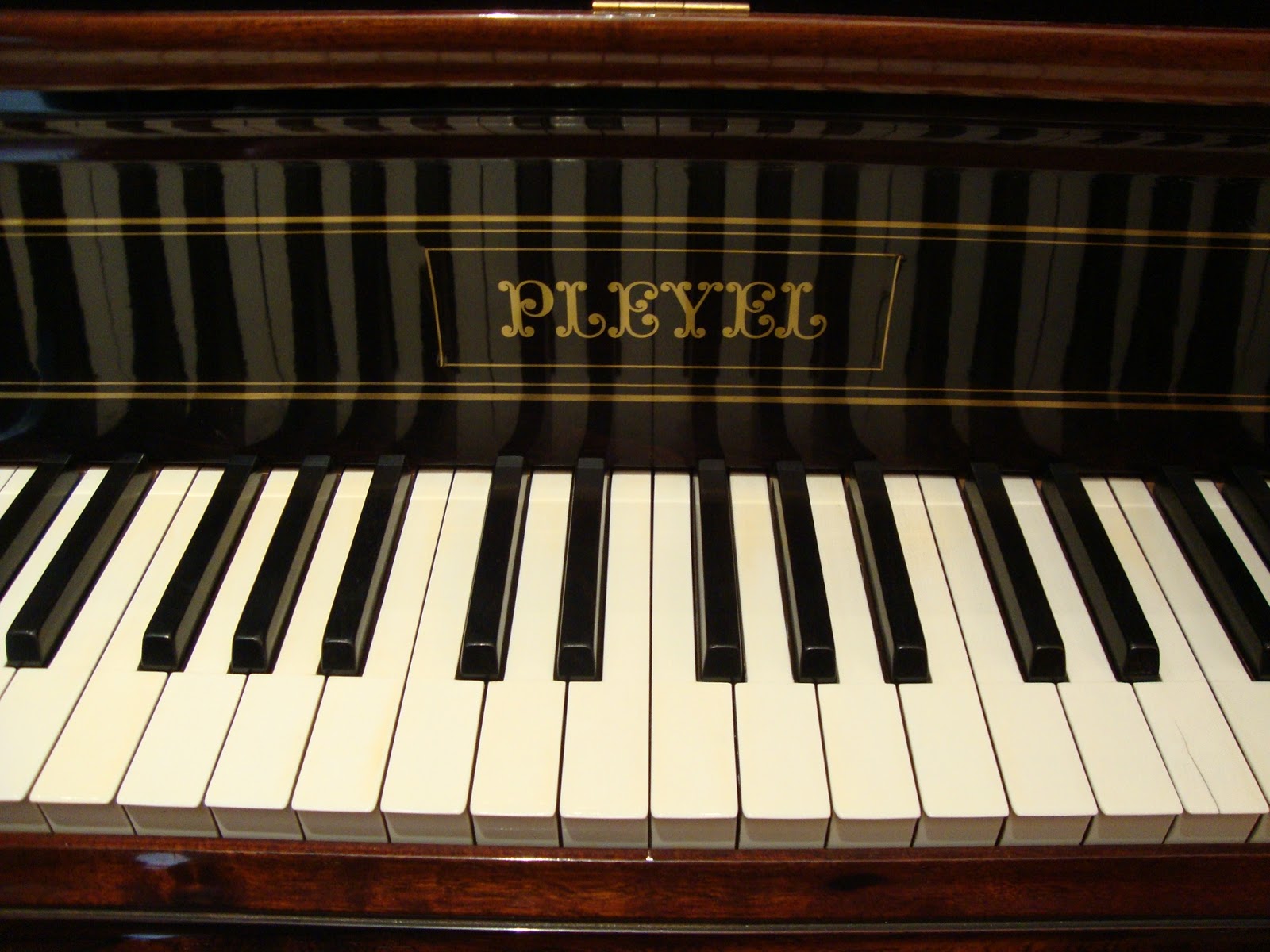
One of the "fringe events" will be an exhibition of photographs about music. Andrew Kolodziey, the founder and president of the Art Group KRAK, invited me to show some of my music-themed photographs and selected two of my photographs - a portrait of Henryk Mikolaj Gorecki and the keyboard of Chopin's Playel Piano in Paris. The piano dates back to 1845 and belongs to the permanent collection of the Polish Library in Paris. The photo was taken during the 2011 Maria Szymanowska Colloquim, when the piano was taken downstairs and played!  The recitals of French songs by women composers and of Szymanowska and Chopin  were unforgettable.

I'm very happy to share this photo here; the Szymanowska concerts and presentations were truly wonderful! But I'm also quite thrilled to be invited to a second "invitation-only" art exhibition of my brief career as a photographer.

Chopin's Piano in Paris, Pleyel 1845 - by Maja Trochimczyk


_____________________________

Photos of roses from my garden and Chopin's piano from Paris
(C) 2011-2013 by Maja Trochimczyk

Friday, June 8, 2012

On Hypnotic Modernism of Maciej Grzybowski (Vol. 3, No. 7)

Maciej Grzybowski in Santa Monica, 2012 Photo by Maja Trochimczyk
How can you tell if a pianist is good enough to be worth the effort of driving on our congested freeways to attend his concert on a Friday night, if you have never heard his name before? Hard to tell… perhaps, you should believe what others say about him.  You certainly should watch for the name of Maciej Grzybowski, an extraordinary Polish pianist, who recently visited Los Angeles upon the invitation of the Helena Modjeska Art and Culture Club. On May 11, 2011, he performed a solo piano recital at the First Presbyterian Church in Santa Monica.  From there, he went on to play for the Polish Arts and Culture Club of San Diego and then to appear in a recital in Montreal, Canada. (In the interest of full disclosure, I have to state that as the President of the Modjeska Club I personally invited him to L.A., while his tour was sponsored by the Adam Mickiewicz Institute of Poland and supported by the Polish Consulate in Los Angeles). 

The specially crafted Santa Monica program included music by Polish composers (Paweł Mykietyn, Witold Lutosławski, Paweł Szymański, and Fryderyk Chopin) juxtaposed with Western classics – Johannes Brahms, Claude Debussy, and Maurice Ravel. Some of the best music of the world, played by one of the best pianists you can ever hear…

Born in 1968 and educated in Warsaw, Maciej Grzybowski is the winner of the First Prize and the Special Prize at the 20th Century Music Competition for Young Performers in Warsaw (1992). He made numerous phonographic, radio and television recordings as a soloist and chamber musician and collaborated with Sinfonia Varsovia conducted by such conductors as Jan Krenz, Witold Lutosławski and Krzysztof Penderecki. From 1996 to 2000 Grzybowski was a co-director of the "NONSTROM presents" concert cycle in Warsaw. He took part in numerous music festivals in Poland, such as the Warsaw Autumn, Musica Polonica Nova, Witold Lutosławski Forum, Warsaw Musical Encounters, and the Polish Radio Music Festival. He also performed at the Biennial of Contemporary Music in Zagreb, Hofkonzerte im Podewil, Berlin and festivals in Lvov, Kiev, and Odessa (Ukraine). In March 2005, Grzybowski’s recital at the Mozart Hall in Bologna was recognized as the greatest music event of the 2000s. After Grzybowski’s U.S. debut in New York, in August 2006 EMI Classics released his second solo CD with works by Paweł Szymański (b. 1954). He also appeared in three concerts at the critically acclaimed Festival of Paweł Szymański's Music in Warsaw. In February 2008, Grzybowski premiered a Piano Concerto by an unjustly forgotten composer, Andrzej Czajkowski (Andre Tchaikovsky).

After the 2004 release of Grzybowski’s first solo CD, Dialog, juxtaposing works by Johann Sebastian Bach, Alban Berg, Pawel Mykietyn, Arnold Schönberg and Pawel Szymanski, (Universal Music Polska), critics raved:
·       “His interpretations of Bach, Berg, Schönberg, Szymański and Mykietyn show the touch of genius! There are certainly none today to equal his readings of Bach! (...) How refreshing and exciting it is to be in the presence of such great art of interpretation, akin to a genius!”   (Bohdan Pociej).
·       “The performance of Berg’s youthful Sonata and Schönberg’s Sechs kleine Klavierstücke could easily stand alongside the recordings of Gould or Pollini.”  (Marcin Gmys).

Maciej Grzybowski performs at First Presbyterian Church, Maj 2012
These exorbitant expressions of praise were seconded by attendees of the Santa Monica recital including composer Walter Arlen, the founder of the music department at Loyola Marymount University and for 30 years the most influential music critic of the Los Angeles Times. After the concert, he stated, “this was the best pianist I have ever heard in my life.” His praise was seconded by another listener, Howard Myers: “Maciej is a phenomenon, a marvel, a miracle, a special kind of genius.” The belief in Grzybowski’s exceptional talent is shared by the Director of the Adam Mickiewicz Institute, Paweł Potoroczyn: “He is more than just a talented pianist – he is both a virtuoso of the highest order and a great musical personality.  The resultant unique combination is that of an uncommon musical genius that fully justifies comparing him with such masters as Glenn Gould or Maurizio Pollini.”

While admitting to a personal bias towards someone who has dedicated years of his life to the music of Paweł Szymański, one of the greatest Polish composers who ever lived (as it will become apparent in 50 years, when the dust settles and musical diamonds will be found in the sea of ashes), I had no doubt that by bringing Maciej Grzybowski to California, I offered our audiences a special treat.  His recital exceeded even my already sky-high expectations. First the program: arranged in two distinct parts, pairing composers of different generations in a surprising dialogue of musical ideas.

The youngest of the composers featured by Grzybowski was Paweł Mykietyn (b. 1971), his colleague and co-founder of the Nonstrom Ensemble where he has played the clarinet. In an entry on the Polish Music Information Center’s website affiliated with the Polish Composers’ Union, Mykietyn’s style is described in the following way:  “The composer ostentatiously applies the major-minor harmonies, introducing tonal fragments interspersed with harmonically free sections. He also makes use of traditional melodic structures, transforming them in his own individual manner. Mykietyn could be described as a model postmodernist, deriving his inspiration as well as material from all the available sources without any inferiority complex.” These words could well be applied to the virtuosic and wistful Four Preludes (1992) that opened the program with their contrasting moods, textures and tempi.


Maciej Grzybowski with Howard Myers and Prof. Walter Arlen
Grzybowski with Howard Myers and Prof. Walter Arlen.
Grzybowski followed the postmodernist Mykietyn with Twelve Folk Melodies by the dean of Polish composers of the 20th century, Witold Lutosławski (1913-1994). Commissioned by PWM in 1945, and elevating folklore to the realm of high art (in a preview of the official ideology of „socialist realism“ of 1948) these little gems show how unimportant is the ideology or context for a great compositional talent. The popular melodies of Hej, od Krakowa jadę [Hey, I come from Cracow], Na jabłoni jabłko wisi [An apple hangs on the apple tree], or Gaik [The grove] were set to music in a sophisticated harmonic style, reminiscent of Bèla Bartók.

Under Grzybowski’s fingers, these charming miniatures sparkled with a caleidoscope of colors and rhythms. The pianist brought out the complexity of inner voices in seemingly simple pieces and endowed folk melodies with an aura of nostalgia and drama.  In a stroke of genius, Grzybowski followed the folk arrangements with an entirely hypnotic and modernist reading of Drei Intermezzi, Op. 117 by Johannes Brahms (1833-1897). A standard in every music theory textbook on Schenkerian analysis, Drei Intermezzi could be heard as small interludes only in comparison with Brahms’s majestic symphonies.  Composed in 1892, the intermezzi (No. 1 in E-flat major, No. 2 in B-flat minor and No. 3 in C-sharp minor) transverse cosmic landscapes of feeling evoked in Rainer Maria Rilke’s timeless poem, An Die Musik.

Cover of Maciej Grzybowski's CDYet it was the piece that followed, Two Etudes by Paweł Szymański(1954), written in 1986 and available on two Grzybowski CDs, that elicited the greatest enthusiasm of the audience.  It is a work of genius, unparalleled in music in its hypnotic effect on the listeners. The Etudes, played without a break, contrast the slow emergence of music in the first etude with the titanic flows of sound in the second.  The piece arises from silence in what appears to be a series of random, repeated notes and chords, but there is nothing random in Szymański’s music, everything is carefully constructed.  Sometimes called a “neo-Baroque” composer (due to his frequent inspirations with the music of that period, and talent for creating complex polyphony), Szymański refers to his style as “sur-conventionalism” and thus describes his main approach: “The modern artist, and this includes composers, finds himself tossed within two extremes. If he chooses to renounce the tradition altogether, there is the danger of falling into the trap of blah-blah; if he follows the tradition too closely, he may prove trivial. This is the paradox of practicing art in modern times. What is the way out? However, there are many methods to stay out of eclecticism despite playing games with tradition. An important method for me is to violate the rules of the traditional language and to create a new context using the elements of that language." Thus, Szymanski draws from traditional tonal and harmonic language by playing with the conventions of musical styles and with the listeners’ expectations. This game of cat-and-mouse was apparent in the stretching and constricting of time in the two Etudes. The irregularity of recurring chords and notes piqued the listeners’ interest and intensified their expectations. Thus, the music grew and expanded in scope in the first Etude, to reach monumental proportions and then dissolve in massive complexities of the second.

Grzybowski performs in Santa Monica, May 2012The second half of the recital started with a series of unusual readings of Fryderyk Chopin’s four mazurkas (in A Minor, Op. 7, No. 2; E Minor, Op. 41, No. 1; F Major, Op. Posth. 68, No. 3; G-sharp Minor, Op. 33, No. 1). The originality of the pianist’s interpretations rendered these well-known gems of the repertoire almost unrecognizable.  More angular and modernist than usual were also three Preludes from the second volume of impressionistic masterpieces by Claude Debussy (1862-1918): II  ...  Feuilles mortes, VI  ... „General Lavine” eccentric; VII ... La terrasse des audiences du clair de lune.  These terraces were lighted less by effervescent moonlight than by the brilliant focused light of Grzybowski’s intellect.  Again, they were so different from what I was used to hearing that I would need to hear these preludes again, to render an opinion. Yet, the rest of the audience was hypnotized into a complete silence and immobility: no slow, tortuous opening of candy wrappers at this recital! 


Grzybowski with the Modjeska Club Board
The finale was indeed “grand” -  a monumental rendering of Valses nobles et sentimentales by Maurice Ravel (1875-1937). In 1906, Ravel started his “waltz” project, culminating with the 1919 publication of the orchestral suite, La Valse. Inspired by the noble and sentimental waltzes by the Viennese Franz Schubert, Ravel published a suite of eight pieces for piano in 1911 and followed them with orchestral versions a year later. The waltzes are not separated into distinct “noble” and “sentimental” sections; it is up to the listener to decide what is what.  The pieces, in contrasting tempi, span the whole expressive trajectory for which the words are too limited to give the music full justice.  An unusual selection to close a solo recital, the suite ended in a slow tranquil dissolution into silence. 

After a well-deserved standing ovation, the pianist relented and added a melancholy and thoroughly modern version of a Scarlatti’s sonata as an encore to the evening’s inspired and inspiring program.  One thing is certain: the name recognition problem mentioned at the beginning should be resolved, once for all, in the case of Maciej Grzybowski: just go to every concert of his, and if you cannot go, buy his CDs.

Thursday, April 26, 2012

Chopin at Midnight, Chopin Behind Bars (Vol. 3, No. 6)

Midnight Fire - Diamond Rose Brooch on Black Velvet, for Poem by Maja Trochimczyk
I listen to Chopin when I drive. My most recent find - all the etudes recorded by Louis Lortie (You Tube recording of Lortie ). The three dramatic ones at the end of Op. 25 are, as a set, a particular favorite. His timing is impeccable and the drama in the music well balanced with the classical perfection of form.

Another favorite CD that I recently returned to is of the two Piano Concerti with Krystian Zimerman at the keyboard, conducting his specially assembled orchestra - Polish Festival Orchestra. The clarinetist from that orchestra, Jan Jakub Bokun, has told me about the experience of rehearsing and playing with the Maestro. It was very strenuous, but immensely rewarding. One phrase, one detail, would take a long time to polish - sometimes aggravatingly long time. It had to be done to perfection... and it was. Just listen to the miraculous details - bringing out inner voices, phrasing, expression... Zimerman's Chopin is a true romantic, quickly moving from one emotional extreme to another, from enchantment to torment. An astounding vision of grand proportions. These are not little pieces of "stile brillante" provenance, ornamental, made to please. These are powerful expressions of the soaring human spirit.

OK, let's leave it at that. The spirit... What about the spirit? First, let me reflect on the spirit of Polish pride. To welcome the year 2010, just as I was finishing the "Chopin with Cherries" anthology that gave rise to this blog, I went to friends' house for a New Year's Eve Party. I never spent that time with this particular family and wanted to do something different, something I had not done before. It was interesting - filled with children and games, not serious adult dinner conversation and dancing.

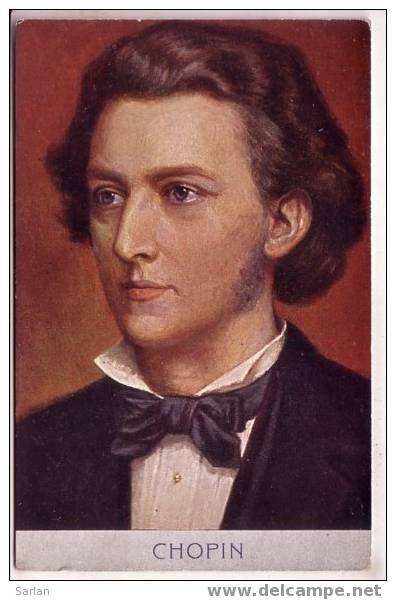
Young Chopin Vintage Postcard from Maja Trochimczyk's Collection
But one dance captured my attention and remained in my memory: Chopin's Polonaise in A Major, Op. 40, nicknamed "The Military" (the link points to a YouTube recording by Maurizio Pollini). Yes, the same Polonaise that gave its first notes to a signal of the British broadcasts to occupied Poland during World War II. And here we are, dancing? Just after midnight all the guests at the party lined up in a long line of couples, the host sat at the grand piano and off we went. Around the living room, out onto the patio, up and down the steps, out one door, in another, all over the house... The moon was unusually bright that night, surrounded by an enormous halo, a portent of things to come. I felt a rush of pride, elation even, when we moved along with dignity, in triple meter: one long step with bended knees and two short ones. Down, up, up, down, up, up, around the house, around the world... It was so incredibly moving - a small group of Poles and their international rag-tag bunch of friends dancing to music written almost two hundred years ago and heard in so many homes, on so many concert stages. Welcome the new year, the year of Chopin! That was two years ago - and the tradition of dancing that particular Polonaise at midnight continues.

On the way back home, I drove through an unfamiliar neighborhood and saw boys playing with a bonfire on the front lawn of their small house. It was a working class neighborhood with tiny houses squished in neat rows on streets leading up to the hill of the Occidental College. The moon, the fire, the dance - I was inspired to write a haibun about it. It was recently published in an Altadena anthology, Poetry and Cookies, edited by Pauli Dutton, the Head Librarian of the Altadena Public Library:

Midnight Fire

In the golden holiness of a night that will never be seen again and will never return… (From a Gypsy tale)

After greeting the New Year with a Chopin polonaise danced around the hall, I drove down the street of your childhood. It was drenched with the glare of the full moon in a magnificent sparkling halo. The old house was not empty and dark. On the front lawn, boys were jumping around a huge bonfire. They screamed with joy, as the flames shot up to the sky. The gold reached out to the icy blue light, when they called me to join their wild party. Sparks scattered among the stars. You were there, hidden in shadows. I sensed your sudden delight.

my rose diamond brooch
sparkles on the black velvet -
stars at midnight


© 2010 by Maja Trochimczyk

I wrote more verse about the Polonaise itself, but all the descriptions fell short of the delight I felt that night, so it was reduced to just an introduction to a story that has no end. The contrast of warm flames and icy moonlight was unforgettable. I added the romance, of course - poetry is not supposed to be real, though, when rooted in an actual experience it touches a nerve in listeners. After one reading I was asked by an eager member of the audience: "So what about the man who gave you that brooch? Where is he now?" "There was no man. This is my brooch, I got it for my daughter and it returned to me," I said. There was nobody lurking in the shadows. . . The poem sounds better this way, though.

Fast forward two years, and I'm playing recordings of Chopin in jail. This is the path that I took, and this is where it is going. . . forward. My students are inmates who have completed the Sheriff's Education-Based Incarceration program, and are approaching dates of their release after completing their sentences. I do not ask what they are in for, it does not matter. What matters is that once released they never come back. Jailing them is a huge cost to society and committing crimes does not help them or anyone else. It is just not the right thing to do. But many offenders keep returning to jails, keep doing the same thing that they were always doing. My approach to changing their thinking, their image of self and the world, involves classical music. Chopin, in particular. Due to his serious illness, dying of TB, composing between fits of coughing and spitting blood, he can be an example of heroic courage. William Pillin expressed this idea very well, in his poem "Chopin" (included in the Chopin with Cherries anthology):

Chopin

(excerpt from a poem by William Pillin)


White and wasting he dotted
with splashes of blood his lunar pages,
carrying death like a singing bird
in his chest, his tissue held together

by dreams and bacilli. “I used to find him,”
wrote George Sand, “late at night at his piano,
pale, with haggard eyes, his hair almost standing,
and it was some minutes before he knew me.”

In Majorca, the doctors
shuddered at his blood-flecked mouth,
burned his belongings, compelled him
to take refuge in a former monastery.

“My stone cell is shaped like a coffin.
You can roar — but always in silence.”
When it stormed he wrote the ‘raindrop’ prelude
and from the thunder he fashioned an étude.

*

“I work a lot,” he wrote to his sister,
“I cross out all the time, I cough without measure.”
With death’s hand on his slender shoulder
he created ballades, études, nocturnes.


Chopin had what it takes to succeed against all odds. He used his time well - he created something lasting that speaks to us two hundred years later. They can do it too. It is heroic courage that is needed to succeed when you leave jail with a felony record, no friends to turn to (because those you had would bring you straight back to jail and those you hurt would not speak to you again), no home, no job...

America is very punitive. Not only does it have the highest rate of incarceration in the world: one in thirty one adults is under correctional supervision, well over 700 people per 100,000 adult residents. The second highest rate is in the second most punitive country, Russia. There, about 500 inmates are locked up per 100,000 of adults. Other countries have a fraction of that. The "war" of imprisonment was clearly won by the U.S. There are serious societal costs associated with that dubious victory. The stigma of having been once in prison or jail remains and permanently marrs the record of an individual who has virtually no chance for redemption. Job applications feature a box: have you ever been incarcerated, or committed felony, or misdemeanor? Once you check the box, the application lands in the garbage bin. I tell my students behind bars that they have to be really tough to ignore the rejections and insults that will come their way. Their sentences are finished but the stigma is there and will bring them back if they do not fight it by having the courage to be good.

Poster for Polanski's The Pianist
Chopin helps here. How? We listen to a Nocturne and then to the same Nocturne played by The Pianist's Adrien Brody in an old-fashioned suit. The camera pans out to show the engineer's booth. This is a live broadcast of the Polish Radio in Warsaw. This is September 1939. Soon the bombs begin to fall, the pianist initially refuses to stop playing but has no choice. He falls off the bench, the building is destroyed by German bombs, and his odyssey begins. The astounding, true story of survival against all odds - the story of Wladyslaw Szpilman, as told by Roman Polanski (another Holocaust survivor) leaves the incarcerated men I'm speaking to visibly shaken. The stellar beauty of the soaring Nocturne melody is cut down by the noise of explosions. War is evil, always evil. What did the musicians do to deserve their fate? What did the residents of Warsaw do to deserve being killed by German bombs? Nothing. War is a calamity that has to be survived. Living with the stigma of incarceration requires survival skills too. It requires a lot of courage - shown by the pianist in the film and the character's real-life model. It requires a persistent clinging to life, the good life.

I pan forward to another favorite scene in the film: the famous Ballade that Szpilman played for the German officer. This has to be one of the most famous music scenes in the whole history of film-making. When the can of pickles falls down from the pale, think hands of the starving musician and rolls to the feet of the uniformed German officer... when the gaze of the emaciated, long-haired pianist dressed in rags meets the eyes of the proud soldier... Then, the pianist begins to play and the Ballade takes them both on a journey. Away from destruction, away from hunger and suffering - somewhere else.

Here, courage and humanity triumph. The officer has to break his laws and his orders if he wants to save the life of the starving pianist. He does so, moved by Chopin's music that brought him back to the time when there was no war, only life and happiness. He must have heard such beautiful music at home, before the tragedy began. The extraordinary courage of the pianist, the compassion of the "enemy" and the drama of the music speak directly to the heart. Would the lesson stick? I do not know, I can only try to share it.

Is it worth my time? I hear comments: "lock them up and throw away the key." Not everyone behind bars committed, serious violent crimes and those who did would have been sent to the prisons, not jails. Once they did something wrong, paid the price for it and returned to the society "rehabilitated" - their sentences are supposed to be over and a new life is supposed to begin. But more often than not, it does not. They cannot find jobs, cannot earn a living, cannot function. Some are willingly returning to drug dealing or stealing. Others feel cornered, feel they have no option. If they do it the second time, the sentence will be longer, the return to the "narrow path" harder. I do not write it to excuse them. But it is important for them to know that they can stay on the "narrow path" of honest life, if they make some sacrifices, just like Chopin had to make sacrifices in order to continue to compose. What other option do we have?