Sunday, August 11, 2013

A Piano Gift for the Chopin University of Music, to Remember my Parents (Vol. 4, No. 9)

When I started learning music back in the 1960s in Poland, I played the violin (badly), then viola (better), and then a bit of piano... At the Elsner Music High School and the Chopin University, we called it "mandatory piano with both hands" - and this is what it was, a required class done because you had to, not very musical. However, I learned to sightread at the keyboard and entertain myself by singing one part and playing two other parts of Bach's Kunst der Fuge. I also loved singing along with his Chorales. In playing Chopin, I did not move beyond easy preludes and nocturnes, but liked playing for myself, getting lost in the shifting moods and soaring melodies of his music.


The hours at the keyboard are long gone and my California upright sits in pieces in the garage, but the Arnold Fibiger "semi-concert" upright has survived in excellent shape in my Mom's place in Warsaw. After her death this summer, I donated the piano to my Warsaw Alma Mater - Fryderyk Chopin University of Music. It used to be "Academy" when I attended it and "State Higher School of Music" a decade earlier. I thought of selling it, but decided that a donation would be a better choice than getting a measly $200 for this beauty. ..

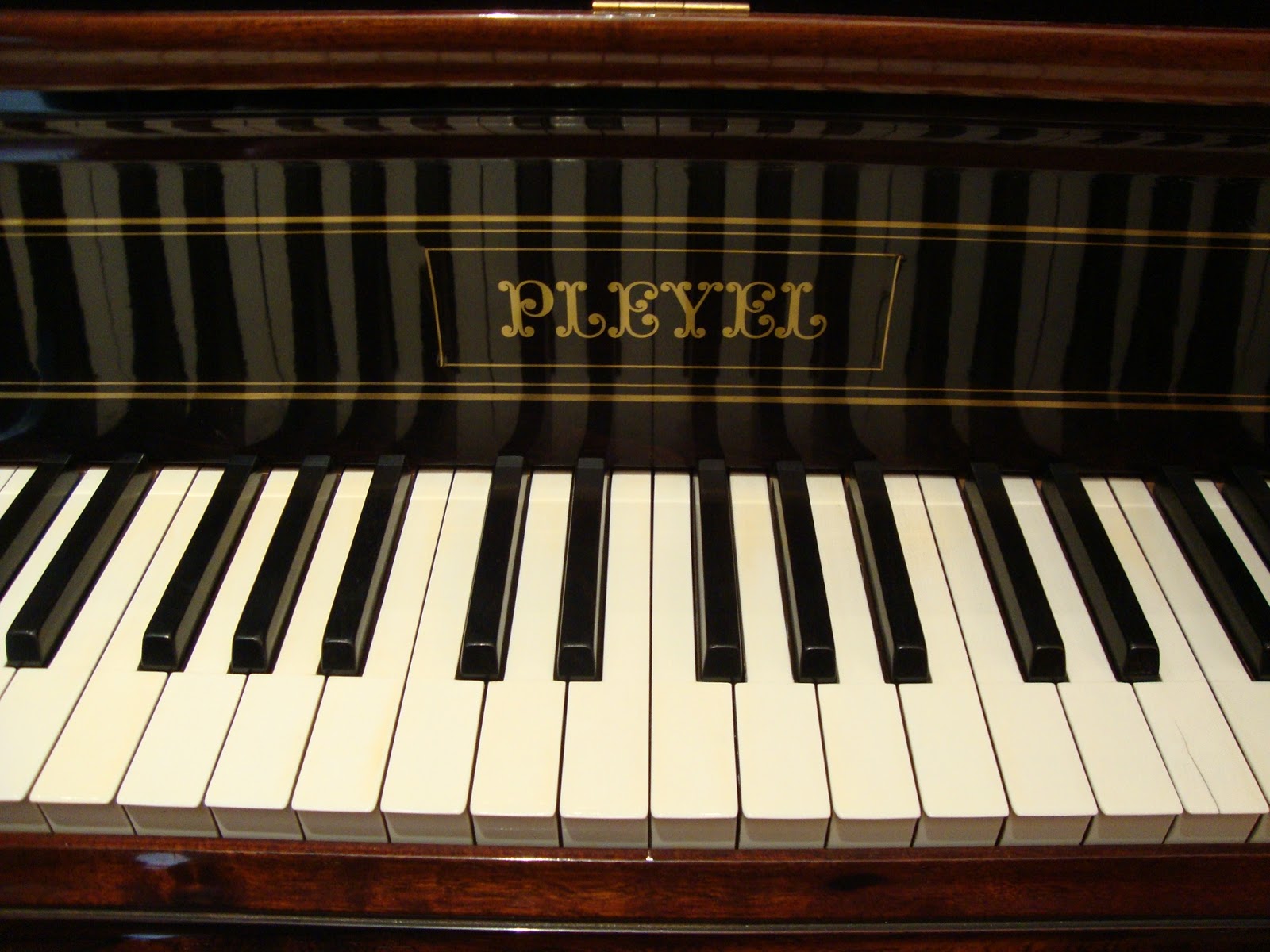
The piano is decorated with Art Nouveau reliefs and carvings; two Art Nouveau candleholders attached in front, and most of the keys still in the original ivory, with some yellowed inserts in plastic. No chance for historical restoration of those keys - ivory is banned, and rightly so... but was not at that time. I hope that my piano will bring long hours of enjoyment to the University's music students and will enrich its permanent collection of antique instruments.


 LINEN OF GRANDMA & GREAT GRANDMA AT THE MUSEUM OF ETHNOGRAPHY 

While in Warsaw, I made four other donations - the Museum of Ethnography received three cuts of home-made linen, two from my great grandmother on the maternal side - Konstancja Wasiuk, and one made from scratch, that is from planting the flax, through making the thread, to weaving the fabric - by my grandmother Nina Niegierysz - Trochimczyk.


 The long stretch of linen was made for towels, with a standard "home-made" (samodzial) weave, 70cm wide and over 4 meters long. The staff at the Museum of Ethnography were thrilled to unwrap and measure the fabric. My grandma told me how she made it, how they planted the flax, harvested the long stems, soaked and beat the stems to create the material for weaving, in a long-lasting process. She then made the thread using her spinning wheel ("kolowrotek"), and finally wove the fabric for her dowry when she was getting married. She was born in 1906 so this activity took place in mid-1920s on their estate in Mieleszki.


 The patterns on two shorter cuts of homemade linen are much more ornate. They were made by a professional weaver near the village of Trzebieszow. My great grandmother Konstancja was repatriated after the war, that is thrown out of the family estate near Baranowicza in the borderlands part of eastern Poland (Kresy, now Belarus), with whatever she could take and pack in the alloted part of the train, and sent back to Poland, while Soviets took over the family estate to convert it to Kolchoz...


She brought with her not only her intense faith in Jesus and a bad temper to boost, but also various strange remnants of her former life, including large spools of linen thread, that was made by her farm girls back home, in the Kresy... The thread made on the estate near Baranowicze was woven into different patterned fabric and used for towels, tablecloth... The museum will use it in its fabric collection.

 BARBARA WYSOCKA'S MEDALS AT THE MUSEUM OF WARSAW UPRISING


The next stop was the Museum of Warsaw Uprising in Warsaw-Wola. I brought there the medals, photographs, and letters of Barbara Wysocka, one of my mother's close friends who house-sat the condo during her travels, and was invited to all major family functions, especially Christmas Eve (when no person should be alone) and Easter breakfast...


 Pani Basia was single, and had no family at all. Her entire family died in the Warsaw Uprising and she was the lone survivor. She never married, never had children... What she had were her medals for bravery and a handful of pictures. The Museum staff took the medals, though was not happy with the one bestowed upon the veteran freedom fighter by the communist government (even though it was the highest honor, Polonia Restituta!) and did not like any of her post-war pictures nor letters...


They took the photos in uniform, of the young Barbara on the poligon, and with other soldier-friends before the war... She was not famous and I do not even know what her Home Army pseudonym was. After the war she had ordinary life, finished college, worked in an office. Thanks to my Mom, she had an "adopted" family - us - and spent her weekends in the summer house, holidays at our table, and one colorful vacation (at the expense of my parents) in Abu Dhabi where my father worked for over 20 years and my mother lived for six months each year, spending her winters in the warm south and summers in cool Poland.

Barbara Wysocka's memory should be preserved by a museum dedicated to this cause - where many of her colleagues are also remembered. I'm glad that the Museum took the medals, but troubled that they wanted to deny that there was any good done in the "communist" times - without these times as a bridge, there would have been no independent Poland today. Some Home Army veterans were hounded and killed, others survived and helped rebuild the country. Warsaw was completely destroyed by Germans who forcefully removed all inhabitants and blew out all buildings, especially the large and historic ones... leaving shantytowns on the outskirts untouched, pocked by bullet holes.... Now, the historic core of the Old Town was rebuilt and Warsaw grows, with its history carefully reconstructed...


TRAVEL GUIDES AT THE MUSEUM OF SPORTS AND TOURISM AND THE TROCHIMCZYK FAMILY AT THE MUSEUM OF DIGITAL INFORMATION


 My parents, Henryka and Aleksy Trochimczyk, loved to travel, loved to see the world and visit far away places. My father, an electrical engineering specializing in power plants, worked first in Iraq and then in the United Arab Emirates - Abu Dhabi. He spent most of his career working abroad, as an electrical engineer building a sugar beet refinery in Mosul, Iraq, and then the power plant and water desalination plant in Abu Dhabi. My mom joined him there, and the family traveled both there and through Europe - Greece, Turkey, Italy...


My mom also went to Spain and took a three month tour of the U.S. while staying with me in Canada. One day she said, I'm going for a trip, the next day she was on a Greyhound bus... Similarly, when Princess Diana died, my Mom decided to pay her respect and my parents drove to London for the funeral. All these trips were documented in picture albums and in guides from the many places visited.

These guides and albums were donated to the Museum of Sports and Tourism and will enrich the permanent collection. The large yellow suitcase of my parents photographs, especially from Abu Dhabi and my mom's American tours, was borrowed by Mr. Piotr Niedziela of the Museum of Digital Information. He loved working with negatives and after reviewing the set of materials, picked over 600 images for his collection to illustrate an important part of Polish history - Polish engineers working abroad, building infrastructure in many countries. The Persian Gulf was certainly exotic enough to merit attention....

Wednesday, July 3, 2013

Chopin or Szymanowska? Kocyan's Quiz at the Bowers Museum (Vol. 4, No. 8)


On Sunday, June 30, 2013, at the Bowers Museum in Santa Ana, during a lecture-recital about "Maria Szymanowska, the Court Pianist to the Tsarinas" Wojciech Kocyan let the audience compare and identify the music of Szymanowska, born in 1789 and publishing since 1810 to her death in 1831, and Chopin, born in 1810 and composing since his childhood to 1849.


Instead of playing their music in a straightforward piano recital, Kocyan arranged six pieces in pairs, in random order, and asked the audience to identify the composers. To make things harder, the pieces were put in the same, or very similar key. The two pieces in A-Flat major were fast, effervescent, and virtuosic, with melody barely indicated above a web of arpeggios. The two pieces in F Minor were melodic and expressive, poignant event. The pieces in E-flat Major were whimsical, nostalgic, and dance-like - both could actually be danced at an aristocratic salon.

In A-Flat Major:

Chopin – Etude in A-flat major, Op. 25 No. 1, known as The Aeolian Harp since Robert Schumann's review in the Neue Zeitschrift fur Musik, composed before 1837, dedicated to Maria d'Agoult.

Szymanowska – http://www.youtube.com/watch?v=mfcmvkbmtygNocturne in A-flat Major “Le Murmure” published in Paris by Henry, with the title on the cover “First Pianist of the Tsarinas of Russia”

In F Minor:

Szymanowska – Polonaise in F Minor, no. 4 from the same collection of 18 Dances dedicated to Princess Vyazemsky

Chopin – Waltz in F minor Op.70 No.2, composed in 1841 and dedicated to Elise Gavard and Anna Caroline Oury [de Belleville] in different editions

In E-flat Major:

Chopin – Waltz in E flat Major Op.Posth., composed around 1827 (he most likely heard Szymanowska in Warsaw at that time), played by Biret Idil, from YouTube.

Szymanowska –  Contredanse, pub. 1820 Leipzig, in 18 Dances dedicated to Madame la Vera Viazemsky nee Princesse Gagarin, wife of Prince Pyotr Viazemsky (in 1819-21 he lived in Warsaw, was friends with Pushkin and Mickiewicz), with a quotation from opera Jean de Paris by Pierre Boieldieu.


Wojciech Kocyan plays Szymanowska and Chopin. Photo by  Maria Kubal.
The audience filled out the answer cards that were collected and counted during the reception. Three books on Szymanowska by Stanislaw Dobrzanski were given to three winners randomly chosen from among 20 listeners who gave correct answers. The lecture recital was attended by about 140 people, so the proportion of correct answers was about 14%, which means that the majority of listeners mistook Chopin for Szymanowska and Szymanowska for Chopin. This indicates the similarity of their compositional styles.

Wojciech Kocyan and Maja Trochimczyk present Szymanowska. Photo by  Maria Kubal. 

To make things harder, Kocyan, who just learned the Szymanowska pieces for this event, but has played Chopin for his entire career, that started with an award in the Warsaw Chopin Competition, decided to not play from memory, but rather use scores, without clearly visible names on the covers, so that the pieces would be identified solely by ear.

As a bonus, the wonderful and witty pianist, selected a piece that grew a collective "aah" from the expectant audience just after two chords. Everyone recognized Chopin's Waltz in C-Sharp Minor Op. 64 No. 2, composed in 1846-47, dedicated to Charlotte de Rotschild and beloved by generations.

Chopin - Waltz in A Minor, op. 34 no. 2, and Waltz in C-sharp Minor Op. 64, No. 2 played by Valentina Igoshiona, from YouTube.


The event started with my lecture on "Fashion, Portraits and Szymanowska's Professional Image" richly illustrated with portraits of the virtuoso pianist, teacher of princesses, and composer of romantic music, endowed with rich melodic invention and a talent for filigree ornamentation, and expressive harmonic progressions. Certain cadences, motives, textures, and melodies in "Chopin's style" pointed to an inspiration or a shared language of the era that is now forgotten, since we only remember Chopin. The poster by the lectern by Janusz Majewski of Poland celebrates another Queen of Polish culture - Helena Modjeska (Modrzejewska), an actress and director, and the patron of the Modjeska Club that sponsored the event.


To learn more about Szymanowska, the audience could buy a book published in 2006 by the Polish Music Center, with a CD insert by Dobrzanski. The book is a result of Dobrzanski's doctoral studies (he's now a piano professor in Kansas) and includes my chapter on Szymanowska's songs.

To learn more about Szymanowska's music I recommend the purchase of her Complete Piano Works, issued by Acte Prealable in Poland this spring, and recorded on three CDs by Slawomir Dobrzanski (AB 181-83). This is a "must-have" set and hopefully some of these recordings will become available for download individually, starting from Szymanowska's greatest hit - her Nocturne "Le Murmure" which was used by Adam Mickiewicz as an accompaniment to poetic improvisations back in her salon in St. Petersburg. There are no excerpts from the CD set available online, but her two Nocturnes have been posted:


The picture on Dobrzanski's CD is the same as the one towering above the performers in the auditorium: Szymanowska styled as a Roman Goddess and placed at a piano, with a putto handing her the book of music, to indicate angelic inspiration, in a exquisite evening gown and elegant interior, with a window pointing at the smoking peak of Vesuvius. Walenty Wankowicz painted Szymanowska in Naples, where she played for the Russian Ambassador on January 19, 1825 and socialized with Princess Natalia Golitzin, one of her closes friends and supporters.

Maja Trochimczyk with poet and artist Kathabela Wilson

Pictures were taken by Maria Kubal and Kathabela Wilson, poet, musician, and artist. The audience included also Prof. Roman Koropeckyj of UCLA, a noted specialist in Mickiewicz, Dr. Mira Mataric, Serbian-American poet and translator, and Susan Dobay, Hungarian-American artist. extraordinaire. Barri Mogilewsky (married to a Polish-American, hence the name), represented the Bowers Museum and coordinated the afternoon, whereas Andrew Z. Dowen, President of the Modjeska Club, represented the Club and coordinated the reception.

To see more pictures from the event, visit the Picasa Album: https://picasaweb.google.com/Maja.Trochimczyk/KocyanAndTrochimczykOnSzymanowska#

Maja Trochimczyk, with Modjeska Club's President Andy Dowen,
and Barri Mogilewsky of the Bowers Museum. June 30, 2013. Photo by  Maria Kubal. 


Wednesday, June 12, 2013

Szymanowska and Chopin at the Bowers Museum, Santa Ana (Vol. 4, No. 7)

On June 30 at 1:30 p.m. at the Norma Kershaw Auditorium of the Bowers Museum in Santa Ana (2002 N Main St, Santa Ana, CA 92706; tel. 714 567 3600) I will present a lecture about "Maria Szymanowska - Court Pianist to the Tsarinas" and pianist Wojciech Kocyan will play piano music by Szymanowska and Chopin. This lecture performance is one of the events associated with an exhibit The Tsar's Cabinet: Two Hundred Years of Decorative Arts Under the Romanovs on display at the Bowers Museum through the summer. The event will be sponsored by the Helena Modjeska Arts and Culture Club, with a small reception to follow. Books about Szymanowska by Slawomir Dobrzanski and a CD set with all of her piano music recorded by Dobrzanski in Poland will be available for purchase at the event.

The lecture will be richly illustrated with portraits of Szymanowska and European nobility, while the musical performance will bring her sound world to life, under the masterful fingers of Prof. Kocyan.  He will juxtapose Szymanowska's nocturnes and etudes with smaller works by Chopin, especially his waltzes - created for the same world of aristocratic salons that were inhabited by Szymanowska. The presentation is loosely based on my paper, read at the International Szymanowska Symposium in Paris, and published in the Annales de Centre de Academie Scientifique Polonaise a Paris, in 2012.

Fee: $7 Member/ $10 Non-member. Advance reservations: Visitor Services Desk, Tuesday – Sunday, 10 AM – 4 PM; bowers.org/tickets or bowers.org/calendar and fill out the reservation form or e-mail education@bowers.org. The event will begin promptly, please leave sufficient travel time.


Szymanowska's portrait by Walenty Wankowicz.
Collection of the Polish Library, Paris 

On Fashion, Portraits, and the Professional Image of Maria Szymanowska (1789-1831)


Fashion choices of classical musicians have recently attracted the interest of Mary E. Davis (Classic Chic, 2006). I bring this topic to the biography of Maria Szymanowska (1789-1831), a Polish pianist-composer who after her 1810 Parisian debut toured Europe in 1822-1826 before settling in St. Petersburg for the rest of her short life. A daughter of a Warsaw brewer, and a divorced mother of three (daughters Celina and Helena, and son Romuald), Szymanowska was able to ascend to an elevated position of the Court Pianist of the Tsarinas, and support her extended family with her music (i.e., concertizing and teaching children from aristocratic families). The pianist’s career benefited from ability to shape her “professional image” as a high-society lady of elegance and multiple talents. My project builds on the research of Anne Schwartz (2009), SÅ‚awomir DobrzaÅ„ski (2007), and Benjamin Vogel (2012) that focused on Szymanowska’s talents as a savvy businesswoman and a musician with a love for English pianos. Through an analysis of her portraits by French and Polish artists (Henri Benner, Nicolas Jacques, Aleksander Chodkiewicz, Józef Oleszkiewicz, Aleksander Kokular, and Walenty WaÅ„kowicz) revealing Szymanowska’s personal image and her fashion choices, I demonstrate that in this pianist we encounter one of the earliest instances of “professional image-making” (term from Laura Morgan Roberts, 2005).

Szymanowska's litograph based on Oleszkiewicz portrait
Collection of the Polish Library, Paris

Szymanowska created her positive image through “impression management” and “social re-categorization”- shifting the attention away from her humble roots to her preferred aristocratic milieu. The means for this transformation included appearance (clothing, hairstyles, and jewelry), carefully cultivated social networks, and virtuous conduct befitting a single mother of three, a teacher of princesses and nobles. The pianist was exposed to the attire of the nobility as a performer in aristocratic salons in Warsaw (in 1805-1806; 1812, 1823, 1827, and 1828), Paris (in 1810, 1824, 1825, and 1826), London (in 1818, 1824, 1825, and 1926), and St. Petersburg (in 1820, 1822, 1827, and 1828-31). The portraits provide an opportunity to compare her white muslin gowns, shawls, turbans, double sleeves, and jeweled belts with the predominant and changing French, Polish, English and Russian fashions of her time, including those of her mentors – Countess Zofia Zamojska, Duchess Maria Czartoryska Wirtemberg, and Empress Alexandra Feodorovna – as well as Queen Hortense, Duchess Laura Junot d’Abrantes, and Madame de Stael, among others.

The striking features of portraits by Kokular and WaÅ„kowicz, both painted in Italy in 1825, point to a possible artistic “Agon” of the two artists who envisioned the pianist as a Queen of Tones in Rome (Kokular, the phrase was coined by Adam Mickiewicz) and a mythological goddess in Naples (WaÅ„kowicz), thus furthering her elevated professional and social status. The ramifications of Szymanowska’s image creation that helped her to become a teacher and a role model for daughters of Russian aristocracy touch upon the concepts of “female genius” and “modesty” (the preferred virtue of society women in the early 19th century). The research for this paper, conducted at the Muzeum Literatury in Warsaw, Poland and Bibliothèque Polonaise in Paris was supported by Maria Szymanowska Society in Paris.

WOJCIECH KOCYAN

Wojciech Kocyan and Maja Trochimczyk after
a Chopin with Cherries Concert, Ruskin Art Club, May 2010

Wojciech Kocyan was praised for his “highly distinctive performances (…) superb, intelligent artistry (…)” (ClassicsToday.com) and “incisive temperament, impeccable technique and sumptuous tone” (Le Monde de la Musique.). He was born in Poland. He studied with two of the world’s most esteemed piano pedagogues: Andrzej Jasinski in Poland, where he received his Masters Degree and with John Perry at the University of Southern California, where he received a Doctor of Musical Arts Degree.

He is a laureate of several international piano competitions, including F.Busoni and Viotti, as well as a special prizes winner of the XI International Chopin Competition and the First Prize winner of the Paderewski Piano Competition. He performed in Europe, America, Australia and Japan, participating in music festivals such as Musica Antiqua Europae Orientalis, Capri Festival, Bydgoszcz International Music Festival, H.M.Gorecki Festival, Beethovenfest, Paderewski Festival, Liszt Festival in Vienna, San Francisco Liszt Festival, Cervantino International Music Festival, Morelia International Music Festival and the Chopin Festival in Paris. He has recorded for television, radio and film and his performances were broadcast in Europe, United States and Australia. His solo and chamber music recordings can also be found on DUX label. He was a subject of press articles in Poland, France, Italy, Germany, Mexico, United States and Japan.

In September 2007 the Gramophone magazine, published in London and considered the world’s most prestigious classical music journal, chose Mr. Kocyan’s recording of Prokofiev, Scriabin and Rachmaninoff as one of 50 best classical recordings ever made, alongside recordings of such luminaries as Leonard Bernstein, Dietrich Fisher-Dieskau, Nicolaus Harnoncourt and Arthur Rubinstein. It also featured the cover headline “The genius of Wojciech Kocyan”. His latest CD, of music by Robert Schumann was released in June 2012.

Dr. Kocyan is much in demand as an adjudicator and lecturer. He has been invited to give masterclasses in France, Hungary, Austria, Poland, Mexico and the United States, including such prestigious venues as the Colburn School. He is the Artistic Director of the Paderewski Music Society in Los Angeles and the Artistic Director of the American Paderewski Piano Competition in Los Angeles.

Maja Trochimczyk, Jane Kaczmarek and Wojciech Kocyan,
First American Paderewski Piano Competition, 2010


Saturday, May 11, 2013

American Paderewski Piano Competition - May 21 - 26, 2013 (Vol. 4, No. 6)

The Ignacy Jan Paderewski Society invites all lovers of music and the piano to attend the 2nd American Paderewski Piano Competition that will take place at the Colburn School of Music in Los Angeles from May 21 to 26, 2013. The Semi-Final Round will take from Tuesday to Thursday, May 21-23. After the day of rest on Friday, May 24, the selected six pianists will compete in the Final Round on Saturday, May 25. The spectators may attend a piano recital of Piotr Kosinski, the winner of the previous round of the competition on Friday at 7:30 p.m. The grand finale and the concert of Prize Winners is scheduled for Sunday, May 26, starting at 4 p.m. For more information about the Competition's events visit its Schedule Site.

There are 27 wonderful pianists of a very high caliber who will show off their interpretations of a broad array of music including classical, romantic and 20th century repertoire and at least one piece by Paderewski.  The International Competition Jury includes two pianists from Poland, Prof. Adam Wibrowski, Prof. Wojciech Switala of Katowice, Prof. Lee Kum Sing, as well as Prof. Wojciech Kocyan of Loyola Marymount University who serves as Artistic Director for the Paderewski Society and Prof. John Perry of the University of Southern California.

All the way through, a photography exhibit by Polish artists from the Group KRAK led by Andrzej Kolodziey, will adorn the walls of the Colburn School. The exhibit will include two images that I took - such as the keyboard of Chopin's 1845 piano, from the collection of the Polish Library in Paris.


To celebrate the life and art of Ignacy Jan Paderewski (1860-1941), a Polish pianist, statesman, and composer, let's read a poem by California's Kathabela Wilson:

What Paderewski Taught Me About Being

good
he tells me
the heart moves

moves like the ocean
sometimes like a mountain
constantly in greeting

his words
my pulse the same
surprises

trembles
holds back
rushes forward

washed always
in silence
silence for what is not

for what has been taken
for what is left
for what has been given

a nation for what is right
the dearly loved
what he always wanted

from the edge
of her seat
a woman leans forward

holds
a breath
time waits

the woman breathes out
whish of wind
essence of man

dark and light
rubato of being
becomes being again

Friday, April 19, 2013

National Poetry Month: A Chopin Poem and Chopin's Piano (Vol. 4, No. 5)

Petals and Randrops in Blush, by Maja Trochimczyk

For the National Poetry Month (April), we will have some Chopin poetry in Pasadena. Three years after the publication of Chopin with Cherries, one of the poets included in this anthology, Rey Romea Luminarias, invited me to present some of my poetry at his National Poetry Month celebration at the Pasadena Public Library, Wright Auditorium, April 29 at 6 p.m.


The event, entitled "Co-Inspirators: Poets, Artists, Music-Makers" will present interactions between various arts. The Pasadena Library is located at 285 East Walnut Street Pasadena, CA 91101, tel. (626) 744-4066. Rey invited me to read three poems: "Memory Mirrors" (inspired by Susan Dobay's digital artwork, "Reminiscence" from her "Impression of China"), and "A Study with Cherries," and "How to Make a Mazurka" from the Chopin with Cherries anthology. For the first poem, Rick Wilson will accompany me on a Chinese flute from his exquisite and extensive flute collection. For the Chopin's pieces, celebrating his music as heard in my childhood, at my grandparents house in a Polish village, I will bring two Chopin music boxes... It is going to be a beautiful, beautiful event.


To play some Chopin, I will bring two of my music boxes tthat play Chopin - I have a mazurka, in a box shaped like a brown, wooden grand piano, and a nocturne in a rectangular jewelry box with a peacock inlay... How very, very sweet...

Here's a Chopin's Nocturne in B-flat Major played on a music box (the whole piece!):
http://www.youtube.com/watch?v=3h0LcKI4dec . The main problem is that it has no rubato, nor any kind of rhythmic flexibility. It is truly mechanical music! Very fast and very square.

That is a strange way to "kill" the charm of Chopin's music. Here's another music box, held in hand, with a fragment of Nocturne Op. 9, No. 2. http://www.youtube.com/watch?v=dDLTmnPB2yk. That one is quite lovely.


Just Joey Rose by Maja Trochimczyk

Reynald Romea Luminarias wrote a beautiful poem for my anthology Chopin with Cherries. I was very happy to include it in the book.


There Is No Other Love

 After Chopin’s Etude in E Major, Opus 10, No. 3

R. Romea Luminarias

—for Annie


November sunlight peers
Between leaf-veins. Oval windows.
Rose petals on velvet. Autumn vines our arms
Glazed with ripeness, steeped in unrestrained embrace.
Tongues stilled; drought-pained mouths this one now-love alone

Can heal. Our Love steers
Unknown universes’ oceans of shadows,
Maps red coral galaxies. Anemone-meteors swarm
Around us, stir hunger’s hull knifing waves, probing abysses.
There is no other love obtains the soul, breaks open steel and stone;

There is no other Love destroys this present, ancient drought, this fall
Stripped bare of songs, deprived of harvest; there is no other Love sees
Through storms of swirling fires; only this love, O this our Love alone:
No other Love ordains, builds up the spirit, breathes life into dry bones.

_______________________

Here's the Etude that inspired this poem:

Here's the information about the Etude on the website of the National Chopin Institute of Poland:
http://en.chopin.nifc.pl/chopin/composition/detail/name/etude_in_E_major_op._10/id/162 (this is very slow and on a historical fortepiano, so it sounds out of tune).

As Prof. Mieczyslaw Tomaszewski writes: "The third Etude (Lento ma non troppo), in E major, is a nostalgic song, broken off by a moment of extreme agitation. It is one of Chopin’s most beautiful melodies, which he also regarded as such. Almost a nocturne, though at the same time a song, it proceeds in accordance with the rhythm of deep breathing, rising and falling. A moment of agitation and passionate explosion fills the middle section of this Etude, as the unavoidable consequence of the previous song. The reprise of the music from the opening is like a mere recollection. The quieting that concludes it heralds the next Etude, with which it forms a coherent whole."


Ballerina Rose Skirt by Maja Trochimczyk


On May 21, there will be another celebration, that of American Paderewski Piano Competition .Held at the Colburn School of Music in Los Angeles, the event will preasent 27 pianists; with 30 hours of Chopin, Paderewski, Bach, Liszt, Ravel, Debussy, Beethoven, Scriabin, Prokofiev, Rachmaninoff, Schumann, Szymanowski, Haydn, Bartok, Brahms, Mozart, Clementi, and many more.

There will be Piano Masterclass with a world-renowned pianists; Piano Recital of the Winner of the APPC 2010 --  http://www.ijpaderewski.org/95812/180712.html

One of the "fringe events" will be an exhibition of photographs about music. Andrew Kolodziey, the founder and president of the Art Group KRAK, invited me to show some of my music-themed photographs and selected two of my photographs - a portrait of Henryk Mikolaj Gorecki and the keyboard of Chopin's Playel Piano in Paris. The piano dates back to 1845 and belongs to the permanent collection of the Polish Library in Paris. The photo was taken during the 2011 Maria Szymanowska Colloquim, when the piano was taken downstairs and played!  The recitals of French songs by women composers and of Szymanowska and Chopin  were unforgettable.

I'm very happy to share this photo here; the Szymanowska concerts and presentations were truly wonderful! But I'm also quite thrilled to be invited to a second "invitation-only" art exhibition of my brief career as a photographer.

Chopin's Piano in Paris, Pleyel 1845 - by Maja Trochimczyk


_____________________________

Photos of roses from my garden and Chopin's piano from Paris
(C) 2011-2013 by Maja Trochimczyk

Friday, March 29, 2013

Happy Easter, Passover, Norooz, Spring... (Vol. 4, No. 4)

Best wishes to all the readers of Chopin with Cherries blog and the Chopin with Cherries poetry anthology! Let us celebrate Easer, Passover, Norooz, and the Spring...

the lily of our valley sings happiness in high noon sun


But first and foremost let us enjoy Chopin's music this spring.

Very, very, very young Yuja Wang plays Chopin's Waltz in C-sharp minor, Op. 64 no. 2 (from Chinese TV):

http://www.youtube.com/watch?v=EXxI44yrINM (about 6 years old)

Very young Yuja Wang plays Chopin's Waltz in C-sharp minor, Op. 64 no. 2 (from Chinese TV):

http://www.youtube.com/watch?v=58N-EL1e3-I (about 9 years old)

Young Yuja Wang plays Chopin's Waltz at her graduation recital in 2006:

http://www.youtube.com/watch?v=vB7_l8wSpz8 (19 years old)

I did not find any recordings of today. The change of her appearance to the current movie star is striking!


Tuesday, March 12, 2013

Chopin's Birthday Parties After 200 Years (Vol. 4, No. 3)


Sculpture of a transparent piano, Chopin's Birthday Concert,
March 1, 2010,  Grand Theater, Warsaw, Poland

Was Chopin born on February 22nd, 1810 or on March 1st? By now, the March date is generally accepted. Why the confusion, then? Because of Chopin's birth record in the church books in Brochow, where he was baptized on April 23, 1810, with Fryderyk Skarbek (1792-1866), the son of the employer of his father, Count Skarbek, as his godfather. The record, discovered in 1892, gives February 22 as the birth date, but Chopin's family has always celebrated his birthday in March. The future composer's names are listed in Latin: Fredericus Franciscus.

The Brochow church was the parish for the estate of Zelazowa Wola, owned by Count Skarbek and now celebrated as the birthplace of Chopin. The pianist's father, Nicolas Chopin (1771-1844) was a son of a French wheelwright, Francois, and was born in a village in the district of Lorraine, France.  The Chopin family, in turn, had roots leading back to an impoverished Swiss village in the Alps. The 16-year old Nicolas came to Poland in 1787 with Adam Weydlich, an estate manager for another Polish aristocrat, Count Michal Jan Pac. After the estate was sold, Weydlich and Chopin traveled to Poland, where the composer's future father spent five years working in Weydlich's tobacco factory in Warsaw. He changed his first name to Polish - Mikolaj and became a Polish patriot.  A participant in the Kosciuszko Insurrection of 1794 - the last failed attempt at defending Poland's independence - Mikolaj Chopin was injured in the fighting and left Warsaw to work as a tutor for sons of landed gentry. 

In June 1806 Mikolaj Chopin married Justyna Tekla Krzyzanowska, a poor relation of Count Skarbek in the same Brochow church where his son was later baptized. The Count and Countess Ludwika Skarbek had four children; the Chopins first, Ludwika, was named after the Countess. However, soon after Fryderyk's birth, the quiet estate life ended. When the Count left the country due to his unpaid debts and the Skarbek children grew up, the abandoned wife could not afford a tutor. The Chopins had to move elsewhere.  The family packed their bags in July; Nicolas became a French teacher at the Warsaw Lyceum and the young Fryderyk's (or "Frycek" as he was nicknamed at home) urban childhood began. 

Did Chopin celebrate his birthday? Apparently not. There are only seven mentions of this word ("urodziny") in his letters, and only two of these relate to his own birthday and name-day - in letters from his mother (1842 and 1848).  The other "birthdays" are celebrations of the Parisian society to which Chopin was invited. There are, however, twenty four mentions of the name-day - "imieniny" - the celebration of the patron saint after whom an individual is named and who serves as the individual's holy protector and benefactor.  Some of the earliest documents in the Chopin Museum in Warsaw are beautiful cards he made and painted for the name-days of his father and mother.

In fact, the very first letter by Chopin, at the age of sixteen, is such a card for Dear Papa, written on December 6, 1816, the feast of St. Nicolas, the traditional patron of gift-giving. 

Gdy Å›wiat Imienin uroczystość gÅ‚osi /
Twoich, mój Papo, wszak i mnie przynosi
Radość, z powodem uczuciów złożenia,
Byś żył szczęśliwie, nie znał przykrych ciosów,
Być zawsze sprzyjał Bóg pomyślnych losów,

Te Ci z pragnieniem ogłaszam życzenia.

When the world announces this celebration of thine 
Name day, my Papa, it brings joy also to me,
Because of the confluence of my feelings. 
May thou live happily, not knowing harm or strife,
May God always bring thee a prosperous fate,
These are the wishes I desire for thee.


Actors in 19th Century costumes mingled with the audience,
Grand Theater, Warsaw, March 1, 2010.

Six months later, on 16 June 1817, Fryderyk wrote a name day wish for his mother:

Imienin Twoich, Mamo, Ci winszujÄ™!
Niech ziszczÄ… nieba, co w mym sercu czujÄ™:
Obyś zawsze zdrową wraz szczęśliwą była,
Jak najdłuższe życie pomyślnie spędziła.

I congratulate thee, Mama, on thine name day
Let heaven bring about what I feel in my heart
May thee be always healthy and happy
May thee live the longest life in prosperity.


Indeed, there are abundant references to name-days in the entire family correspondence, including Fryderyk's annual "name-day" letters to his father and mother. They send their wishes in return. His mother, Justyna, wrote in March 1842, with some motherly advice about trusting God and thankfulness for divine blessings, which alone help being "happy and peaceful." As she explained: "I thought much about you here, my dear child, on your birthday and name day I'm sending to you in my spirit my blessings, while praying for your prosperity. Let God bless you and always keep you in his care." 

One of the last letters of Chopin to his family, written on June 25, 1849, four months before his death, in the throes of last illness, mentions a name-day letter to his Mother as a means of being there at her celebration, if not in body, at least in spirit and thought.

_________________________


Poster of Chopin's Birthday Concert, Warsaw, Poland, March 1, 2013

The music world celebrated Chopin's 200 birthday in a multitude of ways back in 2010. I attended an amazing birthday concert at the Grand Theater of Opera and Ballet in Warsaw on March 1, 2010, as a part of the Third International Chopin Congress.  

We heard the Piano Concerto  in E Minor twice the same evening, in two completely different interpretations, of which the modern and Olympian Garrick Ohlson's remains in mind.


Maja Trochimczyk with Garrick Ohlson after Warsaw Chopin concert, March 2010.

Maja Trochimczyk with actress Alina Janowska at the
Chopin Birthday Concert, Warsaw, March 1, 2010.

________________________________


Three years later, on March 5, 2013, the Ignacy Jan Paderewski Society of Los Angeles decided to celebrate Chopin's Birthday with a bash involving actors and pianists at the Colburn School of Music. The event, grandly entitled "An Evening of Piano and Drama Featuring Internationally Renowned Artists" featured two phenomenal pianists - Gloria Campaner - an Italian pianist who won the previous edition of the American Paderewski Piano Competition, and John Perry - Professor of Piano at USC Thornton School of Music, Kocyan's mentor and teacher, and one of the most important piano pedagogues of this century.

Their interpretations of Chopin, Schubert, and Debussy left the audience breathless. John Perry's profound and inspired interpretation of two Impromptus by Franz Schubert was especially fascinating - as he celebrated Chopin's genius by not playing his music, but by "channeling" his spirit of sublime artistry and emotional maturity. Gloria Campaner, a rising star of the classical music world, has played a half-recital, with German and French music enveloping the "core" of Chopin.

Chopin Birthday Concert of the Paderewski Society - R to L: Jane Kaczmarek,
Marek Probosz, Ms. Pawlicki, Wojciech Kocyan, Gloria Campaner, John Perry,
Dmitry Rachmanov, and Mr. Pawlicki, March 5, 2013, Colburn School of M usic.
Excellent quality and talent were also apparent in the performances by Wojciech Kocyan, Artistic Director of the Paderewski Society and Professor of Piano at Loyola Marymount University, and Dmitry Rachmanov, Professor of Piano at the California State University, Northridge. The talents of these pianists were well matched by the acting ability of Jane Kaczmarek and Marek Probosz who narrated the Birthday Bash and turned from a concert into a party, with some goofy fooling around.

The comedic element was especially strong in a staged performance of a scene from Paderewski Memoirs, with Kocyan standing in for Paderewski and noodling at the piano, and Kaczmarek performing his impetuous "know-it-all" hostess, a student of Chopin convinced she knew better how to play a particular etude. Their act, complete with a grandfather clock - the ringing of which was to be a part of the music - as well as costumes and stage setting was quite entertaining. Coupled with an incredibly high level of artistic performances by the pianists, it would have left us with a delighful feeling of an evening well spent.

Gloria Campaner talks with John Perry, Chopin Birthday Concert, March 5, 2013.
All is well that ends well, one should say, though, and this concert did not end well at all. Instead of just singing "Sto Lat" to Chopin with Kocyan's improvised accompaniment at the end of this Birthday Concert, we were explosed to a transcription of "Happy Birthday" for two pianos in Chopin's style. Worse still was the fact that this piece came right after the last notes of l'Isle joyeuse by Debussy played by Gloria Campaner with such sublime inspiration that the listeners were still on the "seventh cloud" of artistic delight... Thanks to Kocyan who decided to call for a Polish "Sto Lat" right afterwards, we ended the concert on a high note and left this tribute to Monsieur Chopin with a song...


Gloria Kampaner, Wojciech Kocyan, and John Perry after the Chopin Birthday concert.


Lesson for the future: if you have engaged the talents of the stature of Kocyan, Campaner, Perry and Rachmanow, do not put a Mr. and Mrs. Pawlicki in this exalted company, where they clearly do not belong. Nuff said.   

At the end, I went to say hello to Jane Kaczmarek, whose cordial stage presence and lovely voice and laughter have enlivened this birthday concert. She had the same magical effect during the first Chopin's Birthday Bash organized by the Paderewski Society in February 2010. I was thrilled then to hear that she read several poems from the Chopin with Cherries anthology - including some of mine.  But I was not there to hear her, since I was in Warsaw, at the Chopin Birthday Concert...

Maja Trochimczyk, Jane Kaczmarek with Paul Tensor and friend, after the concert.
__________________________________________

Photos from Warsaw Chopin's Birthday Concert, (c) 2010 by Maja Trochimczyk
Photos from Los Angeles Chopin's Birthday Concert, (c) 2013 by Krzysztof Onzol.