Tuesday, July 7, 2015

Martin Willitts, Jr. Discusses Chopin's Music and Poetry (Vol. 6, No. 6)

A talented poet, musician, gardener, healer, and a Quaker, Martin Willitts, Jr., is also a retired librarian, a publisher and an artist, working on paper cutouts. He contributed to two of my anthologies, Chopin with Cherries (2010) and Meditations on Divine Names (2012). In June 2015, he and his wife, also a Quaker and a poet, Linda Griggs, welcomed me to their  home. They took me on a sight-seeing tour of Syracuse, New York, including a splendid rose garden in the rain, and organized a reading for me for the Palace Poetry Group at DeWitt Community Library.

Having spent all this time with these two fascinating individuals and poets, I decided to share Martin's poems about Chopin on this blog, and publish an interview I conducted with him by email, about poetry and Chopin's music.

Willitts Jr. and Griggs - by Maja Trochimczyk
Martin Willitts Jr. and Linda Griggs, Photo by Maja Trochimczyk


MARTIN WILLITTS Jr.'s POEMS ABOUT CHOPIN


THE ENEMY IS IN THE HOUSE


“The enemy is in the house (...) Oh God, do you exist? You do and yet you do not avenge. -  Have you not had enough of Moscow’s crimes - or - or are You Yourself a Muscovite (...) I here, useless! And I here empty-handed. At times I can only groan, suffer, and pour out my despair at my piano!”
                                                — Chopin, 1831, learning that Poland
                                                      had been defeated by Russian armies.


The piano cannot stop wars, nor lift the dead,
nor block the door. I am numb, empty handed,
wondering why you cannot stop this silence
deadly as bullets. There are no avenging angels crying.
The Russians are shooting notes of despair
and all I can do is huddle in the sheet music of snow.
Paris is the gathering place of defeated friends,
failed politicians, grieving mothers and wounded artists.
There are exiles everywhere speaking Polish sadness.
I cannot pound the keys on my piano loud enough.
I shall never return to my homeland.
I shall not give in to the Russian demands.
I shall not let one note from my fingers serve them.
The enemy is in the house.
It does not mean they can trample the rugs with mud.
We have a saying where I come from.
If a stranger stays uninvited, then call him a friend
and mistreat him like a friend, then he will go away
thinking your false friendship is real as butter on bread.
It is like playing with a piano one-handed. It can be done,
but not as well as with two hands.
It is like a gun without bullets.
It is like a person without a home.


Published in "Chopin with Cherries," 2010, p. 24

White rose snowfall - by Maja Trochimczyk

DISCORD

1.  Chopin to George Sand, 1847


The delicate touch you felt on your neck
is the same as on a piano, with the same lyrical rush,
the music of leaves in the resolute winds.
It is the same idiomatic language of geese leaving.
My heart has the same feeling, restless, yearning.
When I play a rondo, no one can hear the silence after.
I leave these early movements behind
like I must leave you.
Some things are finished when they are finished.

I thought of returning to you.
I hesitated at your window.
I knew if you saw me with that melodic look you have,
it would enrapture me.
Our bodies would become counterpoints.
But it would be fragmentary motifs. Textural nuances
of what used to be.

Our love was illicit, some say.
I say, it was melodic, rhythmic, and full of music.
Our love was repetitions of a single note.

You criticized me for my primitive sense of form
when we would lie in bed, soaked in harmonic intonations.
You were right about me as well as everything else.
I cannot help being in the soundscape of textures,
in the lightness of sound, in the last moment leaving you.
For life is opening one door and descending unknown stairs.

Sheltered in White - by Maja Trochimczyk


2. George Sand to “beloved little corpse”


You could not stand a woman who did not act like a woman
except in bed. Even then you were horrified
by the idea a woman could enjoy passion.
What were all those compositions of love-soaked music then?

You were not my first lover and you will not be my last.
A woman should pick and choose who will enter her bedroom.

You shake your head, expecting me to fall for your music like others.

A woman cannot be a slave to men.
You will not allow us to be equal.
So what choice do I have?
What choice does any woman have?

I changed my name so I could publish what scandalizes you.
Women have a right to sincere love and I will write about it.
I shall write about my desires and disappointments.
I will not miss you. I will only find another.

What have you done recently?


Note: “Beloved little corpse” was her name for Chopin due to his numerous sicknesses.

 Published in "Chopin with Cherries" p. 131-132.

Red and White in the Rain - by Maja Trochimczyk


OPUS 21

Blackened corpses of stars are going nova.
All day, it has been crackling with heat insects.
I say, it is God’s voice telling us something important.
The heat grinds us for not listening.
We cannot seem to leave well enough alone.
Our futile attempts to improve or streamline life
only makes it worse.

Sheet music’s passages of wildness — briars
and milkweed sends music into trumpets of wind —
this melody heals stunted saplings, brings Light
to darkened air, finding cures for emptiness —

Light! — come fill us! Heal the forgotten!


Published online in the Black Poppy Review, with the Opus series.
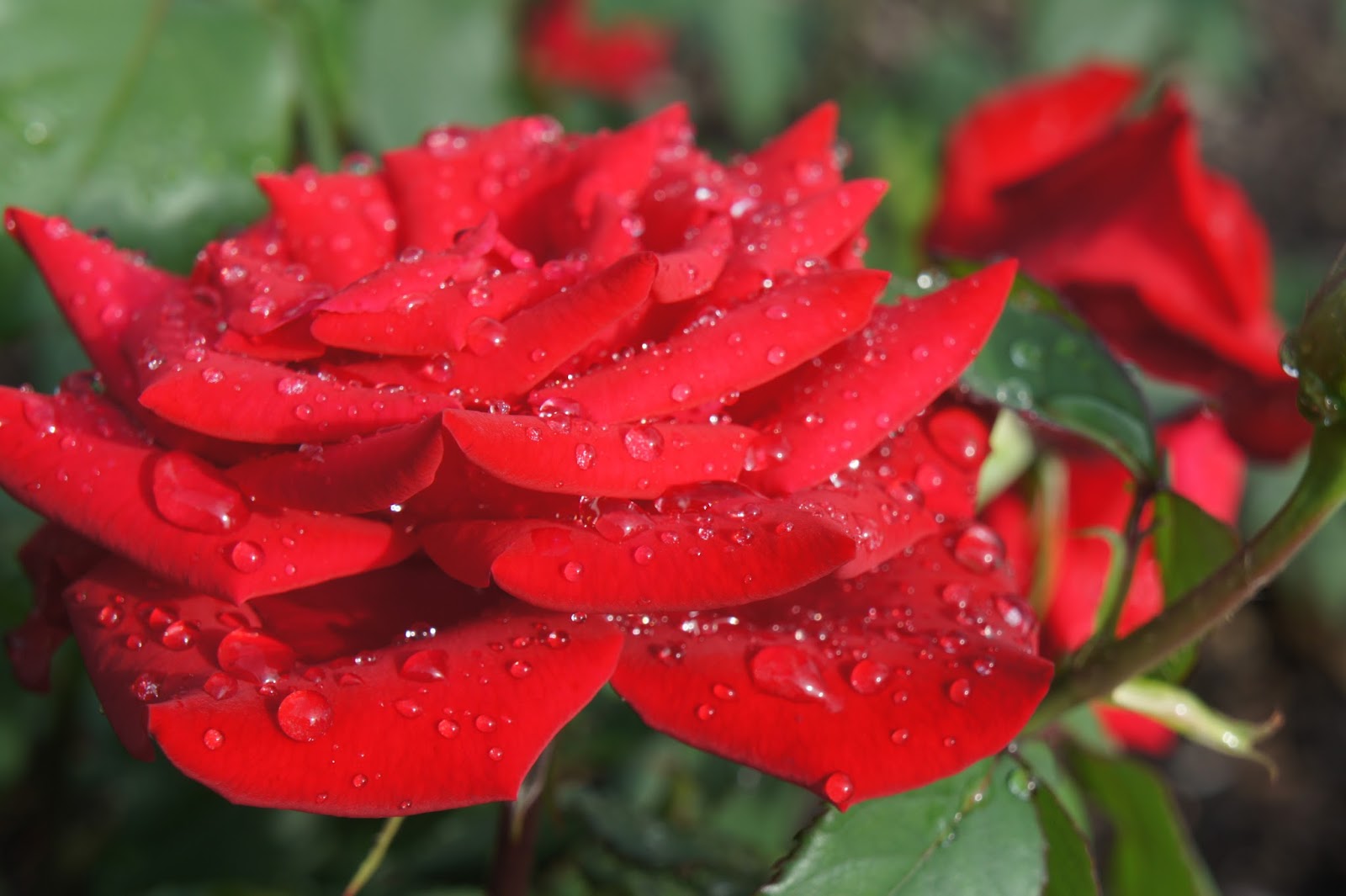
Rainy Red Passion - by Maja Trochimczyk


INTERVIEW WITH MARTIN WILLITTS, JR.

Maja Trochimczyk's Question: What does Chopin mean for you? What do you like about his music?

Martin Willitts, Jr.'s Answer: I was playing piano at an early age. I am not sure when I started, but by the time I entered Kindergarten (about 5) I was already playing classical music: Beethoven, Mozart, Handel, Brahms, Chopin, and others. I eventually played with a full orchestra in Syracuse, New York. I was also playing chamber music. At one point, I played the Brandenburg Concertos by Bach on the harpsichord.

What I liked about Chopin was all the different styles of music: etudes; polonaises; waltzes; nocturnes, sonatas, and preludes. I think his most challenging piece was Prelude in D-flat Major, Opus 28, No, 15, often called “raindrop” for its sound. I never felt I could exactly get that sound right. I felt it was better plucked by bow on a violin, stretching the open E string.

I have written a series of poems based on the concept of the Opus; and I have titled a number of poems as “Nocturne” as I think of the Chopin and Nocturne in E-Flat Major, Opus 9, No. 2, and others. Although I have not played piano since I was about 12, I still recall the sounds, techniques, fingering, and exactness of pitch. When I lost my hearing, I lost pitch, then I quit playing; but I still hear the music in my head.

Q: What types of music have you studied, or played?

I was bored with classical as a child. I needed something to challenge me. I do not remember why I felt this way, but the structure was boring my creativity. I discovered Jazz, and switched from piano to mandolin. My grandfather had this mandolin from when he was a Union organizer. It has a metal plate resonator making high pitch sounds. My grandfather gave it to me when I tried the “raindrop” from the Preludes. Some people call this mandolin a dobro-mandolin, and I would bottle-neck it like a steel guitar player or a Blues slide guitar player.

I played on live radio some swing Jazz, fast tempo, improvisational fingering. Because a mandolin has double strings, I would trill notes (playing notes really fast), and because of the high scales, I was able to go extremely high compared to a piano. By this time, all I was interested in was individual notes and I abandoned all chord structures and sight reading.

For a while I played in coffeehouses with folk singers, and the people I played with became famous later. I decided I did not like the egos involved in band structures. Vietnam interrupted my playing, and I lost perfect-pitch.

When we met, I talked about the mathematics in music, and suggested there were two kinds of composers: the ones who stressed the math and tried to treat music as a mathematical formula; and those who wrote and/or played from the heart. There is an awareness of the metronome and the music signature at the top of the sheet music that tells you the measure and pace. The famous Jazz piece “Take-Five” performed by the Dave Brubeck Quartet is E-Flat Minor, quintuple (5/4) time.

Martin Willitts Jr. with his antique mandoline. 


Q: What is it about music that appeals to you?

A: I listen to all types of music, including contemporary. When I listen, I am focused on the notes, their technique, what they do differently, how they play solos or work with the group. If the band only knows three chords or repeat too often, I lose interest. It also helps if I hear the music without seeing the musicians, so I am not judging them by their “name” or appearance. A good example was the contemporary singer Lady Gaga singing Sound Of Music. I was surprised at her vocal range.

Q: Why do you write poetry?

I became interested in poetry accidentally. If someone had asked me about poetry when I was a teenager, I would have thought they were crazy. Schools do a lousy job at promoting poetry. I originally thought of writing drama. I took a creative writing course to find out if I was good at it. The first day, the teacher said they would only read and talk about poetry. I am the kind of person who hears that as a challenge. At first, I was better than the average beginner. Over time, I would like to think I have become better.

I tend to write like a Jazz musician in that I improvise while writing. I tend to write thematically. I write several poems in a short burst of energy. When you play live music, you learn to perform on one-take, and if you make a mistake, you must continue. I disliked multiple attempts at recording music. When I was a session musician, I had in my contract about the one-take concept. If they wanted to re-record, I was already packing up. I seldom revise for this same reason, because I am revising as I am writing.

Sometimes, the classical musician in me will set aside a poem for revision. I will become overly cautious about every word, the value of each word, the structure of the line, the way it appears on the page, the punctuation, the imagery, and the phrasing of a line.

I have opposite viewpoints about writing. Sometimes, I do not trust my poems and I wonder if I am good enough. Other times I trust whatever I write. There are times I want to destroy everything; and other times the urge to write is overwhelming. I range from the highly structure to the totally unstructured compositions. I think of Chopin: how he must have felt, looking at the blank sheet music, wanting to fill it all in faster than he could write.

I am a retired Librarian. Over thirty years of the same reference questions, I reached to the point I knew a lot of subjects. I tend to bring all that information into the poems: history, art, politics, social issues, plant identification, spirituality, and other subjects.


Martin Willitts Jr. with one of his papercuts. 


ABOUT MARTIN WILLITTS, JR.

Martin Willitts Jr is a retired Librarian living in Syracuse, New York. He was nominated for 11 Pushcart and 11 Best of the Net awards. He provided his hands-on workshop “How to Make Origami Haiku Jumping Frogs” at the 2012 Massachusetts Poetry Festival. Winner of the 2012 Big River Poetry Review’s William K. Hathaway Award ; co-winner of the 2013 Bill Holm Witness Poetry Contest; winner of the 2013 “Trees” Poetry Contest; winner of the 2014 Broadsided award; winner of the 2014 Dylan Thomas International Poetry Contest.

He has over 20 chapbooks including "Swimming in the Ladle of Stars" (Kattywompus Press,2014),“City Of Tents” (Crisis Chronicles Press, 2014), “The Way Things Used To Be” (Writing Knights Press, 2014), and “Late All Night Sessions with Charlie “the Bird” Parker and the Members of Birdland, in Take-Three” (A Kind Of a Hurricane Press, 2015). He has 8 full length poetry books including ), national ecological award winner for “Searching for What You Cannot See” (Hiraeth Press, 2013), “Before Anything, There Was Mystery” (Flutter Press, 2014), and “Irises, the Lightning Conductor For Van Gogh's Illness” (Aldrich Press, 2014).

His forthcoming books include “Martin Willitts Jr, Greatest Hits” (Kattywompus Press), “How to Be Silent” (FutureCycle Press), “God Is Not Amused With What You Are Doing In Her Name” (Aldrich Press).

He wrote a collection of poems numbered “Opus” poems which have appeared in the following magazines (some under different titles): Big River Poetry Review, Blue Heron Review, Kentucky Review, Literature Today, Love Notes (anthology), Moon Magazine, Page & Spine, Black Poppy Review, Poppy Road Review, and Seven Circles Press. You can read the Black Poppy Review Opus Poems here.

Shaded Upside Down - by Maja Trochimczyk


Friday, June 5, 2015

Interview with Kathabela Wilson for "Colorado Boulevard" in Pasadena (Vol. 6, No. 5)

MAJA TROCHIMCZYK INTERVIEW FOR COLORADO BOULEVARD
Short version published in March 2015: 
http://coloradoboulevard.net/mapping-the-artist-maja-trochimczyk/


A Telescope on the Artist

Kathabela Wilson:  As a poet, artist, writer, host, publisher, music historian, I see you as having an unusual scope and vision. How do you see yourself as a poet/artist in the world?

Maja Trochimczyk: Poetry is a window into the soul; an opening into the rift between the earthly and the divine; a unique way of communicating the beauty, and the richness, and the love, and the sorrow of the world. With poetry, first we prove our own existence, then we document the “real” world inside and around us – that has nothing to do with the “reality” created and perpetuated in the media – and then we share the joy of words creating worlds with other poets, listeners and readers. Poetry is written to be read and to be heard, t is best when performed with music. My first, and most favorite musical accompanist is Rick Wilson, flautist extraordinaire, who can set the mood for each poem and describe its trajectory with his music played on a variety of flutes. I was so thrilled to perform my Awakenings poem inspired by Susan Dobay’s painting, City Whispers, with Rick, and you, and Jean Sudbury on the violin at Susan’s salon. It was a group improvisation of the highest caliber. Unfortunately, it was not recorded:  the poem is published in the On Awakening book. Rick played for all of my readings for Poets on Site at the Pacific Asia Museum that included the Illuminata (known as “I want that crown…”) – my humorous take on the Buddhist virtue of renunciation of the worldly riches. Rick was amazing on his Tibetan flute, as he was in many other performances, for instance A Box of Peaches and the recent Woman in Metaphor reading at Beyond Baroque. As one of the original members of Poets on Site, I participated in all Poets on Site  events and have poems in ALL Poets on Site books – this is a perfect marriage of poetry, music and art, by the way. Here’s your “telescope” answer, then, the perfect marriage…


A Compass to the Poet

KAW:  Your Polish roots are strong, and have been set into our local poetic world deeply and with vital expression. What have been the influences of both, the  activities, extensions and blends.

MT: I first read poetry in Polish and my Mom had a huge poetry collection at home in Warsaw, including Rilke, Miłosz, Szymborska, and bilingual editions of Guillaume Apollinaire and Arthur Rimbaud in Polish and French.  (She was learning French until she died in 2013, 13 years after being shot in a 2000 home invasion robbery, that also seriously wounded my father who died after a protracted illness in 2001). I inherited her love of poetry. Interestingly, Apollinaire was a Pole, born Wilhelm Albert Włodzimierz Apolinary Kostrowicki, and French was his second language. I still do not speak much French, but when I learned English, I started to read poetry in the original: I had three favorite poets, T.S. Eliot, E.E. Cummings  and Emily Dickinson. 

When I got a copy of Eliot’s Four Quartets from the composer Louis Andriessen, my artistic mentor, I copied its lines into notes and gave them as hand-made cards to people. These were so amazing: “the dove descending breaks the air,” “the end is where we start from” and “the fire and the rose are one.”  Spiritual themes are at the heart of my poetry – as in the Meditations on Divine Names anthology I edited in 2012. Then, the memory of my Polish childhood and its loss, the pain of homelessness that every immigrant feels – these are the basic themes of my poetry. I recently completed my third book of poems based on childhood memories of my parents and my own, lived in the long shadow of the war. It is called Slicing the Bread: A Children’s Survival Manual in 25 Poems and can be found on Finishing Line Press, with selected poems published in the San Gabriel Valley Poetry Quarterly, Poetry Magazine, Quill and Parchment, Poetry SuperHighway, and others.


Microphone to the Poet

KAW: You have been Poet-Laureate of Sunland- Tujunga, and continue as a gracious host of the Village Poets Reading series at Bolton Hall Museum each month. How does this factor in your life and community? What else in the community, especially Pasadena area has influenced and enlivened your work?

MT: I started writing poetry in English after I emigrated to Canada in 1988; the loss of the “ground under my feet” – my family, language, culture – was just too painful and my first hundred poems were the saddest ever written. It helped – even now I write poems or journal entries for psychotherapeutic reasons and never publish those poems or notes.  I continued after coming to California in 1996, trying to express the inexpressible in a language I started learning in my teens. When my daughter, Anna Harley Trochimczyk (USC Graduate and Ph.D. Candidate at UC Berkeley in Chemical Engineering and an accomplished jazz singer) asked me to enter the competition for the Poet Laureate of Sunland-Tujunga, I read my poems in public for the first time.

A year later, in 2008, I met you and a great poetic and artistic friendship was born. I’ve had many titles and wore many hats – Professor, Director, President – but that title of the Poet-Laureate, mine in 2010-2012, is still my favorite. (I was so delighted I wore a silly grin during most of my Passing of the Laurels ceremony, when I was crowned with an actual laurel wreath at the McGroarty Arts Center, a former home of California Poet Laureate John Steven McGroarty).

I marked my tenure with publication of two anthologies – one dedicated to the music of Chopin called Chopin with Cherries: A Tribute in Verse that saw numerous readings and concerts in the Foothills, Los Angeles and even Chicago, and another one about religion, the Meditations on Divine Names that included work of all four of former Poets-Laureate who form the core of the Village Poets. We put together the monthly readings in the Bolton Hall Museum in Tujunga, Los Angeles’s Historical Monument No. 2, built of river rocks in 1913. The readings were started during my tenure, but the credit goes to poets Dorothy Skiles, Joe  DeCenzo, and Marlene Hitt, plus our newest addition, current Poet Laureate, Elsa Frausto. I select and invite featured poets with the group’s approval and we rotate the duties of the host. We have one Featured Poet on each fourth Sunday of the month (no readings in December) and have presented many Pasadena poets, we are all a part of the Foothills, after all.


Metronome to the Poet

KAW: You are a music historian by education and inclination. What areas have you explored, what have been your adventures, encounters and how does it  relate to your art and poetry?

MT: I already mentioned the Chopin anthology – of 92 poets and an exploration of the music and life of Frederic (Fryderyk) Chopin (1810-1849) in 123 poems. The book was born from an invitation to the Second International Chopin Congress in Warsaw in 2010 – I hold a Ph.D. in music history and Chopin is among composers that I have often written about. (I have a bibliography of my writings on the website www.trochimczyk.net/bio.html.) All Polish people are raised on Chopin whose music became a symbol of national identity in the dark times of the partitions when the country was divided between Russia, Prussia and Austria for 123 years. Chopin’s music was banned by the Germans during World War II and his monument in Warsaw was destroyed. But we love him not for that, but for the deeply personal, intimate voice with which it speaks to each of us, “expressing the inexpressible” – I could say that my poetry tries to do the same. 

I wrote about so many topics and studied so many composers, from the 19th to the 21st century, that I became very hard to classify as a “specialist” that marks his/hers territory like the wolves or dogs mark theirs. I want to know, and I’m most excited when embarking upon a new topic. This intellectual curiosity and restlessness has taken me from the Western avant-garde (the topic of my doctorate on musical space and spatial music), that is Xenakis, Brant, and R. Murray Schafer, back to Bartok and Messiaen. This then led to birdsong and ecomusicology studies – I’m on the Board of the Ecomusicology Newsletter of the American Musicological Society. When I worked as Director of the USC Polish Music Center (1996-2004) I started publishing about Polish music –Bacewicz, Gorecki, Lutoslawski, Paderewski, Szymanowska and Chopin. I just finished co-editing Frederic Chopin – A Research and Information Guide for Routledge in New York, and a book on Witold Lutoslawski for the Polish Institute in Canada.  I’m also on the Board of the Polish American Historical Association documenting the immigrant experience.  Who knows what the future will bring.


Microscope on the Artist/Poet

KAW: What are interior qualities of your artistic  life? Why are you a poet?
 
Poetry is a proof that I exist, that I feel, see, experience… I document my life in poetry: even when it is about others, I write about the way I see them. There is an enormous difference with music history: in my books and articles I write about what the others thought, imagined and did. In my poems, I write about what I think, imagine and do.  Poems come to me when I drive and I have to remember the lines until I can write them down. I call these my “freeway poetry.” I love my roses in my garden, I keep photographing them. I’m fascinated with the veins on the petals, veins on the leaves changing colors, shapes of river rocks. I even had a solo exhibition, thanks to the courtesy of Susan Dobay. I write about roses as the symbol of the core spiritual virtue in our lives: love in all of its incarnations. We do not celebrate the Valentine’s Day in Poland (or did not when I was growing up there, like there was no Halloween, but All Souls’ Day), but I wrote a series of meditations on love for my blog, illustrated with poems from my two books of love poetry, Miriam’s Iris, or Angels in the Garden and Rose Always – A Court Love Story.  Since both books were so personal, I did not want any editors to mess with them, and formed my own Moonrise Press in 2008. By now, the press issued seven books and keeps going – Ed Rosenthal, the L.A.’s original “poet-broker” was the most recently published, and Marlene Hitt, a witty and insightful poet from Sunland will be next.


Pulse of the Poet

KAW: You are a mother and also I know your professional work involves supporting and encouraging others to be creative. Can you elaborate, and show how this motivates and extends your creative work? 

MT: I love being a part of the poetry community in California. In addition to being the core member of Poets on Site and Village Poets, I belong to the group of eight Westside Women Writers, so named by Millicent Borges Accardi, our fearless leader.  I am active, sometimes, in the Southern California Haiku Study Group, and attend a variety of readings. My three children are scientists – Marcin graduated from USC with two computer science degrees and moved back to Poland, Ania is a chemical engineering and jazz singer, and Ian studies theoretical physics at UC Santa Barbara and has great hopes for the future.  They are not into poetry and are not the subjects or recipients of my poems, except for a couple of educational ones, about virtues.

These particular poems have proven very useful for my “day job” as the Senior Director of Planning and Research for Phoenix Houses of California. I occasionally organize poetry readings at our various rehabilitation facilities, with residents reading their own poems about their lives and recovery. Poetry is a great tool for therapy.  An unnamed trauma remains horrific, when you name and describe it, you put a limit to it, a border around it – you enclose it in words. That’s what I did after my parents were shot, I wrote about grief and loss. Many poems like that are not for publication during the poet’s lifetime. But you can sublimate the pain into art, and leave the details behind while capturing the essence…
For me it is that late afternoon, with the last golden-red rays of sunlight, and the nostalgic mood of the “waning of the day” – the farewell, the end of life, of time….  I talked about this and other issues in an interview with Lois P. Jones on Poets’ Café, featuring “Tiger Nights” inspired by a nightmare and a concert at the Hollywood Bowl. I wrote about the impossibility of stopping time, in the “Easter Apocalypsis” and the “Three Postcards from Paris ” (featured on Poetry L.A.)  You have to capture the moment, enjoy the here and now: like grains of sand, seconds and minutes slip through your fingers. And poof! We are gone.


A SAMPLE POEM


Moon Reality

I watched the Moon around the House 
Until upon a Pane –
She stopped –
                     ~ Emily Dickinson

Long nets of power lines
Stretch out to catch the orange
Ball of the moon that falls, falls, falls
Down to the horizon

It bounces off the mountaintops
A bright white pancake
That floats in silver sky
Above the freeway turning home

What is real? What imagined?

We are caught in the electric net
Of our own devising
Hypnotized
We stare at moving electrons in a black box
We smile at pictures
Looking straight into the eyes on the screen
We practice witticisms on the keyboard
For all to see, no one to hear

Illusion of connection

The flat pancake of full moon
Slides along the taunt wires
Over purple hills, deserted streets

I am going home
To gaze at my pale moon of a screen
Read my personal invitation
To Atlantis


SELECTED POEMS AND LINKS

Illuminata:


A Box of Peaches:
T.S. Eliot reading the Four Quartets. https://www.youtube.com/watch?v=Ga8tQrG4ZSw
PAHAnews.blogspot.com
Moonday Feature with three poems
Poetry LA reading of Three Postcards from Paris https://www.youtube.com/watch?v=cVgHby3aKJw

Thursday, May 14, 2015

Chopin - A Research and Information Guide from Routledge (Vol. 6, No. 4)


Hardback: $150.00

ISBN: 978-0-415-99884-0

Publication Date: June 23rd 2015

I'm pleased to announce the imminent publication of the second revised edition of Frederic Chopin: A Research and Information Guide, that will be issued by Routledge probably in June 2015.  The work on edits took a while, with a variety of corrections and updates being made. The original Guide, by William Smialek, appeared in 1999, and has long since been out of print. Additionally, there was an explosion in Chopin research in the following 15 years, that called for a complete reorganization of the Guide. The newly reorganized chapters are listed below the preface. The cover is based on a 19th century engraving purporting to portray young and strong Chopin, as Poles wanted him to be, not necessarily as he was... The myth, more important than reality. In Chopin's case: the myth is the reality.

FROM MY PREFACE TO THE SECOND EDITION

Starting a research project about Chopin in the 21st century may be a daunting task, given the overwhelming diversity and number of books, studies, editions, articles, and other resources dedicated to this composer.  Five key fields of Chopin studies have recently witnessed a dramatic growth: manuscript and source studies linked to the chronology of works and compositional process; revisions to his biography based on the expanding knowledge of his milieu; performance studies including computer-assisted analysis of recordings; studies of reception in the context of musical culture; and cultural studies, examining the presence of Chopin’s image, music and myths in popular culture as well as providing unconventional interpretations of his life and work.  

The phenomenon of Chopin’s music and life preoccupied music critics and writers for nearly 200 years: the first article was published when the composer was just eight years old, in 1818.  Online catalogs now tell us that there are 2,478 books on Fryderyk Chopin and 6,832 books on Frédéric Chopin in libraries worldwide. This Research and Information Guide organizes a portion of these publications into a manageable scheme of writings that belong to particular traditions or are associated with a specific approach.  
The revised Guide includes 1014 references to books, articles, recordings and electronic databases with information about the great composer. In comparison with the first edition, these references are completely renumbered and reorganized, with numerous additions and some replacements.  

“Researching Chopin” (Chapter I) starts from reference works and internet resources, but quickly takes readers on a tour of the beginnings (publications to 1914) and the current state of research (conference proceedings and edited volumes from the past three decades). Chopin-specific periodicals are singled-out, along with a scattering of Chopin-themed anniversary issues of various journals. Although the major collections of Chopin letters have long ago been edited and published, recent discoveries have added to the corpus of extant correspondence, and the dating of many letters has been revised (Chapter II). Studies of Chopin’s life (Chapter III) have seen a major expansion, especially in the areas of teaching and performance, but also family genealogy, the circles of his friends, and even the history of his pianos. The Calendar of Chopin’s Life is expanded and corrected, taking into account new biographical discoveries. There is a new List of Works, needed for a quick check of the order of their composition and publication (Chapter IV).  

Due to the explosive growth of the number and type of research projects, the studies of works have been divided into two chapters: Manuscripts, Editions and Transcriptions in Chapter IV, and Surveys, Studies and Analyses in Chapter V.  Catalogs and facsimiles of manuscripts are accompanied by research studies; first and early editions now form a separate field; various critical and complete editions are noted. Studies and Analyses (Chapter V) range from general surveys to close readings of individual works, organized by genre, and seen through a variety of lenses, from Schenkerian analysis to narratives, subjectivity, and gender.  Chapter VI, Reception and Performance Studies, brings a dizzying diversity of interpretations of Chopin’s life and work, including appropriations by composers and ideologues, and portrayals by artists, writers, and filmmakers. Like a chameleon, he changes from an effeminate youth; to a sick and dying visionary; to a heroic, patriotic Pole; a sublime spiritual “bard;” or a revolutionary artistic genius. 

Studies of performance issues include discussions of Chopin traditions, inherited by generations of students of his students, and portrayals of individual pianists. Instead of an extensive discography, the Guide provides an alphabetic list of names of excellent Chopin pianists, several complete works editions (including a set recorded on period instruments), and a handful of discographies of historical recordings, as well as information where to look for more... The Guide ends with a survey of Chopin societies and institutions providing material support and preserving Chopin documents and artifacts.  

While my doctoral dissertation was not about Chopin, or not even the 19th-century, I owe my grounding in Chopin studies to professors at the University of Warsaw, my – and Chopin’s – alma mater: Zofia Helman, Irena Poniatowska, Wojciech Nowik, Maciej Gołąb, and Benjamin Vogel. I’m also grateful to my childhood neighbor, Dr. Zofia Chechlińska of NIFC and the sound of her grand piano filling our suburban streets with Chopin. I would not have become aware of the scope and intensity of expansion in Chopin research, if not for my participation in two International Chopin Congresses in Warsaw (1999 and 2010) that opened my eyes to the richness of new ideas, while I brought my own reception studies and poetry to the table.


TABLE OF CONTENTS

CALENDAR OF CHOPIN’S LIFE

I. RESEARCHING CHOPIN
I.A. Entries in Reference Works
I.B. Resources and Bibliographies (including Traditional Bibliographies)
I.C. Books and Studies to 1914
I. D. Collected Essays and Conference Proceedings (Chopin Congresses and Conferences and Essay Collections)
I. F. Chopin in Periodicals (Journals Dedicated to Chopin and Special Issues of Other Journals)

II. CHOPIN’S CORRESPONDENCE
II.A. Lists of Letters
II.A.1. Main Letter Editions
II.A.2. A Chronology of Letters
II. B. Letter Facsimiles and Studies
II. C. The Potocka Controversy

III. CHOPIN’S BIOGRAPHIES
III.A. General Biographies
III.B. Chopin as a Student
III.C. Chopin as a Teacher
III.D. Chopin as a Performer
III.E. Pianos and Other Instruments
III.F. Chopin in Context – Places (Poland, Warsaw, Other Locations in Poland, France, Travels)
III.G. Chopin in Context – People (Circles of Family and Friends, and Individuals, with a list of names)
III. H. Health, Illness and Death

IV. WORKS – MANUSCRIPTS, EDITIONS, AND TRANSCRIPTIONS
IV.A. List of Works (Chopin’s works with opus numbers published during his life; Chopin’s works without opus numbers published during his life; Posthumously published works with opus numbers; Posthumous works without opus numbers)
IV.B. Classification and Chronology
IV.C. Manuscripts (Catalogs of Manuscripts, Facsimile Editions, Manuscript and Sketch Studies, including specific works)
IV.D. Editions (Collected Works - historical and critical editions, first editions and their catalogue and studies)
IV.E. Publication History
IV.F. Transcriptions

V. WORKS – SURVEYS, STUDIES AND ANALYSES
V.A. Surveys of Works
V.B. Style and Aesthetics (national style, inspirations, opera and bel canto, the late/last style)
V.C. Narrative and Meaning
V.D. Music Analysis
V.E. Form and Genre
V.F. Harmony and Tonality
V.G. Melody and Counterpoint
V.H. Rhythm and Meter
V.I. Tempo and Tempo Rubato
V.J. Dynamics and Expression
V.K. Texture
V.L. Timbre and Instrumentation
V.M. Individual Works by Genre

VI. RECEPTION AND PERFORMANCE STUDIES
VI.A. Reception Studies (sources, appropriations, myths in Poland, musicians, regional reception studies)
VI.B. Chopin in the Arts (iconography, exhibitions, sites and monuments)
VI.C. Chopin in Literature
VI.D. Dance, Opera, and Theater
VI.E. Chopin and Film
VI.F. Performance Studies (performance practice, ornamentation, pedaling, tempo rubato, pianists, specific works)
VI.G. Discography (historical recordings and collected works)
VI.H. Chopin Institutions (competitions, societies and museums)


Tuesday, February 24, 2015

Celebrating Chopin's Birthdays (Vol. 6, No. 3)

Was Chopin born on March 1 or February 22? According to the biography on the website of the National Chopin Institute in Poland (NIFC.pl), we will never know. The official entry is for March 1 and NIFC biography (http://en.chopin.nifc.pl/chopin/life/calendar/year/1810) states the following:

"The question of the date on which Fryderyk Franciszek Chopin entered the world has never been satisfactorily resolved: according to his own written testimony –  1 March; according to the official entry in the baptismal register of Brochów parish church – 22 February. The place of birth is beyond dispute: Żelazowa Wola, a Mazovian village lying on the River Utrata, close to the Kampinos Forest, 54 kilometres west of Warsaw, belonging at that time to the family of Count Skarbek."

"His father, Mikołaj (1771–1844), 'the lawful son of Franciszek Chopin, wheelwright, and Małgorzata Delfin, his wife', born in Marainville (Lorraine), had resided in Poland since 1787. He is known to have taken part in the Kościuszko Rising. He became Polonised, and discharged the functions of governor, first to the Łączyński family, then to the Skarbeks. Fryderyk held his father in respect and esteem, and his death caused him considerable grief. His mother, Tekla Justyna (1782–1861), 'born of noble parents: Antonina (nee Kołomińska) and Jakub Krzyżanowski, lawful spouses', in Długie, in the Kujawy region, was raised as an orphan (a distant relative?) by the Skarbek family, with whom she resided." 

"The wedding of Justyna and Mikołaj took place in 1806, in Brochów. Their first child, three years older than Fryderyk, was his sister Ludwika (1807–1855), later Jędrzejewiczowa, who displayed considerable musical and literary talents; she would care for him and watch over him all her life."

23 April was the date of Chopin's baptism in the church of St Roch in Brochów, near Sochaczew. Chosen as godparents were Anna Skarbek, later Wiesiołowska, of Strzyżew, and Fryderyk Skarbek, a pupil of Mikołaj Chopin, a future scholar and writer."

Now that we know what happened, we can celebrate in concerts - here's information for the West Coast. Other concerts are listed on the website of NIFC


The Polish Music Center presents…
CRACOW DUO PERFORMS CHOPIN, MEYER, OPAŁKA & TANSMAN

USC’s Polish Music Center kicks off its 30th Anniversary season with a concert by the acclaimed Cracow Duo in a recital of works for cello and piano by Polish composers. The program includes a world premiere by Tomasz J. Opałka and an American premiere by Krzysztof Meyer, as well as works by Frederic Chopin, Alexandre Tansman and more

TUESDAY, 24 February 2015, 7:30 p.m.
Alfred Newman Recital Hall (AHF)
3616 Trousdale Pkwy, Los Angeles, CA 90089
Free admission
A reception at the PMC in Stonier Hall (STO) will follow the concert
More info: music.usc.edu/events/details/?event=913749


Frederic's Birthday

SATURDAY, Feb 28th @ 7:30 pm
Polish Hall
3832 N Interstate map
Tickets at the door:
$15 general/ $10 senior, student, PLBA member
BUY TICKETS
on line: http://fredbirthday.bpt.me/ 

     Frédéric François Chopin was born between the 22nd of February and 1st of March 1810 - different sources cite different dates. We choose to celebrate his birthday on Feb. 28 with music dance and more! Since Chopin was a child prodigy, we invited some VERY young pianists - along with seasoned artists, to celebrate with us. Birthday cake included!
Tickets: Regular: $15.00; senior, student, PLBA members: $10.00
on line: http://fredbirthday.bpt.me.

Colleen Adent - piano:
1. Waltz in Db Major (Minute Waltz),Op 64, No 1
2. Nocturne in Eb Major, Op 55, No 2
3. Barcarolle, Op 60
Excerpts from "On an Overgrown Path" - a Spring 2015 concert at the Alberta Rose Theater by the Lyrical Strings Duo, (Lucia Conrad - violin and Stephen Osserman - classical guitar) with ALDancers. Chopin's preludes #4, #7 and #12 from Op. 28
Mitchell Falconer - piano + ALDancers, choreography by Agnieszka Laska; Chopin's preludes #1, #14 and #17 from Op. 28
Matthew Kaminski - piano, will play his own composition: "At the Top of the World" inspired by Chopin
Sebastian Stenfert Kroese - piano, Little Prelude #18 in C Minor by J.S. Bach
-----------------------------

Colleen Adent, Mitchell Falconer - piano
Lyrical Strings Duo: Lucia Conrad - violin and Stephen Osserman - classical guitar
ALDancers in Chopin Project
Matthew Kaminski (age 13) - piano/ composition
Sebastian Stenfert Kroese (age 12) - piano
music by: Chopin, Bach, Kaminski
concert piano thanks to Michelle's Pianos

Informacja - Agnieszka Laska
Supported in part by: Polish Library Association, Polish Festival, Saint Stanislaus Parish, Multnomah County Cultural Coalition, Oregon Cultural Trust. Piano thanks to Michelle's Pianos.
http://portlandpolonia.org/

Wednesday, February 11, 2015

Venetian Love Songs - Barcarolles by Chopin and Szymanowska (Vol. 6, No. 2)

First there was Venice,..

The Grand Canal in Venice from Palazzo Flangini to Campo San Marcuola, 
Canaletto, about 1738. The J. Paul Getty Museum, Los Angeles

... and then there was the most exquisite of love's songs, permeated with the lilting motion of the gondolas on the canals in Venice: Chopin's Barcarolle...


...
 

In the introduction to Chopin's Op. 60 (in F-sharp Major, composed in 1845-6), Prof. Mieczyslaw Tomaszewski calls it "a work that intoxicates with the beauty of its sound and thrills with its seethingly ardent expression."  As the case should be for a piece both searing and soaring, the Barcarolle evoked a whole range of nearly ecstatic descriptions from typically rather somber scholars. Tomaszewski himself wrote:

Musicologist Hugo Leichtentritt called it "a work of bewildering beauty;" Marceli Szulc heard in the music "a duet between a couple of lovers – threatened for a moment by death." Writer Andre Gide was attunted to its "languor in excessive joy." A fellow composer, Maurice Ravel found it to be “the synthesis of the expressive and sumptuous art of this great Slav.”

Chopin was well aware of the barcarolle as a genre, primarily from the operas of Rossini (Guillaume Tell, and Daniel Auber (Fra Diavolo), but also from its rendition by Mendelssohn in his Songs without Words. Yet, his take is thoroughly different and completely modern, especially in its seemingly pointless wondering, loss of continuity, and suspensions of musical narrative at the end of the central section.  This is one of the most sublime moments in all pianistic repertoire. It occurs deep in the piece, where the score is marked with "dolce sfogato" - a rare Italian expression, "sweet like a breeze" - that has not been known to grace the pages of other compositions. He reaches the boundaries of atonality in this prophetic moment of timelessness.

The overall formal scheme is traditional for a nocturne: ABA' song-form, with the main sections in F-sharp Major and the central episode in A Major and a prominent 12/8 lilt. This is music overflowing with light - reflections, waves, interference, brief, passing shadows and a myriad of stars scattered on the water at midnight...

The Fryderyk Chopin National Institute in Poland (NIFC) selected a recording by Tatiana Shebanova, that fully modernizes the Barcarolle, emphasizing is modernist discontinuities, interruptions and irruptions, while sustaining an overall tone of  melancholy mixed with passion.

There are many other interpretations of this sublime piece of music. Five are gathered in one YouTube post by a music lover, Ashish Xiangyi Kumar: Pollini, Zimerman, Kissin, Argerich.... (I wish he skipped Horowitz...). Over 40 minutes of otherworldly romanticism. A perfect gift for St. Valentine's Day, especially for musicians: the recording is accompanied by the score.

As Kumar writes, placing the recordings in a chronological order:

00:00 -- Pollini (Warm and lyrical. He has a reputation for technicality and coldness that is not deserved.)
08:37 -- Zimerman (Hushed and worshipful, occasionally rising to majesty)
17:30 -- Kissin (Tender and surprisingly meditative)
26:23 -- Horowitz (Scriabinesque, aching, enigmatic, some nice voicing)
35:21 -- Argerich (Intimate, and as you would expect, relatively free and occasionally tempestuous.)


Listen for yourself. And let the music take you to the breathtakingly beautiful and melancholy canal-streets of Venice - that Chopin never visited himself... Here's the gift of

As an encore, let us turn to another Barcarolle, far less known and much smaller in size:


Maria Szymanowska wrote her Barcarolle as a farewell gift to the poet Adam Mickiewicz on the day of his departure from St. Petersburg, in May of 1829.  He left for Paris, banished from his temporary residence in Russia, destined for exile until his death 25 years later. She gave him recommendation letters to famous poets and influential nobility that earlier delighted with her performances.

The work has never been published and was preserved only in manuscript. Elisabeth Zapolska-Chapelle, President of the Société Maria Szymanowska, Paris, France, provided a copy of the sheet music of this unknown composition to pianist Slawomir Dobrzanski, a Szymanowska specialist. This is a live recording from October 11, 2014, his concert in Paris.

Szymanowska's Barcarolle is just a violet, compared with the glorious bouquet of velvety red roses blossoming in Chopin's... still both are welcome in the perennial world of Valentines:


Na gorze roze
Na dole fijolki
Kochajmy sie
Jak dwa aniolki!